
präsentiert von

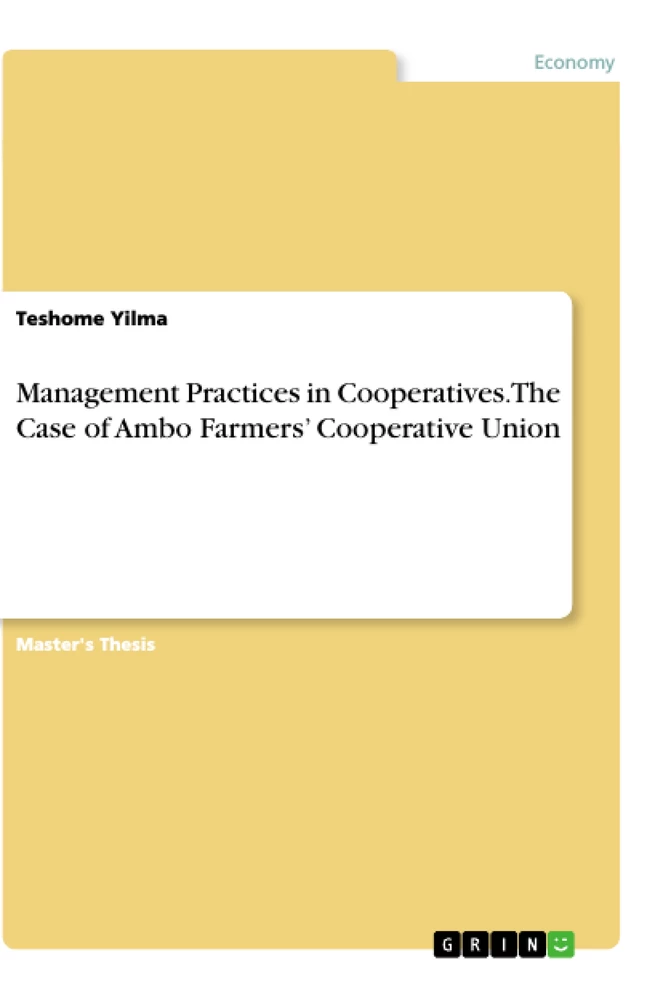
Table of Contents
CHAPTER ONE: INTRODUCTION
1.1. Background
1.2 The Three Tier System of Ethiopian Cooperatives
1.3. Statement of the Problem
1.4. Objectives of the Study
1.4.1. General Objective:-
1.4.2. Specific Objectives
1.5. Research Questions
1.6 Significance of the Study
1.7 Scope and Limitation of the Study
CHAPTER TWO: REVIEW OF LITERATURE
2.1. General Concept and Definition
2.2. Importance of Cooperatives
2.2.1. Economic Importance of Cooperatives
2.2.2. Social Importance of Cooperatives
2.3. Concept of Leadership in Cooperatives
2.3.1. Functions of cooperative Leaders
2.3.2. Qualities of Cooperative Leaders
2.4. Governance Concepts in Cooperatives
2.4.1. Internal Governance
2.4.2. External Governance
2.4.3. Individual Governance
2.6. Conceptualization and Operationalization
2.6.1. Conceptual Framework
2.6.2. Operational Definition of Variables
CHAPTER THREE: RESEARCH METHODOLOGY
3.1. Description of the Study Area
3.1.1 An Overview of Oromia National Regional State
3.1.2. An Overview of West Shoa Zone
3.1.2.1. Types of Cooperatives in West Shoa Zone
3.1.2.2. Types of Cooperative Unions in West Shoa Zone
3.1.3. Description of Ambo Farmers Cooperatives’ Union (AFCU)
3.1.4. Justification of the Selected Cooperative Union
3.2. Sample Design
3.2.1. Sampling Frame
3.2.2. Sampling Size
3.3. Data Types and Sources
3.3.1. Primary Data Sources and Collection Methods
3.3.1.1. Interview Schedule
3.3.1.2. Focus Group Discussion (FGD)
3.3.1.3 Key Informant Interviews (KIIs
3.3.2. Sources of Secondary Data
3.4 Methods of Data Analysis
3.4.1 Descriptive Analysis
3.4.2 Logistic Regression Analysis
CHAPTER FOUR: RESULTS AND DISCUSSIONS
4.1. General Information:-
4.2. Descriptive Analysis of Institutional Determinants of the Management Practices:-
4.2.1. Leadership Qualities (LDRSQ)
4.2.2. Internal Stakeholders’ Participation
4.2.3. Good Governance
4.2.4. Communication
4.2.5. Job specification and description
4.2.6. Equity and Financial stability..
4.2.7. Attitude of Members
4.2.8. Nepotism
4.3. Descriptive Analysis of Legal determinants of Management Practices..
4.3.1. Bylaw Awareness (BLAWR)
4.3.2. Internal Rules and Regulations
4.3.3-Government Strategies
4.3.4. Cooperative Proclamation
4.4. Identification of Institutional and legal determinants:-
4.4.1. Statistical results for binary Logistic regression Analysis Model
4.5. Other External Determinants of Management Practices of AFCU:-
CHAPTER FIVE: CONCLUSIONS AND RECOMMENDATIONS
5.1 Conclusions
5.2. RECOMMENDATIONS
Objectives and Topics
The research aims to investigate the factors that influence the management practices of the Ambo Farmers' Cooperative Union in Ethiopia. It seeks to assess how various institutional, legal, and external determinants affect the overall operational performance and decision-making within the cooperative structure.
- Institutional determinants of management, including leadership qualities, governance, and stakeholder participation.
- Legal factors such as bylaw awareness, government strategies, and the impact of the Cooperative Proclamation.
- Financial stability and equity management in the context of cooperative development.
- External challenges including infrastructure, market competition, and governmental interference.
Excerpt from the Book
1.1. Background
Cooperation is the very basis of human civilization .The interdependence and mutual help among human beings have been essentials of social life. History tells us that man cannot successfully live by himself and for himself alone. He is dependent on others. Therefore working together is as old as human society. Since the beginning of the human society; men have cooperated first in foraging and then hunting; later in agriculture and still in manufacture. There is practically nothing which a man by himself alone can achieve. Cooperation is therefore, the basis and essence of human life (V.Kulandaiswamy, 1987).
Cooperatives are member-owned business enterprises. The simplest way to understand cooperatives is that they aggregate the market power of people who on their own could achieve little or nothing, and in so doing they provide ways out of poverty and become powerful.
Summary of Chapters
CHAPTER ONE: INTRODUCTION: This chapter provides the foundation for the study by defining cooperative concepts, outlining the three-tier system of Ethiopian cooperatives, and stating the research problem and objectives.
CHAPTER TWO: REVIEW OF LITERATURE: This section reviews existing theoretical and empirical research regarding cooperative management, leadership, governance, and the specific context of Ethiopian cooperatives.
CHAPTER THREE: RESEARCH METHODOLOGY: This chapter details the research design, area of study, sampling techniques, and the econometric methods used for data analysis.
CHAPTER FOUR: RESULTS AND DISCUSSIONS: This section presents the empirical findings and discussions regarding institutional, legal, and external determinants of management practices.
CHAPTER FIVE: CONCLUSIONS AND RECOMMENDATIONS: The final chapter summarizes the research findings and provides recommendations for improving cooperative management practices.
Keywords
Cooperatives, Ambo Farmers’ Cooperative Union, Management Practices, Ethiopia, Leadership, Governance, Institutional Determinants, Legal Factors, Cooperative Proclamation, Member Participation, Financial Stability, Logistic Regression, Agricultural Cooperatives, Rural Development, Stakeholders
Frequently Asked Questions
What is the primary focus of this research?
The thesis focuses on identifying the institutional, legal, and external determinants that affect the management practices within the Ambo Farmers’ Cooperative Union in Ethiopia.
What are the central themes of the work?
The core themes include cooperative governance, leadership effectiveness, the influence of legal proclamations on management, and external constraints such as market competition and infrastructure.
What is the main objective of the study?
The primary objective is to investigate and assess the specific determinants of management practices to improve the operational efficiency and sustainability of the cooperative union.
What scientific methodology does the researcher use?
The researcher uses both descriptive statistics (frequencies, percentages, cross-tabulations) and a binary logistic regression model to analyze the significance of various explanatory variables.
What is discussed in the main part of the document?
The main part covers detailed survey results on board leadership, member participation, internal governance, communication systems, and the impact of governmental and legal frameworks on the union's daily functions.
Which keywords characterize this work?
Key terms include: Cooperatives, Ambo Farmers’ Cooperative Union, Management Practices, Governance, Leadership, Ethiopia, and Member Participation.
How does the researcher measure 'Management Practices'?
Management practices are treated as a dependent dummy variable representing the organization's performance, where '1' denotes good management practices and '0' otherwise.
What specific problem does the research identify regarding the Ambo Farmers’ Cooperative Union?
The study highlights issues such as poor board leadership roles, lack of standardized job descriptions, weak communication flows, and dependency on debt-based financing.
Ende der Leseprobe aus 117 Seiten
- nach oben
- Arbeit zitieren
- Teshome Yilma (Autor:in), 2012, Management Practices in Cooperatives. The Case of Ambo Farmers’ Cooperative Union, München, Page::Imprint:: GRINVerlagOHG, https://www.diplomarbeiten24.de/document/538725

neugierig - aktuell - relevant
Entdecken Sie hilfreiche Tipps und Tricks rund ums Studium!

Entdecken Sie hilfreiche Tipps und Tricks rund ums Studium!
Ihre Hausarbeit / Abschlussarbeit:

- - Publikation als E-Book und Buch
- - Hohes Honorar auf die Verkäufe
- - Für Sie komplett kostenlos - mit ISBN
- - Es dauert nur 5 Minuten
- - Jede Arbeit findet Leser

- © GRIN Publishing GmbH.
- Alle Inhalte urheberrechtlich geschützt. Kopieren und verbreiten untersagt.
- info@grin.com
- AGB
- Open Publishing
Der GRIN Verlag hat sich seit 1998 auf die Veröffentlichung akademischer eBooks und Bücher spezialisiert. Der GRIN Verlag steht damit als erstes Unternehmen für User Generated Quality Content. Die Verlagsseiten GRIN.com, Hausarbeiten.de und Diplomarbeiten24 bieten für Hochschullehrer, Absolventen und Studenten die ideale Plattform, wissenschaftliche Texte wie Hausarbeiten, Referate, Bachelorarbeiten, Masterarbeiten, Diplomarbeiten, Dissertationen und wissenschaftliche Aufsätze einem breiten Publikum zu präsentieren.
Kostenfreie Veröffentlichung: Hausarbeit, Bachelorarbeit, Diplomarbeit, Dissertation, Masterarbeit, Interpretation oder Referat jetzt veröffentlichen!
Folgen Sie GRIN auf


- GRIN Verlag GmbH
-
- Nymphenburger Str. 86
- 80636
- Munich, Deutschland
- +49 89-550559-0
- +49 89-550559-10
- info@grin.com
-
