
präsentiert von

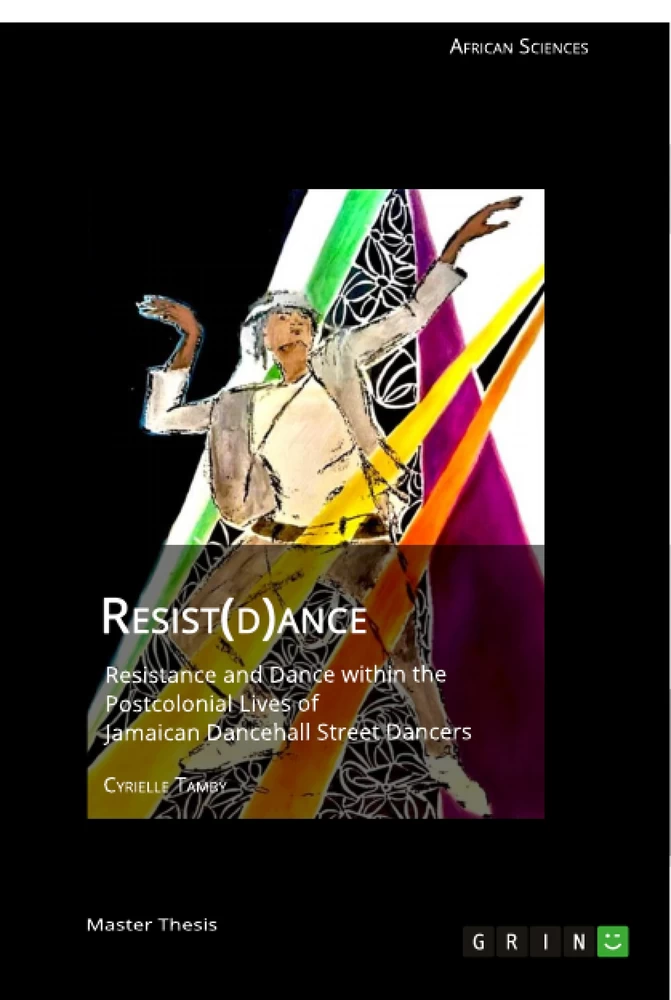
Table of Contents
1. Introduction
2. Theoretical toolkit and some methodological issues
2.1. The Diasporic experience of blackness
2.2. Recalling silenced narratives
2.3. Centering body politics by looking at Jamaican Dancehall as responsive to a postcolonial malaise in Jamaica
2.4. Tracing the notion of resistance in the Caribbean
2.5. Ethnography as a method to (de)construct knowledge
3. Dancehall street parties as black queer spatialities
3.1. Street parties as cosmos of energies
3.2. Street parties as erotic and ritualistic architectures
3.3. Refashioning processes as a strategy of survival
3.4. Conquering the street: Tensions between national and local identity-makers
3.5. Queering spatialities of black life
3.6. Epilogue
4. Mapping a home outside of home: Diasporic-making, New-York and the constant struggle
4.1. A home outside of home
4.2. Mapping familiarity and the unknown in the diasporic-making
4.3. Generating an economy from diasporic-making
4.4. A gendered sense of diasporic-making
4.5. Struggling outside of home
4.6. Epilogue
5. Vernacular love: Focus on transnational and transactional love relationships
5.1. Practices of street smartness
5.2. The Dancehall Hostel : Infrastructure of body-consuming
5.3. Epilogue
6. Digital territoriality: Instagram as a visual economy of bodies and word
6.1. Archiving realities
6.2. Conflating ephemeral and permanent temporalities
6.3. Visual economy of bodies
6.4. Visual economy of words
6.5. Instagram as a vernacular poetry of resistance
6.6. Epilogue
7. Coda
7.1. Traveling across the territorialities of resistance
7.2. Repeated practices of resistance and their purpose
7.3. Rethinking knowledge through cultural production in diasporic-making
Objectives and Topics
The primary objective of this work is to explore how marginalized Jamaican street dancers utilize everyday practices and cultural production to navigate and resist postcolonial, neoliberal socio-spatial realities. The research investigates how dance acts as a "matrix of resistance," transforming bodies and spaces into sites of agency, belonging, and survival.
- The conceptualization of Dancehall street parties as black queer spatialities and territorialities of resistance.
- The mechanisms of "diasporic-making" in spaces like New York and how they reconcile the struggle for survival with a sense of home.
- The intersection of transnational/transactional love relationships and "street smartness" as economic survival strategies.
- The role of digital platforms, specifically Instagram, in creating a "visual economy" that archives black bodies and produces a vernacular poetry of resistance.
Excerpt from the Book
3.1. Street parties as cosmos of energies
In this section, I play with my auto-ethnographic “inside” position and the “outside”-perspective of the ethnographer to reconstitute the narratives of the particular universe of Street Parties in Kingston31. Kingston’s night life is one of the main nexuses of the street dancer’s life. Parties are a central element of the Dancehall culture. Street parties are embodied by the dancers and become a way of promoting dancehall and a “terrain”32 of expression. The first time I arrived in Kingston, I was surprised by the large number of parties that take place every night. Each day is marked by a famous street party. I did not expect to see the same people moving from one party to another and to see them every night going to parties in Kingston. I was wondering how the experience of poverty in the inner city of Kingston could match with this daily rhythm of partying. Parties are the rhythmic leitmotiv of a dancer’s life. Parties are like a protocol with no written rules. Rules are embodied by space, time, dancers’ attitudes. Every day or to be more precise, every night, dancers attend two or three parties in different venues. Mojito Mondays and Uptown Mondays33are the most famous ones and take place in parking lots in the uptown district of Halfway Tree34. Dancers show up with their craziest and shiniest outfits, the ones that can catch the sight of the photographers35. Crews come together as one body. They find their spot on the circle formed by the crowd. Dancers have their own emplacement at parties. They possess the public space of the street at this particular time. Once they are on their spot, they don’t start dancing. They wait, pose, look seriously.
Summary of Chapters
1. Introduction: The author introduces their research on Jamaican Dancehall, reflecting on their positionality as a dancer and researcher, and framing Dancehall as a response to the postcolonial malaise in Jamaica.
2. Theoretical toolkit and some methodological issues: This chapter establishes the theoretical framework, incorporating concepts of blackness, silenced narratives, body politics, resistance, and the role of ethnography in knowledge construction.
3. Dancehall street parties as black queer spatialities: The author analyzes street parties as sites where bodies and energies are reconfigured into modes of survival and insurgence, shifting public space into black queer spatialities.
4. Mapping a home outside of home: Diasporic-making, New-York and the constant struggle: This section examines how Jamaican dancers negotiate resistance in New York, articulating the concept of "home" through diasporic-making and familiar practices.
5. Vernacular love: Focus on transnational and transactional love relationships: The author explores how transactional love relationships and "street smartness" function as survival strategies in the transnational Dancehall scene.
6. Digital territoriality: Instagram as a visual economy of bodies and word: The chapter investigates how Instagram serves as a living archive and a site of vernacular poetry, where dancers perform agency and negotiate their social status.
7. Coda: The final section reflects on the study's findings, emphasizing the transformative role of Dancehall as a matrix of resistance and a surface for sharing knowledge across diasporic circles.
Keywords
Dancehall, Jamaica, Resistance, Diaspora, Black Geographies, Body Politics, Street Parties, Neoliberalism, Instagram, Vernacular Theory, Survival, Postcolonialism, Gender, Spatiality, Agency
Frequently Asked Questions
What is the core focus of this research?
The work focuses on the lived experiences of Jamaican street dancers and how they use the Dancehall culture as a means of resistance, survival, and identity formation within postcolonial socio-economic structures.
What are the primary thematic areas explored?
The research explores themes such as body politics, the transformation of urban space, diasporic identity, transnational economies, and the role of digital media in archiving and performing black subjectivities.
What is the research’s main objective?
The objective is to understand how Jamaican dancers "write themselves" into landscapes of poverty and systemic exclusion, using creativity and performance to assert existence and agency.
Which scientific methodology is applied?
The author employs a multi-sited ethnographic approach, combining auto-ethnography as a dancer with traditional observation, interviews, and the analysis of digital media archives like Instagram.
What does the main body of the work cover?
The main body analyzes four distinct territorialities: street parties in Kingston, the diasporic space of New York, transnational love relationships as survival strategies, and digital spaces on Instagram as visual and poetic archives.
What keywords best describe this study?
Key terms include Dancehall, Resistance, Diaspora, Body Politics, Street Smartness, Black Geographies, and Digital Territoriality.
How does the author characterize "Dancehall" in the context of Jamaica's political history?
The author identifies Dancehall as a response to a "postcolonial malaise" and a "rebellious child" that challenges the national project of respectability and state attempts to control informal labor.
How does the research analyze the role of Instagram for dancers?
The author presents Instagram as a "visual economy" and "moving archive" where dancers curate their images, archive dance moves (hashtags), and construct narratives of success that transcend their local ghetto boundaries.
Ende der Leseprobe aus 121 Seiten
- nach oben
- Arbeit zitieren
- Cyrielle Tamby (Autor:in), 2019, Resist(d)ance, München, Page::Imprint:: GRINVerlagOHG, https://www.diplomarbeiten24.de/document/539232

neugierig - aktuell - relevant
Entdecken Sie hilfreiche Tipps und Tricks rund ums Studium!

Entdecken Sie hilfreiche Tipps und Tricks rund ums Studium!
Ihre Hausarbeit / Abschlussarbeit:

- - Publikation als E-Book und Buch
- - Hohes Honorar auf die Verkäufe
- - Für Sie komplett kostenlos - mit ISBN
- - Es dauert nur 5 Minuten
- - Jede Arbeit findet Leser

- © GRIN Publishing GmbH.
- Alle Inhalte urheberrechtlich geschützt. Kopieren und verbreiten untersagt.
- info@grin.com
- AGB
- Open Publishing
Der GRIN Verlag hat sich seit 1998 auf die Veröffentlichung akademischer eBooks und Bücher spezialisiert. Der GRIN Verlag steht damit als erstes Unternehmen für User Generated Quality Content. Die Verlagsseiten GRIN.com, Hausarbeiten.de und Diplomarbeiten24 bieten für Hochschullehrer, Absolventen und Studenten die ideale Plattform, wissenschaftliche Texte wie Hausarbeiten, Referate, Bachelorarbeiten, Masterarbeiten, Diplomarbeiten, Dissertationen und wissenschaftliche Aufsätze einem breiten Publikum zu präsentieren.
Kostenfreie Veröffentlichung: Hausarbeit, Bachelorarbeit, Diplomarbeit, Dissertation, Masterarbeit, Interpretation oder Referat jetzt veröffentlichen!
Folgen Sie GRIN auf


- GRIN Verlag GmbH
-
- Nymphenburger Str. 86
- 80636
- Munich, Deutschland
- +49 89-550559-0
- +49 89-550559-10
- info@grin.com
-
