
präsentiert von

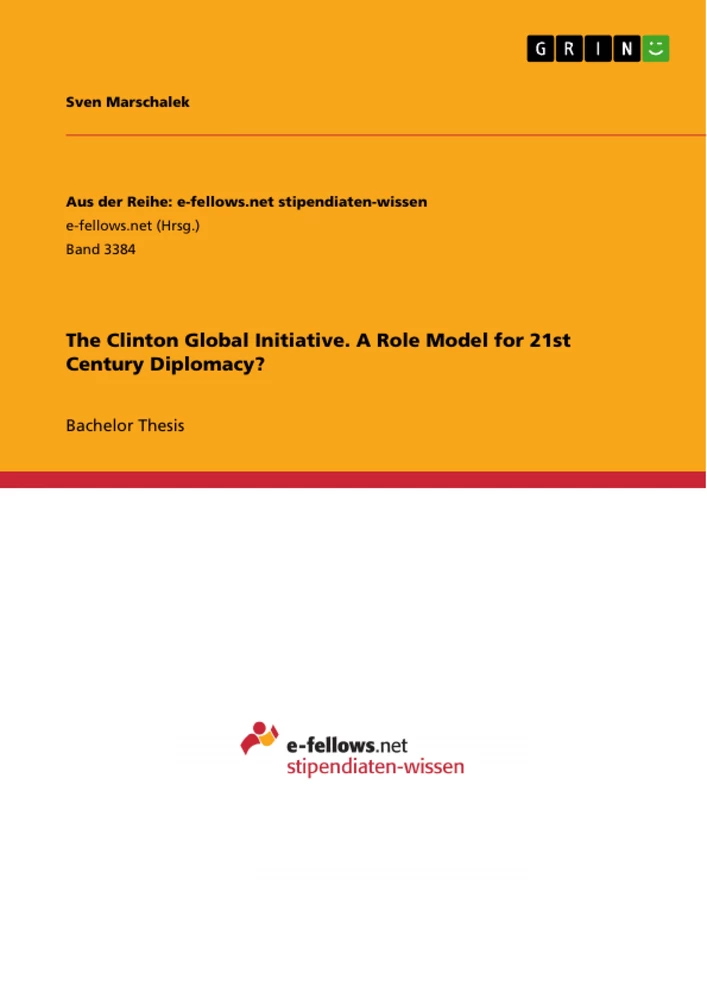
Table of Contents
1. Introduction
2. Literature Review
2.1 What is Diplomacy?
2.2 “New Diplomacy” in a Multipolar World
2.2.1 Global Interdependence
2.2.2 Key Characteristics of “New Diplomacy”
2.2.3 Partnerships, “Philanthrocapitalism” and Elite Groups
2.3 Characteristics of Traditional Diplomacy
2.4 Climate Change Governance
2.4.1 The Global Issue of Climate Change
2.4.2 State Actors and International Organizations
2.4.3 Non-State Actors and Multi-Level Partnerships
3. Methodology
3.1 Epistemological and Ontological Position
3.2 Case Study Research
3.3 Commitment Analysis
3.3.1 Statistical Analysis
3.3.2 Qualitative Content Analysis
3.4 Qualitative in-depth Interviews
3.4.1 Interviewees
3.4.2 Themes and Questioning
3.4.3 Interview Style and Technique
3.4.4 Transcription and Analysis
3.4.5 Ethical Considerations
3.5 Comparative Analysis
4. Findings
4.1 Statistical Analysis
4.1.1 Number and Estimated Value
4.1.2 Actors
4.1.3 Regional Focus
4.1.4 Approaches towards Climate Change
4.1.5 Length
4.2 Content Analysis
4.2.1 Board
4.2.2 Players
4.2.3 Stakes
4.2.4 Moves
4.3 Qualitative Interviews
4.3.1 Board
4.3.2 Players
4.3.3 Stakes
4.3.4 Moves
4.4 The United Nations Framework Convention on Climate Change
4.4.1 Board
4.4.2 Players
4.4.3 Stakes
4.4.4 Moves
5. Discussion
5.1 The Clinton Global Initiative – a TOWS-Matrix
5.1.1 Threats
5.1.2 Opportunities
5.1.3 Weaknesses
5.1.4 Strengths
5.2 Traditional and New Diplomacy Exemplified by CGI and UNFCCC
6. Conclusion
Objectives & Research Questions
This thesis explores whether the Clinton Global Initiative (CGI) serves as a successful role model for modern diplomacy by examining how it addresses global climate change and what lessons traditional international organizations, such as the UN, might learn from its approach.
- The theoretical tension between "traditional" state-centric diplomacy and "new" multi-actor, network-based diplomacy.
- A multi-method case study of CGI, utilizing statistical analysis of commitment data and qualitative in-depth interviews.
- The comparative performance of CGI and the United Nations Framework Convention on Climate Change (UNFCCC) regarding climate change governance.
- Critical analysis of CGI's organizational structure, leadership, accountability, and member impact.
Excerpt from the Book
2.1 What is Diplomacy?
The Oxford English Dictionary (as cited in Kerr and Wiseman 2012, p1) defines diplomacy as “the management of international relations by negotiation; the methods by which these relations are adjusted and managed by ambassadors and envoys.” This definition entails two elements which are ascribed to the practice of diplomacy by academics, namely the inclusion of negotiations by “a special group of individuals, or accredited representatives” (Kerr and Wiseman 2012, p13), and the focus on the institutions of sovereign political units – today: of sovereign nation-states (Berridge 2010; Sharp 2009; Starkey, Boyer and Wilkenfeld 2010).
Within these assumptions, Berridge (2010) states that diplomats and diplomacy as employed by consulates and embassies fulfil the following functions: representation and friendly relations, negotiating and lobbying, clarifying intentions, political reporting, commercial diplomacy and trade relations, providing services to nationals and information gathering. However, noting Morgan’s (1981, p240) remark whether we can “really study international politics with a model of the international system that just lists nations as members and leaves … others out,” it becomes questionable if such a detailed list of diplomatic functions and such a narrow focus on nation-state diplomats is a fruitful approach for this research.
In fact, according to Kerr and Wiseman (2012), many academics believe in a changing diplomacy that embraces more than formal inter-state relations and involves a multitude of non-state actors. From an analytical point of view, it is therefore more beneficial to apply a broader definition of diplomacy such as Sharp’s (2009, p96), who writes that diplomacy’s primary concern “is with the conduct of relations between people who, whatever the underlying trends in these terms, at the given moment do not believe or feel themselves to be bound to one another by conventional familial, community, or societal links and yet who want to, or believe that they have to, have relations with each other.”
Summary of Chapters
1. Introduction: This chapter introduces the core research problem concerning the transformation of global diplomacy and establishes the focus on the Clinton Global Initiative.
2. Literature Review: The chapter explores the theoretical landscape of "traditional" versus "new" diplomacy and reviews how climate change is governed within these competing paradigms.
3. Methodology: This section details the multi-method research design, including commitment analysis, qualitative interviews, and comparative frameworks used for the study.
4. Findings: The findings present empirical data on CGI's commitments and interview results, offering a detailed look at how the initiative operates in practice.
5. Discussion: This chapter synthesizes findings using a TOWS-matrix to assess internal strengths and weaknesses against external threats and opportunities, followed by a comparison with the UNFCCC.
6. Conclusion: The conclusion answers the initial research questions and provides recommendations for the future practice of global diplomacy.
Keywords
Clinton Global Initiative, Diplomacy, New Diplomacy, Traditional Diplomacy, Climate Change, Governance, Public-Private Partnerships, Commitments, International Relations, Non-state Actors, Philanthrocapitalism, Accountability, Multi-actor Diplomacy, Global Policy, Negotiations.
Frequently Asked Questions
What is the core focus of this research?
The research investigates the Clinton Global Initiative as a modern "diplomatic forum" and evaluates whether its multi-actor, solution-focused approach represents a viable model for 21st-century diplomacy compared to traditional state-centric organizations.
What are the primary themes discussed?
Key themes include the shift from traditional to "new" diplomacy, the governance of global public goods like climate change, the role of non-state actors, and the efficacy of public-private partnerships.
What is the central research question?
The research asks how the Clinton Global Initiative addresses climate change and what lessons international organizations like the UN can derive from the initiative's practices.
Which methodologies are employed?
The study uses a mixed-method approach, consisting of a statistical analysis of 270 commitment plans, qualitative content analysis of 24 specific commitments, and in-depth expert interviews.
What does the main body of the work address?
The main body covers the literature on diplomatic theory, the specific methodology of the case study, detailed empirical findings from the CGI analysis, and a critical discussion of the initiative's performance using a TOWS-Matrix.
Which keywords best characterize this work?
The study is characterized by terms such as New Diplomacy, Climate Change Governance, CGI, Non-state Actors, and Public-Private Partnerships.
How does CGI differ from the UNFCCC in its approach to climate change?
Unlike the regulatory, state-centric UNFCCC, CGI acts as a flexible, outcome-oriented platform that facilitates partnerships and promotes multidisciplinary, voluntary commitments to action.
What role does Bill Clinton play in the organization?
The research identifies Clinton as a central, charismatic leader who provides essential networking and "match-making" services, acting as the organization's moral and political figurehead.
Does the initiative have significant limitations?
Yes, the research highlights weaknesses such as the organization's America-centric focus, a lack of formal democratic accountability mechanisms, and its tendency to avoid addressing sensitive political issues like structural power imbalances and conflict.
Ende der Leseprobe aus 99 Seiten
- nach oben
- Arbeit zitieren
- Sven Marschalek (Autor:in), 2013, The Clinton Global Initiative. A Role Model for 21st Century Diplomacy?, München, Page::Imprint:: GRINVerlagOHG, https://www.diplomarbeiten24.de/document/539704

neugierig - aktuell - relevant
Entdecken Sie hilfreiche Tipps und Tricks rund ums Studium!

Entdecken Sie hilfreiche Tipps und Tricks rund ums Studium!
Ihre Hausarbeit / Abschlussarbeit:

- - Publikation als E-Book und Buch
- - Hohes Honorar auf die Verkäufe
- - Für Sie komplett kostenlos - mit ISBN
- - Es dauert nur 5 Minuten
- - Jede Arbeit findet Leser

- © GRIN Publishing GmbH.
- Alle Inhalte urheberrechtlich geschützt. Kopieren und verbreiten untersagt.
- info@grin.com
- AGB
- Open Publishing
Der GRIN Verlag hat sich seit 1998 auf die Veröffentlichung akademischer eBooks und Bücher spezialisiert. Der GRIN Verlag steht damit als erstes Unternehmen für User Generated Quality Content. Die Verlagsseiten GRIN.com, Hausarbeiten.de und Diplomarbeiten24 bieten für Hochschullehrer, Absolventen und Studenten die ideale Plattform, wissenschaftliche Texte wie Hausarbeiten, Referate, Bachelorarbeiten, Masterarbeiten, Diplomarbeiten, Dissertationen und wissenschaftliche Aufsätze einem breiten Publikum zu präsentieren.
Kostenfreie Veröffentlichung: Hausarbeit, Bachelorarbeit, Diplomarbeit, Dissertation, Masterarbeit, Interpretation oder Referat jetzt veröffentlichen!
Folgen Sie GRIN auf


- GRIN Verlag GmbH
-
- Nymphenburger Str. 86
- 80636
- Munich, Deutschland
- +49 89-550559-0
- +49 89-550559-10
- info@grin.com
-
