
präsentiert von

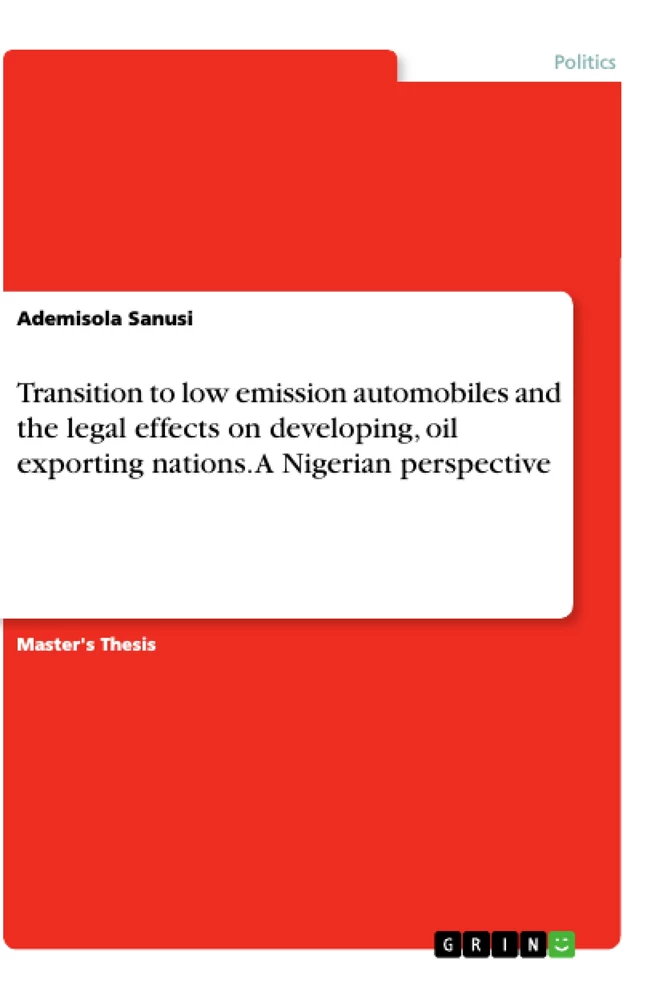
Table of Contents
CHAPTER 1
1.1. INTRODUCTION
1.2. METHODOLOGY
1.3. RESEARCH QUESTIONS AND OBJECTIVES
1.4. LITERATURE REVIEW
CHAPTER 2: NIGERIA: OIL SECTOR, STRUCTURES AND ISSUES.
2.1: NIGERIA’S OIL SECTOR AND STRUCTURES.
2.2: NIGERIA AND THE RESOURCE CURSE.
2.3: NIGERIA AND THE DUTCH DISEASE.
CHAPTER 3: CLIMATE CHANGE AND DEVELOPMENTS IN THE AUTO INDUSTRY.
3.1: TECHNOLOGICAL ADVANCEMENTS IN THE AUTOMOTIVE INDUSTRY.
3.2: CLIMATE CHANGE AND GLOBAL WARMING: AGREEMENTS, PROTOCOLS, SIGNATORIES AND ADOPTION EXAMPLES.
CHAPTER 4: THE NIGERIAN LEGAL FRAMEWORK ON COMBATTING CLIMATE CHANGE.
4.1: CLIMATE CHANGE IN NIGERIA
4.2: NIGERIA’S LEGAL AND POLICY FRAMEWORK IMPLEMENTATION FOR TACKLING CLIMATE CHANGE.
CHAPTER 5: CONCLUSIONS
5.1: CONCLUSIONS AND RECOMMENDATIONS.
Research Objectives and Core Themes
This dissertation examines the intersection of the evolving global automotive industry and the legal landscape of Nigeria, an oil-export dependent nation. The research aims to assess how Nigeria can align its legal and regulatory framework with international climate change mandates, such as the Paris Agreement and the Kyoto Protocol, to mitigate the environmental impact of transport-related emissions without compromising economic stability.
- The impact of global sustainable automotive trends on the Nigerian transport sector.
- The efficacy of Nigeria's current legal framework in regulating vehicle emissions and combating climate change.
- Comparative analysis of climate-related legal strategies between Nigeria and other sub-Saharan African nations.
- The challenges of balancing oil-dependent revenue streams with the need for low-emission policy adoption.
- Recommendations for legal reforms to promote a gradual transition to cleaner energy and transport standards.
Excerpt from the Dissertation
3.1: Technological advancements in the automotive industry.
Currently, as a result of the development and adoption of newer technologies, the modern automotive industry is gradually drawing away from the use of internal combustion engines, to a system that requires less oil and gas petroleum resources. What this means is that the industry is now focused on the development of Electric Vehicles (EV’s). This development is quickly gaining popularity and is also being quickly adopted by the masses as one of the driving forces behind this development is to lower the contribution of transport means, particularly passenger and cargo vehicles to the contribution of greenhouse gases.
The reason for the strength in the above development as highlighted is to curb the emission of greenhouse gases and other environmentally degrading outcomes. Following a report in 2009, it was gathered that the transport sector contributed to 25% of the total greenhouse gases produced by the energy sector and other related sectors. The development and market acceptance of electric vehicles is forecasted to reduce the percentage figures recorded in 2009. Furthermore, adoption of this development contributes more to the environment as it releases no emissions into the environment and does not require any petroleum-derived resource to function thereby contributing positively to the management of the effects of climate change.
Further study backing up the development comes from a review of the works carried out by the EPA by researchers at Stanford University as it analyses how a slowdown in economic growth is associated with climate change. This particularly has a strong impact on less-developed and developing economies, and the study goes on further to develop an estimate for the social cost of carbon pollution at $220 per ton of Carbon released into the atmosphere which was one of the driving factors by industries to develop cleaner alternatives to help reduce the environmental pollution and social carbon costs.
Summary of Chapters
CHAPTER 1: Provides the introduction, methodology, and research objectives, setting the context of Nigeria's dependence on the oil sector and its relationship with global environmental policy.
CHAPTER 2: NIGERIA: OIL SECTOR, STRUCTURES AND ISSUES.: Analyzes the structural reliance of the Nigerian economy on oil, incorporating discussions on the resource curse and the Dutch disease.
CHAPTER 3: CLIMATE CHANGE AND DEVELOPMENTS IN THE AUTO INDUSTRY.: Explores global technological shifts in the automotive sector towards electric vehicles and reviews international climate treaties and protocols.
CHAPTER 4: THE NIGERIAN LEGAL FRAMEWORK ON COMBATTING CLIMATE CHANGE.: Evaluates Nigeria's existing environmental laws and policies and identifies the legal gaps in addressing climate change within the transport sector.
CHAPTER 5: CONCLUSIONS: Offers final synthesis and policy recommendations, suggesting legal reforms and strategic adaptation models based on successful practices in other jurisdictions.
Keywords
Nigeria, Oil Export, Climate Change, Automotive Industry, Electric Vehicles, Environmental Law, Greenhouse Gas Emissions, Resource Curse, Dutch Disease, Sustainable Development, Regulatory Framework, Carbon Footprint, Policy Adaptation, Transport Sector, Emission Standards
Frequently Asked Questions
What is the primary focus of this dissertation?
The work focuses on the legal effects of the global transition toward low-emission automobiles on Nigeria, an economy heavily dependent on oil exports.
What are the central themes discussed in the paper?
Key themes include the impact of oil dependency on legal development, the technological shift in the global auto industry, and the necessity of aligning national policies with international climate agreements.
What is the central research objective?
The objective is to identify how Nigeria can manage its climate change risks and legal framework, particularly within the transport sector, to ensure future environmental and resource sustainability.
Which methodology is employed in this research?
The author utilizes an analytical research approach, analyzing existing documentation, legislation, and contractual/regulatory frameworks to develop future-oriented policy suggestions.
What does the main body of the work cover?
It covers Nigeria's oil-dependent economic structure, technological developments in the global automotive sector, an analysis of international climate treaties, and an assessment of Nigeria's current legal framework for environmental protection.
Which key terms describe this study?
The study is best characterized by terms like environmental law, resource curse, sustainable development, emission standards, and policy reform in developing nations.
What specifically does the author suggest regarding electric vehicle legislation in Nigeria?
The author argues that attempting a sudden phase-out of petrol vehicles by 2035 is unrealistic; instead, the government should focus on infrastructure, legal incentives, and public awareness to foster a gradual transition.
How does the author use the example of Rwanda in this analysis?
Rwanda is cited as a successful model of legal implementation, specifically regarding mandatory vehicle emission testing, car-free zones, and infrastructure development, which the author suggests Nigeria should emulate.
Ende der Leseprobe aus 50 Seiten
- nach oben
- Arbeit zitieren
- Ademisola Sanusi (Autor:in), 2019, Transition to low emission automobiles and the legal effects on developing, oil exporting nations. A Nigerian perspective, München, Page::Imprint:: GRINVerlagOHG, https://www.diplomarbeiten24.de/document/540076

neugierig - aktuell - relevant
Entdecken Sie hilfreiche Tipps und Tricks rund ums Studium!

Entdecken Sie hilfreiche Tipps und Tricks rund ums Studium!
Ihre Hausarbeit / Abschlussarbeit:

- - Publikation als E-Book und Buch
- - Hohes Honorar auf die Verkäufe
- - Für Sie komplett kostenlos - mit ISBN
- - Es dauert nur 5 Minuten
- - Jede Arbeit findet Leser

- © GRIN Publishing GmbH.
- Alle Inhalte urheberrechtlich geschützt. Kopieren und verbreiten untersagt.
- info@grin.com
- AGB
- Open Publishing
Der GRIN Verlag hat sich seit 1998 auf die Veröffentlichung akademischer eBooks und Bücher spezialisiert. Der GRIN Verlag steht damit als erstes Unternehmen für User Generated Quality Content. Die Verlagsseiten GRIN.com, Hausarbeiten.de und Diplomarbeiten24 bieten für Hochschullehrer, Absolventen und Studenten die ideale Plattform, wissenschaftliche Texte wie Hausarbeiten, Referate, Bachelorarbeiten, Masterarbeiten, Diplomarbeiten, Dissertationen und wissenschaftliche Aufsätze einem breiten Publikum zu präsentieren.
Kostenfreie Veröffentlichung: Hausarbeit, Bachelorarbeit, Diplomarbeit, Dissertation, Masterarbeit, Interpretation oder Referat jetzt veröffentlichen!
Folgen Sie GRIN auf


- GRIN Verlag GmbH
-
- Nymphenburger Str. 86
- 80636
- Munich, Deutschland
- +49 89-550559-0
- +49 89-550559-10
- info@grin.com
-
