
präsentiert von

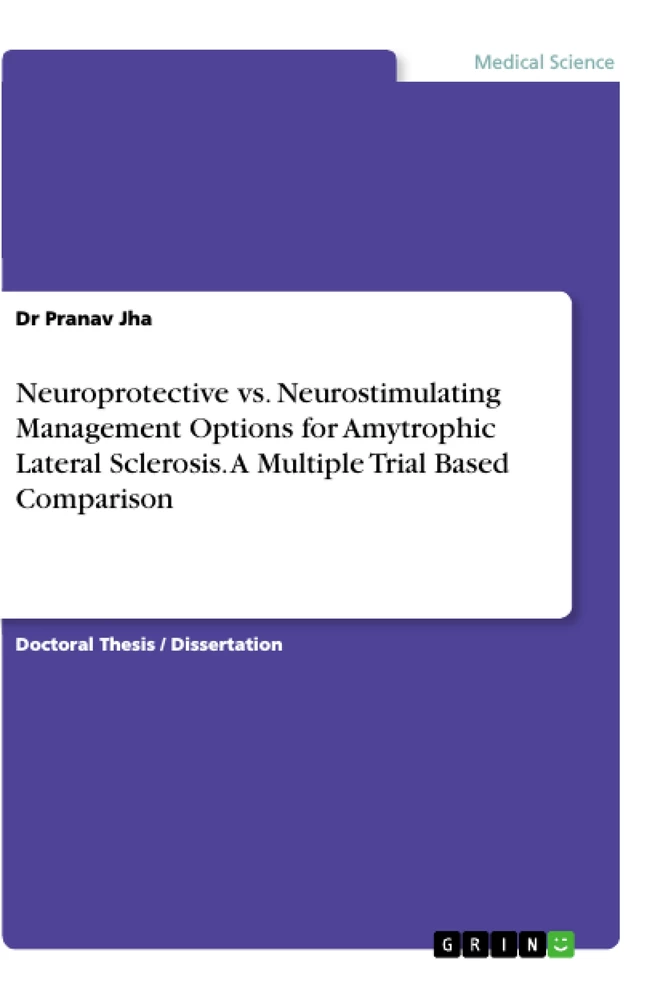
Table of Contents
1. Dissertation Methodology
2. Aims and Objectives
3. Introduction
4. Major Neuro-protective Methods
4.1 Literature Review on Controlled Trial of Riluzole in Amyotrophic Lateral Sclerosis
4.1.1 Introduction
4.1.2 Material and Methods
4.1.3 Randomization and Criteria
4.1.4 Figures
4.1.5 Results
4.2 Literature Review on Clinical trial with ceftriaxone in amyotrophic lateral sclerosis
4.2.1 Introduction
4.2.2 Material and Methods
4.2.3 Randomization and Criteria
4.2.4 Figures
4.2.5 Results
4.3 Literature Review on Randomised, Double-Blind, Placebo-Controlled, Study of Safety and Efficacy of Dexpramipexole in Subjects with ALS
4.3.1 Introduction
4.3.2 Material and Methods
4.3.3 Randomization and Criteria
4.3.4 Figures
4.3.5 Results
4.4 Literature Review on Efficacy and Safety of MCI-186 Edaravone
4.4.1 Introduction
4.4.2 Material and Methods
4.4.3 Randomization and Criteria
4.4.4 Figures
4.4.5 Results
5. Major Neuro-stimulative Methods
5.1 Literature Review on CY4031-VITALITY-ALS (TIRASEMTIV)
5.1.1 Introduction
5.1.2 Material and Methods
5.1.3 Randomization and Criteria
5.1.4 Figures
5.1.5 Results
5.2 Literature Review on Multi-Centre, Randomised Controlled Study of NeuRx® Diaphragm Pacing System™ In Participants with A LS
5.2.1 Introduction
5.2.2 Material and Methods
5.2.3 Randomization and Criteria
5.2.4 Figures
5.2.5 Results
5.3 Literature Review on Repetitive Transcranial Magnetic Stimulation (rTMS) in ALS
5.3.1 Introduction
5.3.2 Material and Methods
5.3.3 Randomization and Criteria
5.3.4 Figures
5.3.5 Results
6. Critical Analysis
7. Conclusions and Future Scopes
7.1 Conclusions
7.2 Future Scope
Research Goals and Themes
This dissertation aims to conduct a comparative analysis of major therapeutic options for Amyotrophic Lateral Sclerosis (ALS), categorized into Neuroprotective Methods (NPMs) and Neurostimulating Methods (NSMs). By evaluating clinical trials and existing literature, the work seeks to determine the efficacy of these interventions, both as singular treatments and in combination, to provide a more structured approach to ALS management through a proposed "TOS-ALS" classification system.
- Comparative evaluation of neuroprotective drugs, including Riluzole, Ceftriaxone, Dexpramipexole, and Edaravone.
- Assessment of neurostimulating interventions, specifically Tirasemtiv, Diaphragm Pacing Systems (DPS), and Transcranial Magnetic Stimulation (rTMS).
- Development of the "Therapy Options Classification system for ALS" (TOS-ALS) to improve clinical management.
- Analysis of survival rates, functional status, and quality of life (QOL) outcomes across diverse clinical trial data.
- Investigation of disease mechanisms and pathophysiology to identify more targeted treatment pathways.
Excerpt from the Book
2.1. Literature Review on Controlled Trial of Riluzole in Amyotrophic Lateral Sclerosis
Glutamate, which do form in CNS as being a variant of transport form of glutamine or stimulant glutaminergic electrical tract.
These highly charged chemical bodies lead to early and accelerated nerve cell apoptosis via accumulation through calcium dependent gated paths.
Hence any formulation capable of interfering the above system can be of some use in terms of ALS therapy or relief or any intervention.
This made Riluzole, ie 2-amino-6-(trifluoromethoxy) benzothiazole or, RP 54274; eligible to get checked by a clinical trial under GMP European guidance, in a progressive, bias free, randomised and placebo controlled manner. The attempt hence done years back is known as “controlled trial of Riluzole in ALS”.
The RP 54274 has already shown the ability of leak proofing the glutamic acid release in proximal nervous convex synapses, and hamper the distal, synaptic post ‘fluid-zone-vesicular’ propagation of excitatory amino acid (EAA).
Summary of Chapters
Chapter 1: GENERAL INTRODUCTION: This chapter outlines the methodology of the dissertation and introduces the current understanding of ALS, including its classification and existing management challenges.
Chapter 2: MAJOR NEURO-PROTECTIVE METHODS: This chapter provides a detailed literature review and evaluation of four key neuroprotective drugs—Riluzole, Ceftriaxone, Dexpramipexole, and Edaravone—focusing on their trial results.
Chapter 3: MAJOR NEURO-STIMULATIVE METHODS: This chapter investigates stimulation-based therapies, covering Tirasemtiv, the Diaphragm Pacing System, and Repetitive Transcranial Magnetic Stimulation.
Chapter 4: CRITICAL ANALYSIS: This section offers a comprehensive synthesis of all discussed trials, analyzing their results, limitations, and overall impact on ALS management.
Chapter 5: CONCLUSIONS and FUTURE SCOPES: The final chapter summarizes the dissertation's findings, proposes the TOS-ALS classification system, and highlights emerging therapeutic avenues for future research.
Keywords
Amyotrophic Lateral Sclerosis, ALS, Neuroprotection, Neurostimulation, Riluzole, Edaravone, Clinical Trials, TOS-ALS, Survival Analysis, Glutamate, Respiratory Function, Tirasemtiv, Diaphragm Pacing System, rTMS, Disease Progression
Frequently Asked Questions
What is the primary focus of this dissertation?
The work focuses on comparing various therapeutic management options for Amyotrophic Lateral Sclerosis, specifically categorizing them into neuroprotective and neurostimulating approaches.
What are the central themes of the research?
The central themes include the evaluation of pharmacological interventions, the role of stimulation technologies in respiratory and muscular support, and the proposal of a new binary management classification system.
What is the main objective of this study?
The primary aim is to evaluate major therapeutic options for ALS in a comparative manner, assessing their effectiveness in improving survival, quality of life, and symptomatic relief.
Which scientific methods are employed in this work?
The author utilizes a systematic literature review and critical analysis approach, examining data from multiple randomized, double-blind, placebo-controlled clinical trials to synthesize evidence on current ALS treatments.
What does the main body of the work cover?
The main body evaluates individual drugs (such as Riluzole and Edaravone) and therapies (like Diaphragm Pacing and rTMS), providing details on their study design, randomization, inclusion/exclusion criteria, and results.
Which keywords characterize this publication?
Key terms include ALS, Neuroprotection, Neurostimulation, Riluzole, Edaravone, clinical trial efficacy, disease progression, and the proposed TOS-ALS classification.
How does the author define the "TOS-ALS" system?
TOS-ALS stands for "Therapy Options Classification system for ALS," which is a binary classification system proposed by the author to streamline the selection of neuroprotective and neurostimulating treatments.
What is the significance of the Diaphragm Pacing System (DPS) in this context?
The dissertation analyzes DPS as a neurostimulating intervention, noting its use on humanitarian grounds despite mixed trial results regarding its impact on overall survival.
Why is the "Critical Analysis" section important?
It acts as the "cream" of the research, where the author synthesizes trial outcomes to determine which interventions show potential for modifying future standard-of-care guidelines.
Ende der Leseprobe aus 59 Seiten
- nach oben
- Arbeit zitieren
- Dr Pranav Jha (Autor:in), 2017, Neuroprotective vs. Neurostimulating Management Options for Amytrophic Lateral Sclerosis. A Multiple Trial Based Comparison, München, Page::Imprint:: GRINVerlagOHG, https://www.diplomarbeiten24.de/document/542438

neugierig - aktuell - relevant
Entdecken Sie hilfreiche Tipps und Tricks rund ums Studium!

Entdecken Sie hilfreiche Tipps und Tricks rund ums Studium!
Ihre Hausarbeit / Abschlussarbeit:

- - Publikation als E-Book und Buch
- - Hohes Honorar auf die Verkäufe
- - Für Sie komplett kostenlos - mit ISBN
- - Es dauert nur 5 Minuten
- - Jede Arbeit findet Leser

- © GRIN Publishing GmbH.
- Alle Inhalte urheberrechtlich geschützt. Kopieren und verbreiten untersagt.
- info@grin.com
- AGB
- Open Publishing
Der GRIN Verlag hat sich seit 1998 auf die Veröffentlichung akademischer eBooks und Bücher spezialisiert. Der GRIN Verlag steht damit als erstes Unternehmen für User Generated Quality Content. Die Verlagsseiten GRIN.com, Hausarbeiten.de und Diplomarbeiten24 bieten für Hochschullehrer, Absolventen und Studenten die ideale Plattform, wissenschaftliche Texte wie Hausarbeiten, Referate, Bachelorarbeiten, Masterarbeiten, Diplomarbeiten, Dissertationen und wissenschaftliche Aufsätze einem breiten Publikum zu präsentieren.
Kostenfreie Veröffentlichung: Hausarbeit, Bachelorarbeit, Diplomarbeit, Dissertation, Masterarbeit, Interpretation oder Referat jetzt veröffentlichen!
Folgen Sie GRIN auf


- GRIN Verlag GmbH
-
- Nymphenburger Str. 86
- 80636
- Munich, Deutschland
- +49 89-550559-0
- +49 89-550559-10
- info@grin.com
-
