
präsentiert von

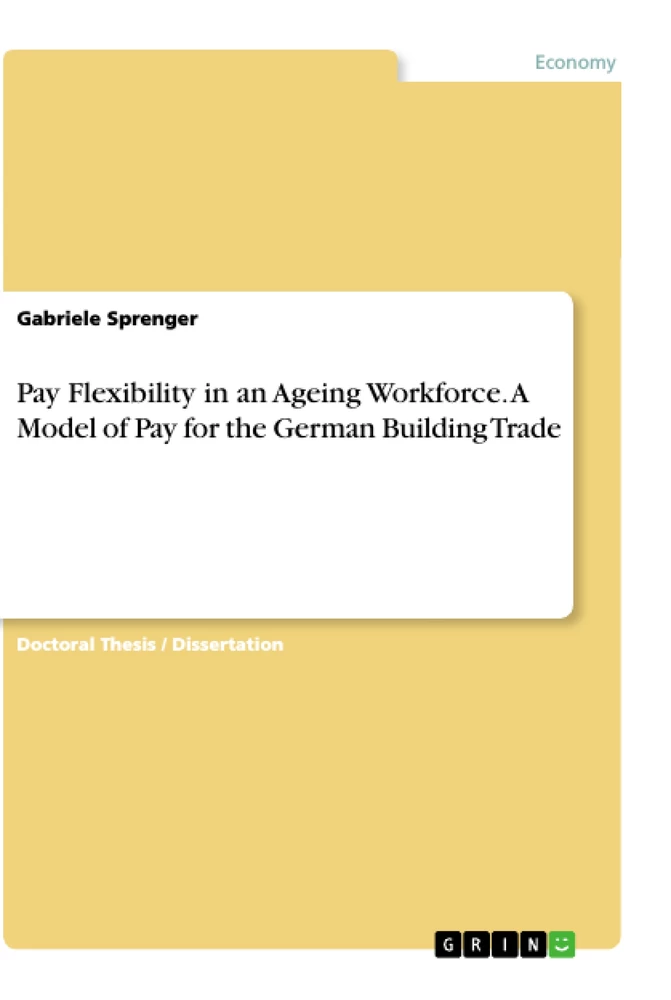
Table of Contents
1 Introduction
1.1 Statement of the problem
1.2 Research aim with questions and objectives
1.3 Overview of the methodology
1.4 Rationale and significance
1.5 Role of the researcher
1.6 Organisation of the thesis
2 Literature review
2.1 Working with teams
2.1.1 Team processes and group dynamics
2.1.2 Communication in work teams
2.2 Effects of a higher average age in work teams
2.2.1 Changing workforce composition
2.2.2 Age structure in the German building trade
2.2.3 Team performance and productivity
2.2.4 Team effectiveness and successful teamwork
2.2.5 Summary
2.3 The interrelation between performance and pay
2.3.1 Performance in anticipation of pay
2.3.2 Effects of perceived unjust pay to performance
2.3.3 Motivation in connection with pay and performance
2.3.4 Summary
2.4 Rewarding teams
2.4.1 Pay based on the job or on skills
2.4.2 Seniority-based pay
2.4.3 Performance-based pay
2.4.4 Team-based pay
2.4.5 Collective bargaining agreements in the German building trade
2.4.6 Effectiveness of team-based-pay
2.4.7 Pay flexibility and more dynamism in pay
2.5 Theoretical concept and conclusions
3 Research Methodology
3.1 Structured organisational plan
3.2 Methodological foundations
3.2.1 Embodied philosophy and researcher‘s values
3.2.2 Adopting an inductive approach
3.2.3 Qualitative research
3.2.4 Selection of the research design
3.2.5 Case study research design
3.3 Research sample and data sources
3.4 Limitations and delimitations
3.5 Data collection using triangulation
3.5.1 Description of the procedure
3.5.2 Selection of the cases
3.5.3 The method of semi-structured and in-depth expert interviews
3.5.4 The method of focus group
3.6 Data analysis methods and interpretation
3.7 Quality criteria in case study research
3.8 Ethics of qualitative research
3.9 Own methodological experiences
4 Data collection and findings from the case studies
4.1 Structure of the case organisations
4.2 Different headings of the data collection
4.2.1 Data that emerged from the expert interviews
4.2.2 Data that emerged from the focus groups
4.3 Further data interpretation
4.3.1 Cross-case matrix of different performance shapes
4.3.2 Cross-case analysis
4.3.3 Labour market conditions influences on pay flexibility
4.3.4 Moral dilemma of pay flexibility
4.4 Summarized findings of the expert interviews and focus groups
5 Results of the research
5.1 Why pay flexibility at all?
5.2 Requirements for a model of pay flexibility
5.3 The Four-dimensions-model of pay flexibility
5.3.1 The central factors of the model
5.3.2 The dimension of "individually"
5.3.3 The dimension of "contractually"
5.3.4 The dimension of "collectively"
5.3.5 The dimension of "market-oriented"
6 Contributions and an outlook to further research
Research Objectives and Themes
This study aims to investigate the impact of an ageing workforce on team performance in the German building trade and to develop a flexible payment model. The primary research question addresses whether and how pay systems can be adapted to accommodate the shifting demographic composition of work teams without negatively affecting motivation or productivity.
- Demographic shifts and the ageing workforce in the German construction sector.
- The interrelationship between team performance, productivity, and pay.
- Collective bargaining agreements and their constraints on wage flexibility.
- The development of the "Four-dimensions-model of pay flexibility" (individual, contractual, collective, market-oriented).
- Strategies to ensure pay remains socially acceptable while maintaining corporate competitiveness.
Excerpt from the Book
2.1.1 Team processes and group dynamics
If two or more individuals work together in a team, group dynamic processes affect the work results of the team. In the following, group dynamics in teams are presented in more detail.
Regardless of the group targets or group results, group processes are constantly changing and are permanently subject to a circular course (Worchel et al. 1992).
If two or more individuals enter into an interpersonal relationship, interactions arise and develop (Thibaut & Kelley 1959). The individuals are aware of each other and interact with one another. Communication between individuals arises. The extent of the interaction is determined by factors which reduce costs or generate rewards. The individuals of the group strive to reach their personal goals or to maximize their results through this interaction (Thibaut & Kelley 1959). If the group works in a company in team work, higher productivity or group effectiveness can be the result. For this, it is necessary that the group members perceive the company as a supportive setting for achieving their group goals. If this is not the case, productivity can be restricted (Thibaut & Kelley 1959). For the team composition, it is therefore important to know as much as possible about the goals of the group members and their common team goal. Thus a higher productivity can be realized.
Summary of Chapters
1 Introduction: This chapter provides the foundation for the research, outlining the demographic challenges in the German building trade and introducing the research aim regarding pay flexibility.
2 Literature review: This section reviews existing theories on team dynamics, the effects of age on team performance, and established remuneration models, while identifying gaps in research regarding the German building sector.
3 Research Methodology: This chapter details the exploratory research strategy, explaining the relativist, constructivist approach and the usage of multiple case studies with triangulation to obtain qualitative data.
4 Data collection and findings from the case studies: This section presents the empirical data gathered from expert interviews and focus groups, categorizing the findings related to team composition, performance impacts, and pay attitudes.
5 Results of the research: This core chapter synthesizes the literature review and empirical findings to develop the "Four-dimensions-model of pay flexibility," detailing its implementation through individual, contractual, collective, and market-oriented fields of action.
6 Contributions and an outlook to further research: This final chapter discusses the theoretical and practical implications of the model, addresses study limitations, and proposes future research avenues in the context of global economic and technological changes.
Keywords
Demographic change, German building trade, work team, team performance, pay flexibility, seniority-based pay, performance-based pay, labour market, collective bargaining, skills shortage, motivation, equity theory, age structure, qualitative research, case study.
Frequently Asked Questions
What is the fundamental goal of this research?
The study aims to develop a "Four-dimensions-model of pay flexibility" for the German building trade to adapt pay systems to the realities of an ageing workforce.
What are the central thematic areas?
The work focuses on team dynamics, the correlation between worker age and performance, current constraints in collective bargaining, and the motivation of employees regarding pay.
What is the primary research question?
The research asks how pay systems in the German building trade can be made sufficiently flexible to reflect changing demographic compositions while remaining fair, motivating, and economically viable.
Which scientific methods were applied?
The researcher employed a qualitative research strategy, utilizing semi-structured in-depth expert interviews and focus groups across twelve different types of businesses within the building trade, analyzed through a multiple case study design.
What does the main body of the work cover?
The main part encompasses an extensive literature review on group dynamics and performance-pay links, followed by empirical findings from thirteen case studies regarding how decision-makers and workers view pay adjustments.
Which keywords characterize this thesis?
Key terms include demographic change, pay flexibility, German building trade, team performance, and an ageing workforce.
Why is a new payment model necessary for the building trade?
Current collective bargaining agreements in the German building trade are rigid and often prioritize seniority over actual performance, which fails to address the challenges posed by a shrinking pool of skilled young workers and an ageing current workforce.
What is the "Four-dimensions-model"?
It is a holistic framework developed by the researcher consisting of four areas—individually, contractually, collectively, and market-oriented—to manage pay flexibility by balancing the needs of the employer for competitiveness and the employee for financial security and social equity.
Ende der Leseprobe aus 244 Seiten
- nach oben
- Arbeit zitieren
- Gabriele Sprenger (Autor:in), 2018, Pay Flexibility in an Ageing Workforce. A Model of Pay for the German Building Trade, München, Page::Imprint:: GRINVerlagOHG, https://www.diplomarbeiten24.de/document/583878

neugierig - aktuell - relevant
Entdecken Sie hilfreiche Tipps und Tricks rund ums Studium!

Entdecken Sie hilfreiche Tipps und Tricks rund ums Studium!
Ihre Hausarbeit / Abschlussarbeit:

- - Publikation als E-Book und Buch
- - Hohes Honorar auf die Verkäufe
- - Für Sie komplett kostenlos - mit ISBN
- - Es dauert nur 5 Minuten
- - Jede Arbeit findet Leser

- © GRIN Publishing GmbH.
- Alle Inhalte urheberrechtlich geschützt. Kopieren und verbreiten untersagt.
- info@grin.com
- AGB
- Open Publishing
Der GRIN Verlag hat sich seit 1998 auf die Veröffentlichung akademischer eBooks und Bücher spezialisiert. Der GRIN Verlag steht damit als erstes Unternehmen für User Generated Quality Content. Die Verlagsseiten GRIN.com, Hausarbeiten.de und Diplomarbeiten24 bieten für Hochschullehrer, Absolventen und Studenten die ideale Plattform, wissenschaftliche Texte wie Hausarbeiten, Referate, Bachelorarbeiten, Masterarbeiten, Diplomarbeiten, Dissertationen und wissenschaftliche Aufsätze einem breiten Publikum zu präsentieren.
Kostenfreie Veröffentlichung: Hausarbeit, Bachelorarbeit, Diplomarbeit, Dissertation, Masterarbeit, Interpretation oder Referat jetzt veröffentlichen!
Folgen Sie GRIN auf


- GRIN Verlag GmbH
-
- Nymphenburger Str. 86
- 80636
- Munich, Deutschland
- +49 89-550559-0
- +49 89-550559-10
- info@grin.com
-
