
präsentiert von

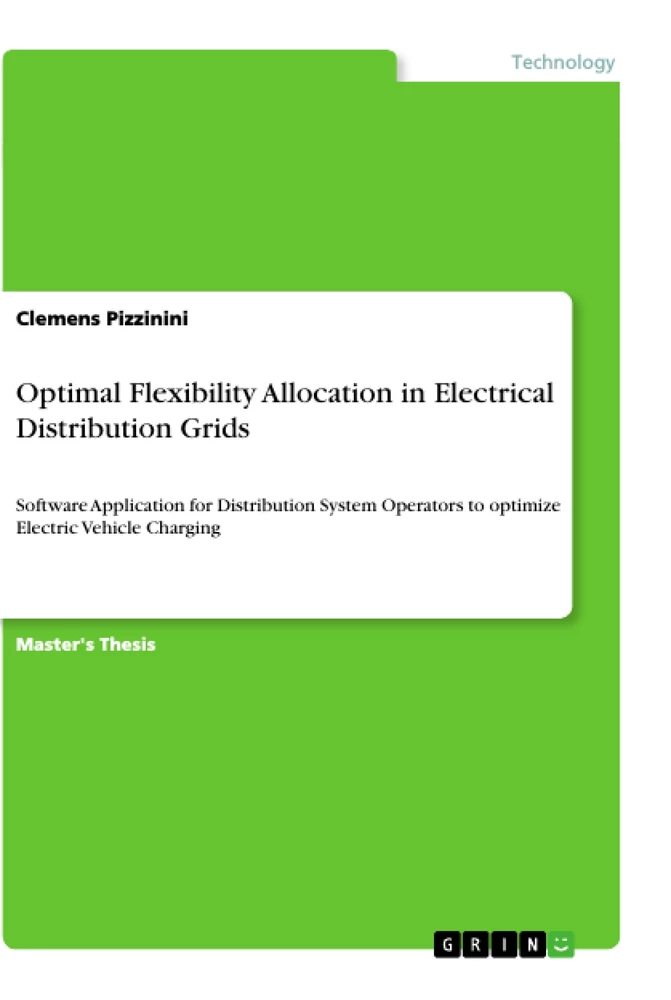
Table of Contents
1 Executive Summary
2 Introduction
2.1 Motivation and Problem Identification
2.2 Research Question and Objectives
2.3 Structure of the Thesis
3 Theoretical Foundations
3.1 Brief History of the German Energy Grid
3.2 Distribution and Transmission
3.3 Energy Markets
3.3.1 Energy-Only-Markets
3.3.2 Capacity Markets
3.3.3 Contractual Balancing
3.3.4 Auctions in Competitive Electricity Pools
3.4 The Problem of Balancing and Congestion
3.4.1 Grid Congestions and Frequency Balance
3.4.2 Congestion Mechanism
3.4.3 Balancing Mechanism
4 Local Flexibility: A Novel Approach
4.1 The new importance of Distribution System Operators
4.2 Definition of Flexibility
4.3 The Problem of Low Demand Flexibility
4.4 Flexibility from Electric Vehicles
4.4.1 V2G
4.4.2 Current Limitations of V2G
4.4.3 Controlled Charging
4.4.4 Current Research to Controlled Charging
4.5 Local Flexibility Markets
4.6 The Traffic Light Concept
4.6.1 Historical Background
4.6.2 Concept
4.7 Focus of this work
5 Simulation Software: Concept and Design
5.1 Problem Definition and Goal
5.2 Conceptual Design
5.2.1 Applied Grid Environment
5.2.2 Traffic Light Thresholds
5.2.3 DSO and Flexmarket Concept
5.2.4 EV Concept
5.2.5 Communication and Information Concept
5.3 Architectural Design
5.3.1 Simulation Framework
5.3.2 System Design
5.3.3 Input values
5.3.4 Agent Behaviour Modeling
6 Evaluation
6.1 Evaluation process and tools
6.2 Time-Series Simulation
6.2.1 Grid Workload
6.2.2 Completed Charging Requests
6.2.3 Bid Acceptanc Ratio
6.2.4 Price of Bids
6.2.5 Charging pattern of Example EV
6.2.6 Summary Time-Series Simulation
6.3 Sensitivity Simulation
6.3.1 Auction Cost, EV Profit and SoC Increase
6.3.2 Completed Charging Requests
6.3.3 State of Charge and Optimal EV penetration
6.3.4 Summary Sensitivity Simulation
6.4 Identified Effects
6.4.1 Request Control
6.4.2 Latency
6.4.3 Batching
6.5 Robustness against Dynamic Inputs
6.5.1 Initial Sate of Charge
6.5.2 Arrival and Departure Time
6.5.3 Risk Preferences
6.5.4 Random Seed
6.6 Limitations
6.6.1 Forecasting Demand Structure
6.6.2 Dynamic Charge Power
6.6.3 Optimal Segmentation
6.6.4 Balancing Group Problem
6.6.5 Price Cap and Price Function
7 Conclusion, Discussion and Outlook
Objectives and Research Themes
This thesis investigates how local flexibility from electric vehicles can be utilized for congestion management in distribution grids. The primary research goal is to design and evaluate an auction-based market mechanism that enables Distribution System Operators (DSOs) to manage grid load by contracting controlled charging breaks from electric vehicles in real-time, thereby preventing physical grid extension.
- Integration of Electric Vehicles as flexible loads to support grid stability.
- Implementation of the Traffic Light Concept within a local market design.
- Development of a multi-agent simulation software for auction-based congestion management.
- Evaluation of grid load balancing efficiency under varying electric vehicle penetration rates.
- Analysis of the robustness and limitations of the proposed market-based control mechanism.
Excerpt from the Book
4.4.2 Current Limitations of V2G
Nevertheless, it can be questioned why V2G technology has not yet found its way to commercialisations apart from several small pilot projects (see for example: Nissan Leaf at Enervie). Literature suggests six major challanges to the integration of V2G [36] [34] : (1) Battery degeneration is still not fully understood and a higher frequency of charging cycles due to V2G can possible lead to costs that have to be offset by the reveunes. (2) Bidirectional charging is an advanced technical feature only two EV support by 2017 with little efforts from the industry to change this. (3) If capacity is contracted, the EV owner is left with less kilometer range which still has to satisfy the need for mobility. (4) There is no standard for charging facilities resulting in a fragmented market for viable business cases as well as (5) no standardized communication protocol for the highly complex procedure. (6) In addition, the regulatory framework needed is by far not in place and will take more time to be passed by legislative. Condensing the above, there are technical, regulatory and behavioural challenges to be tackled before V2G might be adopted in the future.
Summary of Chapters
1 Executive Summary: This chapter provides a brief overview of the thesis, highlighting the motivation for managing grid congestion through electric vehicle flexibility and the effectiveness of the developed micro-auction model.
2 Introduction: It outlines the paradigm shift in the energy industry caused by renewable energy sources and electric vehicles, identifying the need for decentralized control mechanisms like local flexibility markets.
3 Theoretical Foundations: This section covers the historical development of the German power grid, explains energy and capacity markets, and defines the physical challenges of grid congestion and frequency balancing.
4 Local Flexibility: A Novel Approach: It defines the concept of flexibility, introduces the potential of electric vehicles as controlled loads, and presents the Traffic Light Concept as a framework for managing distribution grid congestion.
5 Simulation Software: Concept and Design: This chapter details the multi-agent simulation model, including the grid environment, the DSO/flexmarket mechanism, and the agent behaviour modeling implemented in Python.
6 Evaluation: This chapter presents the results of the time-series and sensitivity simulations, analyzing the impact of electric vehicle penetration, identified latency effects, and the robustness of the request control mechanism.
7 Conclusion, Discussion and Outlook: It summarizes the findings, concludes that the proposed model stabilizes the grid and allows for higher electric vehicle penetration, and discusses future research directions such as blockchain integration and bidirectional charging.
Keywords
Electric Vehicles, Local Flexibility Markets, Congestion Management, Traffic Light Concept, Grid Stability, Micro-Auctions, Multi-Agent Simulation, Distribution System Operator, Demand Side Management, Renewable Energy Integration, Power Grid, Charging Infrastructure, V2G, Controlled Charging, Energy Markets
Frequently Asked Questions
What is the core problem addressed in this work?
The work addresses the increasing grid congestion in electrical distribution systems caused by the mass adoption of electric vehicles and renewable energy sources, which traditional, centralized grid management struggle to handle efficiently.
What are the primary thematic areas of this thesis?
The main themes include local congestion management, market-based mechanisms for flexibility, the technical integration of electric vehicles, and multi-agent simulation frameworks for smart grids.
What is the main objective of the research?
The objective is to develop and simulate a novel, auction-based market design that utilizes controlled charging of electric vehicles to relieve local grid congestion without requiring extensive physical grid expansion.
Which scientific methods are applied in this thesis?
The thesis utilizes a multi-agent system approach to simulate a virtual market environment, applying mathematical modeling for bid pricing and grid load calculation, as well as time-series and sensitivity analysis for performance evaluation.
What does the main part of the thesis focus on?
The main part focuses on the conceptual design of the local flexibility market, the translation of the "Traffic Light Concept" into a simulation-ready mechanism, and the subsequent evaluation of its performance regarding grid load reduction.
What are the key terms that define this research?
Key terms include "local flexibility," "electric vehicles," "congestion management," "Traffic Light Concept," "multi-agent simulation," and "micro-auctions."
How does the proposed "request control mechanism" work in practice?
It proactively monitors charging requests against available grid capacity. If the threshold for congestion (yellow Traffic Light Phase) is reached, it uses an auction to contract the most cost-efficient flexibility bids, temporarily pausing selected vehicles to keep the grid within safe limits.
Why is the "Traffic Light Concept" significant for this model?
It provides a standardized, color-coded framework for communicating grid status (Green, Yellow, Red) between the grid operator and market participants, which is essential for triggering the auction mechanism only when necessary.
What impact does electric vehicle penetration have on the auction costs?
The study shows that total auction costs for the DSO rise proportionally with increasing electric vehicle penetration, as more capacity needs to be contracted to balance the grid during peak times.
Ende der Leseprobe aus 70 Seiten
- nach oben
- Arbeit zitieren
- Clemens Pizzinini (Autor:in), 2019, Optimal Flexibility Allocation in Electrical Distribution Grids, München, Page::Imprint:: GRINVerlagOHG, https://www.diplomarbeiten24.de/document/583990

neugierig - aktuell - relevant
Entdecken Sie hilfreiche Tipps und Tricks rund ums Studium!

Entdecken Sie hilfreiche Tipps und Tricks rund ums Studium!
Ihre Hausarbeit / Abschlussarbeit:

- - Publikation als E-Book und Buch
- - Hohes Honorar auf die Verkäufe
- - Für Sie komplett kostenlos - mit ISBN
- - Es dauert nur 5 Minuten
- - Jede Arbeit findet Leser

- © GRIN Publishing GmbH.
- Alle Inhalte urheberrechtlich geschützt. Kopieren und verbreiten untersagt.
- info@grin.com
- AGB
- Open Publishing
Der GRIN Verlag hat sich seit 1998 auf die Veröffentlichung akademischer eBooks und Bücher spezialisiert. Der GRIN Verlag steht damit als erstes Unternehmen für User Generated Quality Content. Die Verlagsseiten GRIN.com, Hausarbeiten.de und Diplomarbeiten24 bieten für Hochschullehrer, Absolventen und Studenten die ideale Plattform, wissenschaftliche Texte wie Hausarbeiten, Referate, Bachelorarbeiten, Masterarbeiten, Diplomarbeiten, Dissertationen und wissenschaftliche Aufsätze einem breiten Publikum zu präsentieren.
Kostenfreie Veröffentlichung: Hausarbeit, Bachelorarbeit, Diplomarbeit, Dissertation, Masterarbeit, Interpretation oder Referat jetzt veröffentlichen!
Folgen Sie GRIN auf


- GRIN Verlag GmbH
-
- Nymphenburger Str. 86
- 80636
- Munich, Deutschland
- +49 89-550559-0
- +49 89-550559-10
- info@grin.com
-
