
präsentiert von

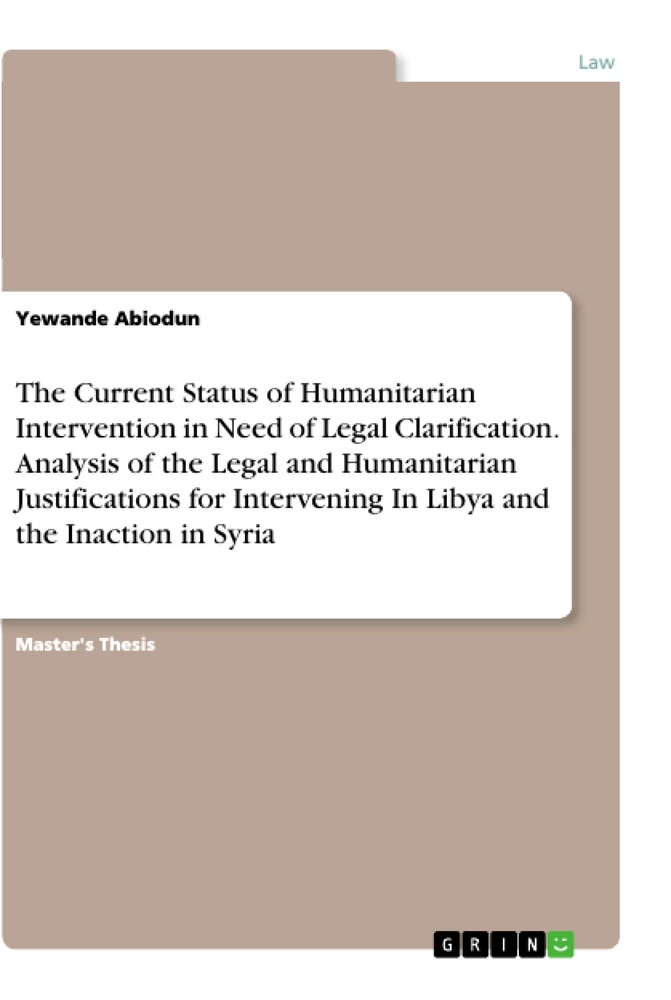
Table of Contents
CHAPTER ONE: STATE SOVEREIGNTY AND THE PRINCIPLE OF NON-INTERVENTION
LAW ON THE USE OF FORCE
AUTHORIZATION BY THE UN SECURITY COUNCIL
THE CONCEPT OF HUMANITARIAN INTERVENTION
HISTORICAL EVOLUTION OF HUMANITARIAN INTERVENTION
HUMANITARIAN INTERVENTION UNDER CUSTOMARY INTERNATIONAL LAW
HUMANITARIAN INTERVENTION UNDER THE UNITED NATIONS CHARTER
CHAPTER TWO: LEGAL JUSTIFICATION FOR HUMANITARIAN INTERVENTION UNDER THE UNITED NATIONS CHARTER
TEXTUAL ARGUMENTS
CLASSICISTS VIEW
NON-RESTRICTIONISTS VIEW
THE EMERGENCE OF RESPONSIBILITY TO PROTECT
CHAPTER THREE: REACTION OF THE INTERNATIONAL COMMUNITY TOWARDS INTERVENTION
THE PROBLEM WITH UNILATERAL AND REGIONAL HUMANITARIAN INTERVENTION
CASE STUDIES OF HUMANITARIAN INTERVENTIONS
KOSOVO
SOMALIA AND RWANDA
BOSNIA
PANAMA
LIBERIA
LIBYA AND SYRIA: TWO DIFFERENT CASES?
CHAPTER FOUR: MORAL JUSTIFICATION FOR HUMANITARIAN INTERVENTION
HUMANITARIAN INTERVENTION: A NEW PARADIGM; THE WAY FORWARD
OBSERVATIONS AND PROPOSALS FOR SUCCESSFUL IMPLEMENTATION OF HUMANITARIAN INTERVENTION
Objectives and Topics
The primary objective of this thesis is to critically evaluate the legal and humanitarian justifications for humanitarian intervention, specifically exploring the tension between the principle of state sovereignty and the international obligation to protect populations from mass atrocities. The research aims to clarify the legal status of unilateral intervention within the framework of the United Nations Charter while questioning why certain crises, such as those in Libya and Syria, elicit different international reactions.
- The evolution of the principle of state sovereignty and the norm of non-intervention.
- Legal arguments surrounding the authorization of force under the UN Charter and customary international law.
- Comparative analysis of intervention and inaction in specific international case studies.
- The moral and ethical imperatives underlying the "Responsibility to Protect" doctrine.
- Proposals for reform to improve the efficacy and consistency of humanitarian interventions.
Excerpt from the Book
HISTORICAL EVOLUTION OF HUMANITARIAN INTERVENTION
The basic problem of how to protect human rights and safeguard human security remains one most persistent problem which the international community faces, although ‘the dilemma of what to do about strangers who are subjected to appalling cruelty by their government’ has been particularly pressing over the last hundred years. Simms argues that though various attempts have been made to provide answers to this dilemma, the notion of humanitarian intervention had always been treated as if it were a subject without a history.
The Classical Origin of humanitarian Intervention lies in the emergence of the substantive doctrine of the Just War in the middle ages. The opinions of Scholars gradually contributed to its development; however the most comprehensive and widely publicized work on this subject was that of Hugo Grotius. He reasoned that it was important that laws governing every human society be limited by the principle of humanity. Hence, where a sovereign while exercising his rights, acts contrary to the rights of humanity by grievously mistreating his subjects, the right of intervention can be considered lawful.
It may be observed that Intervention was common in the Greek city-state system, the Roman Empire and in religious wars of 16th and 17th century. Green posits that it seems to be largely a creation of 19th century because prior to this time, Intervention was based on Christian Beliefs and religious concepts of the dignity of man. On this basis, the teachings of Thomas Aquinas usually referred to the fact that a sovereign had right to intervene in the internal affairs of another when the latter greatly mistreats its subjects.
Summary of Chapters
CHAPTER ONE: STATE SOVEREIGNTY AND THE PRINCIPLE OF NON-INTERVENTION: This chapter establishes the theoretical foundations of state sovereignty and the non-intervention principle, contextualizing them within the framework of the UN Charter and historical international law.
CHAPTER TWO: LEGAL JUSTIFICATION FOR HUMANITARIAN INTERVENTION UNDER THE UNITED NATIONS CHARTER: This chapter analyzes the legal debates between restrictionists and non-restrictionists regarding the legality of intervention, examining whether the UN Charter allows for exceptions in cases of humanitarian necessity.
CHAPTER THREE: REACTION OF THE INTERNATIONAL COMMUNITY TOWARDS INTERVENTION: This chapter examines how international actors respond to crises, utilizing case studies such as Kosovo, Rwanda, and Syria to illustrate the inconsistencies in the application of humanitarian interventions.
CHAPTER FOUR: MORAL JUSTIFICATION FOR HUMANITARIAN INTERVENTION: This chapter explores the moral and ethical dimensions of humanitarian intervention, arguing that the protection of human rights should take precedence over absolute state sovereignty when governments fail their own citizens.
Keywords
Humanitarian Intervention, State Sovereignty, Non-Intervention, United Nations Charter, Use of Force, Responsibility to Protect, Customary International Law, Human Rights, International Security, Unilateral Intervention, Moral Justification, Collective Security, Genocide, International Law, Syrian Crisis.
Frequently Asked Questions
What is the core focus of this academic work?
The thesis explores the legal and moral justifications for humanitarian intervention, specifically analyzing the conflict between the principle of non-intervention and the global responsibility to protect human rights.
What are the central themes of the research?
The study centers on state sovereignty, the limitations of the UN collective security system, the emergence of the "Responsibility to Protect" doctrine, and the inconsistent state practices regarding military interventions.
What is the primary research question?
The author questions the legal status of unilateral humanitarian intervention and investigates the reasons behind the varying levels of international response to similar humanitarian disasters.
What methodology is employed throughout the thesis?
The author employs a comparative legal analysis, reviewing historical precedents, international treaty law (specifically the UN Charter), and existing academic discourse on international law and moral philosophy.
Which topics are covered in the main body of the work?
The main body covers the historical roots of humanitarian intervention, legal debates under the UN Charter, an evaluation of various regional and global interventions (e.g., Kosovo, Liberia, Panama), and the ethical foundations of intervention.
Which keywords best describe this research?
The most important keywords include Humanitarian Intervention, State Sovereignty, Non-Intervention, UN Charter, Responsibility to Protect, and International Law.
How does the author distinguish between intervention in Libya and Syria?
The author notes that while Libya saw an authorized international response, Syria has faced inaction due to geopolitical complexities, including Russian/Chinese veto power and the risks associated with ground combat in densely populated areas.
What is the conclusion regarding the current status of international law?
The author concludes that current international law lacks a clear, consistent rule regarding unilateral intervention, and calls for a reform of the UN Charter to create a more flexible and humane system for addressing mass atrocities.
Ende der Leseprobe aus 74 Seiten
- nach oben
- Arbeit zitieren
- Yewande Abiodun (Autor:in), 2014, The Current Status of Humanitarian Intervention in Need of Legal Clarification. Analysis of the Legal and Humanitarian Justifications for Intervening In Libya and the Inaction in Syria, München, Page::Imprint:: GRINVerlagOHG, https://www.diplomarbeiten24.de/document/584787

neugierig - aktuell - relevant
Entdecken Sie hilfreiche Tipps und Tricks rund ums Studium!

Entdecken Sie hilfreiche Tipps und Tricks rund ums Studium!
Ihre Hausarbeit / Abschlussarbeit:

- - Publikation als E-Book und Buch
- - Hohes Honorar auf die Verkäufe
- - Für Sie komplett kostenlos - mit ISBN
- - Es dauert nur 5 Minuten
- - Jede Arbeit findet Leser

- © GRIN Publishing GmbH.
- Alle Inhalte urheberrechtlich geschützt. Kopieren und verbreiten untersagt.
- info@grin.com
- AGB
- Open Publishing
Der GRIN Verlag hat sich seit 1998 auf die Veröffentlichung akademischer eBooks und Bücher spezialisiert. Der GRIN Verlag steht damit als erstes Unternehmen für User Generated Quality Content. Die Verlagsseiten GRIN.com, Hausarbeiten.de und Diplomarbeiten24 bieten für Hochschullehrer, Absolventen und Studenten die ideale Plattform, wissenschaftliche Texte wie Hausarbeiten, Referate, Bachelorarbeiten, Masterarbeiten, Diplomarbeiten, Dissertationen und wissenschaftliche Aufsätze einem breiten Publikum zu präsentieren.
Kostenfreie Veröffentlichung: Hausarbeit, Bachelorarbeit, Diplomarbeit, Dissertation, Masterarbeit, Interpretation oder Referat jetzt veröffentlichen!
Folgen Sie GRIN auf


- GRIN Verlag GmbH
-
- Nymphenburger Str. 86
- 80636
- Munich, Deutschland
- +49 89-550559-0
- +49 89-550559-10
- info@grin.com
-
