
präsentiert von

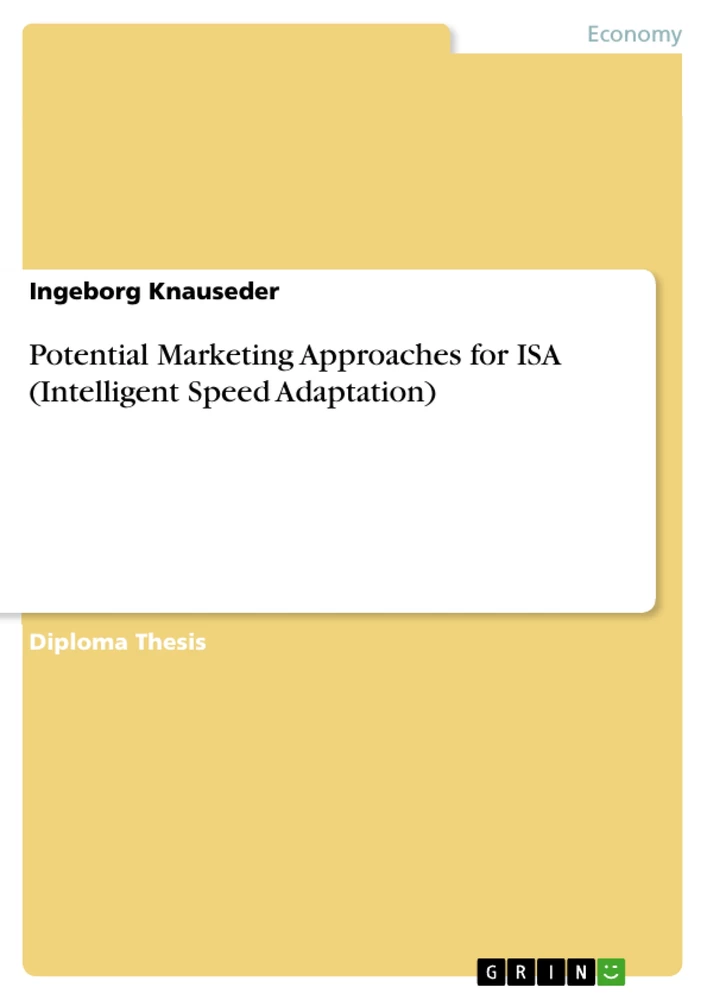
Table of Contents
1 INTRODUCTION
1.1 Background
1.1.1 Informative or Active Support
1.1.2 Signal by GPS or Roadside Transmitters
1.2 Purpose
1.3 Limitations
1.4 Problem Analyzes
2 METHOD
2.1 Systematic Combining
2.2 Data collection
2.3 Primary data
2.4 Validity and Reliability
2.5 Secondary data
2.6 Benchmarking
3 THEORY
3.1 New Product Development Strategy
3.1.1 New Product Development and Partnering
3.1.2 New Technology Commercialization and Diffusion
3.2 Managerial View
3.2.1 A Kind of Standard Approach
3.2.1 Definition of the Managerial Approach
3.3 Market Segmentation
3.3.1 Needs-Based-Approach
3.4 Organizational Relations
3.5 Change Process
3.6 Social Marketing Approach
3.6.1 Definition of Social Marketing
3.6.2 The Development of Social Marketing
3.6.3 Core Principles of Social Marketing
3.6.4 Consumer Orientation and Key Segments
3.6.5 Exchange
3.6.6 Alliance Building
3.6.7 Long-Term Planning Approach and High Involvement Issue
3.6.8 Going further than the Individual Customer
3.7 Differences between Economic and Non Economic Marketing
3.7.1 Different Missions and Final Goals lead to Different Benefits
3.7.2 Product Complexity
3.7.3 Negative Demand
3.8 Interaction Approach
3.8.1 Relationships became Networks
3.8.2 Comparison of the Network and the Interaction Approach
3.9 Industrial Networks Approach
3.9.1 Characteristics of the Different Parts of a Network
3.9.2 The Structures of a Network (Håkansson, 1992)
3.9.3 A Second Stage in the Network Conceptualization
3.9.4 Connection with ISA
3.10 Comparison and differences Managerial and the Network Approach
3.10.1 Localization of the Different Approaches
3.10.2 Coordination and Social Aspect
3.10.3 Unit of Analysis
3.10.4 Dynamism
3.10.5 The future position of the different paradigms
3.11 How will we lead our Study about ISA regarding these Approaches?
4 DATA PRESENTATION
4.1 Authorities
4.1.1 Customer
4.1.2 Product
4.1.3 Network
4.2 Car Manufacturer
4.2.1 Customer
4.2.2 Product
4.2.3 Network
4.3 Insurance Companies
4.3.1 Customer
4.3.2 Product
4.3.3 Network
4.4 Research and Safety Institutes
4.4.1 Customer
4.4.2 Product
4.4.3 Network
4.5 Professional Drivers
4.5.1 Customer
4.5.2 Product
4.5.3 Network
5 ANALYSIS
5.1 Network Analysis
5.1.1 Actors
5.1.2 Actor Bonds
5.1.3 Resource Ties
5.1.4 Activity Links
5.2 Transition
5.3 Analysis - Social Marketing Point of View
5.3.1 Segmentation
5.3.2 Early Adopters
5.3.3 Slow Adopters
5.3.4 Benchmarking
6 CONCLUSION
6.1.1 Comments upon the Actual Network
6.1.2 Actual Problems
6.1.3 Comments about the Social Marketing Perspective
7 RECOMMENDATIONS
Objectives and Scope
The primary objective of this thesis is to examine and understand effective marketing strategies for the implementation of Intelligent Speed Adaptation (ISA) by the Swedish National Road Administration (Vägverket). The study aims to bridge the gap between technological innovation and social acceptance, focusing on how stakeholders can cooperate to facilitate a large-scale introduction of systems that limit personal control for the greater good of traffic safety.
- The role of the network approach in understanding stakeholder cooperation and relationship density.
- Application of social marketing principles to address negative demand and behavior change.
- Benchmarking ISA against historical automotive innovations with social aspects.
- Identification of key customer segments based on needs and safety consciousness.
Excerpt from the Book
3.6.4 Consumer Orientation and Key Segments
According to Kotler (1996), consumer orientation is probably the key element of all forms of marketing. In social marketing, the consumer is even more involved since he is assumed to be an active participant in the change process. The social marketer strive to build a relationship with target consumers over time and their input is taken into account at all stages in the development of a research program. The Health Sponsorship Council of New Zealand goes even further in this point of view stating that the consumer behavior is the bottom line of the paradigm. Andreasen (1995), proposed it also as a second out of twelve central principals to define the social marketing paradigm. He states that “social marketing programs must be guided by an underlying mindset that puts the target customer at the center of every strategic decision”, following the way of the so-called “customer driven” view of the managerial approach.
In order to reach such a goal, strong consumer and market researches are necessary and essential to design, pre-test and evaluate the product: these studies are the starting point of social marketing, the bedrocks upon which program strategy is developed. Qualitative and quantitative research is conducted to understand the consumers’ perception of product benefit and price for example. When it comes to social, heath protective or responsible behaviors (like is the case for ISA), these studies rely on social and behavioral sciences, used to identify potential behavior determinants (social norms, beliefs, values…). This behavioral orientation enables program planners to design strategies that address the critical factors, which determine a specific audience segment’s adoption of the targeted behavior (Goldberg et al. 1997).
Summary of Chapters
1 INTRODUCTION: Outlines the background of ISA, the vision of zero traffic fatalities, and the purpose of identifying cooperative strategies between stakeholders.
2 METHOD: Describes the use of Systematic Combining, triangulation of data sources, and the rationale behind the benchmarking process.
3 THEORY: Provides a comprehensive theoretical foundation covering new product development, managerial marketing, market segmentation, and industrial network approaches.
4 DATA PRESENTATION: Summarizes empirical findings gathered from authorities, car manufacturers, insurance companies, research institutes, and professional drivers.
5 ANALYSIS: Synthesizes empirical data using network analysis (actor bonds, resource ties, activity links) and social marketing perspectives on segmentation.
6 CONCLUSION: Reflects on the feasibility of ISA, emphasizing the necessity of a European-wide consensus and the challenge of reaching non-safety-conscious drivers.
7 RECOMMENDATIONS: Proposes actionable steps, such as building a European expert team, standardizing communications, and using incentives to foster adoption.
Keywords
Intelligent Speed Adaptation, ISA, Social Marketing, Network Theory, Stakeholder Cooperation, Traffic Safety, Market Segmentation, Early Adopters, Benchmarking, Automotive Industry, Vision Zero, Behavioral Change, Industrial Networks, Public Policy, Consumer Orientation
Frequently Asked Questions
What is the core focus of this research?
The work focuses on determining how Intelligent Speed Adaptation (ISA) can be marketed on a large scale, acknowledging that personal benefits may not be immediately obvious to the consumer.
Which theoretical frameworks are applied?
The study utilizes the Industrial Network Approach to analyze stakeholder relationships and the Social Marketing perspective to understand how to trigger behavioral change.
What is the primary goal regarding ISA?
The aim is to foster cooperation between car manufacturers, government authorities, and insurance companies to create an environment where ISA can be implemented effectively.
How is the research methodology structured?
The authors use "Systematic Combining," moving iteratively between theoretical frameworks and empirical fieldwork, incorporating interviews with various industry stakeholders.
What are the primary themes discussed in the analysis?
The analysis covers the definition of actor roles, the evaluation of resource ties and activity links, and the critical importance of segmenting drivers based on safety consciousness.
Which keywords define this thesis?
Key terms include Intelligent Speed Adaptation, Industrial Networks, Social Marketing, and Stakeholder Management.
Why are car manufacturers hesitant about ISA?
Car manufacturers prioritize customer demand, which is currently perceived as low, and fear that forced implementation might negatively impact their brand image and profitability.
How do insurance companies view their role in the ISA network?
They see themselves as key partners who could incentivize adoption through reduced insurance premiums, provided that the system proves to lower accident severity and frequency.
Ende der Leseprobe aus 144 Seiten
- nach oben
- Arbeit zitieren
- Ingeborg Knauseder (Autor:in), 2001, Potential Marketing Approaches for ISA (Intelligent Speed Adaptation), München, Page::Imprint:: GRINVerlagOHG, https://www.diplomarbeiten24.de/document/628


neugierig - aktuell - relevant
Entdecken Sie hilfreiche Tipps und Tricks rund ums Studium!

Entdecken Sie hilfreiche Tipps und Tricks rund ums Studium!
Ihre Hausarbeit / Abschlussarbeit:

- - Publikation als E-Book und Buch
- - Hohes Honorar auf die Verkäufe
- - Für Sie komplett kostenlos - mit ISBN
- - Es dauert nur 5 Minuten
- - Jede Arbeit findet Leser

- © GRIN Publishing GmbH.
- Alle Inhalte urheberrechtlich geschützt. Kopieren und verbreiten untersagt.
- info@grin.com
- AGB
- Open Publishing
Der GRIN Verlag hat sich seit 1998 auf die Veröffentlichung akademischer eBooks und Bücher spezialisiert. Der GRIN Verlag steht damit als erstes Unternehmen für User Generated Quality Content. Die Verlagsseiten GRIN.com, Hausarbeiten.de und Diplomarbeiten24 bieten für Hochschullehrer, Absolventen und Studenten die ideale Plattform, wissenschaftliche Texte wie Hausarbeiten, Referate, Bachelorarbeiten, Masterarbeiten, Diplomarbeiten, Dissertationen und wissenschaftliche Aufsätze einem breiten Publikum zu präsentieren.
Kostenfreie Veröffentlichung: Hausarbeit, Bachelorarbeit, Diplomarbeit, Dissertation, Masterarbeit, Interpretation oder Referat jetzt veröffentlichen!
Folgen Sie GRIN auf


- GRIN Verlag GmbH
-
- Nymphenburger Str. 86
- 80636
- Munich, Deutschland
- +49 89-550559-0
- +49 89-550559-10
- info@grin.com
-
