
präsentiert von

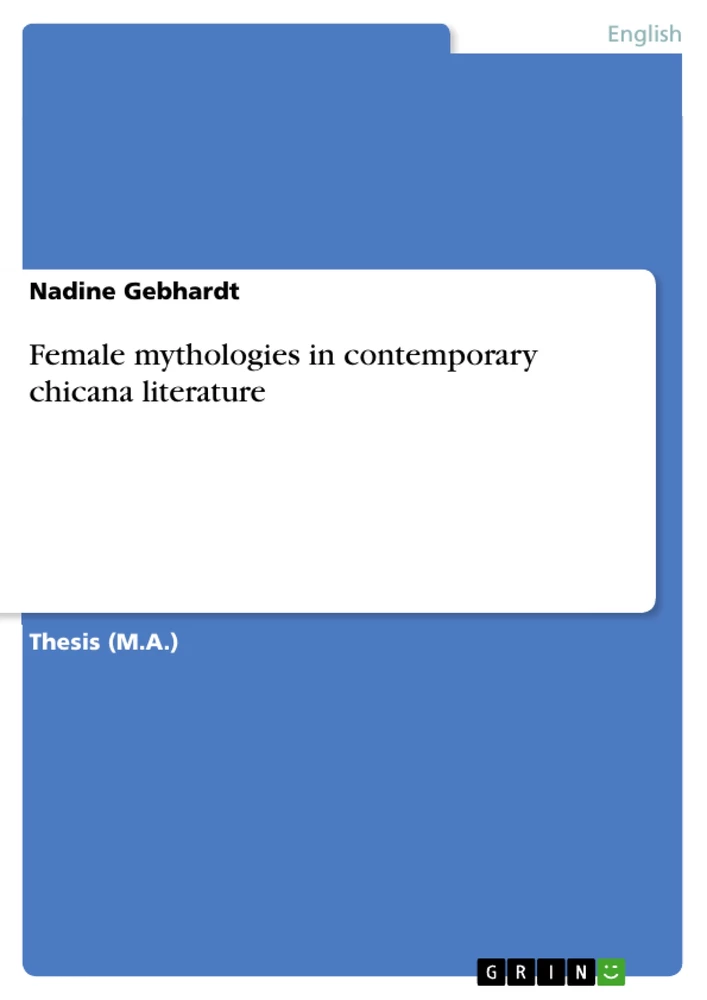
Table of Contents
1. Introduction
1.1. A Brief Look at Chicana/o History
1.2. Chicana Feminism and Chicana Feminist Literature
2. Traditional Mythic Figures in Chicana/o Culture
2.1. Defining Myths and Mythological Archetypes
2.2. The Virgin of Guadalupe
2.3. La Malinche
2.4. La Llorona
3. Female Mythologies in the Fiction of Three Contemporary Chicana Writers
3.1. Helena María Viramontes
3.1.1. Biography
3.1.2. Guadalupe, Malinche, and La Llorona in “The Broken Web”
3.1.3. La Llorona in “The Cariboo Cafe”
3.2. Sandra Cisneros
3.2.1. Biography
3.2.2. The Virgin of Guadalupe in “Little Miracles, Kept Promises”
3.2.3. Malinche in “Never Marry a Mexican”
3.2.4. La Llorona in “Woman Hollering Creek”
3.3. Ana Castillo
3.3.1. Biography
3.3.2. La Llorona in So Far from God
3.3.2.1. Fe
3.3.2.2. Caridad
3.3.2.3. Esperanza
3.3.2.4. La Loca
3.3.2.5. Sofi
3.4. A Comparison of Viramontes’s, Cisneros’s and Castillo’s Fiction
4. Conclusion
5. Bibliography
6. Deutsche Zusammenfassung
Objectives & Themes
The primary objective of this thesis is to examine how contemporary Chicana authors appropriate and rewrite traditional patriarchal mythic figures such as the Virgin of Guadalupe, La Malinche, and La Llorona. By exploring these figures in novels and short stories, the work aims to demonstrate how Chicana feminists deconstruct binary oppositions—such as the virgin/whore dichotomy—to reveal feminine power and establish feminist role models that support the emancipation of Chicanas.
- Analysis of traditional patriarchal constructions of feminine archetypes in Mexican and Chicana/o culture.
- Exploration of Chicana feminist literary responses and revisions of these cultural icons.
- Comparative analysis of works by Helena María Viramontes, Sandra Cisneros, and Ana Castillo.
- Deconstruction of the virgin/whore and good mother/bad mother dichotomies.
- Investigation of how these myths impact Chicana subjectivity and the pursuit of self-definition.
Excerpt from the Book
2.1. Defining Myth and Mythological Archetypes
Especially in cultures with a strong oral tradition, myths and mythological archetypes play an important role:
It is common in largely oral cultures to organize knowledge, values, and beliefs around symbolic icons, figures, or even persons, which is a characteristic of both the Spanish and the natives at the time of the conquest, and one that in surprising numbers continues to our day in Mexican/ Chicano culture. (Alarcón 1989: 62)
Hence it is not surprising that the term “myth” derives from the Greek word “mythéomai” which means “to tell, to say” (cf. Ikas 143). A culture’s mythology is composed of a series of images and narratives that are the product of “[…] several generations who share a particular space over a significant period of time […]” (Alurista 83). Myths and archetypes have been created to serve a variety of functions. They may explain a culture’s origins, its beliefs, traditions as well as its morals and values. Often, they justify the presence of certain hierarchical structures within a society. They may also express a culture’s desires, hopes and fears (cf. Cook 127; Lauter 1309). Similarly, Chicana critic Tey Diana Rebolledo defines mythology in her cultural analysis of Chicana literature, Women Singing in the Snow, which features an entire chapter on myths and archetypes in Chicano culture:
Mythology often functions as a collective symbolic code that identifies how we should live. Cultures use myths and the stories of heroines and heroes to create role models. These stories enable us to differentiate correct behavior from incorrect, transmit moral values, and identify those traits considered desirable by a group or society. (Rebolledo 1995: 49)
Summary of Chapters
1. Introduction: This chapter introduces the role of feminine archetypes in Chicana/o culture and outlines the research objective to explore these myths as potential sources of feminist empowerment.
2. Traditional Mythic Figures in Chicana/o Culture: This section provides a historical and theoretical overview of the three core myths—the Virgin of Guadalupe, La Malinche, and La Llorona—and their function within patriarchal discourse.
3. Female Mythologies in the Fiction of Three Contemporary Chicana Writers: The chapter offers an in-depth analysis of how Viramontes, Cisneros, and Castillo critically rewrite these archetypes in their literary works to foster Chicana subjectivity.
4. Conclusion: The concluding chapter synthesizes the findings, confirming that contemporary Chicana writers successfully transform restrictive patriarchal myths into symbols of resistance and self-assertion.
5. Bibliography: Lists all primary and secondary sources cited throughout the thesis.
6. Deutsche Zusammenfassung: A summary of the thesis provided in German.
Keywords
Chicana literature, Virgin of Guadalupe, La Malinche, La Llorona, Chicana feminism, feminine archetypes, patriarchal discourse, literary revision, subjectivity, cultural identity, self-definition, Xicanisma, Helena María Viramontes, Sandra Cisneros, Ana Castillo.
Frequently Asked Questions
What is the core subject of this thesis?
The thesis explores the significance of feminine archetypes—specifically the Virgin of Guadalupe, La Malinche, and La Llorona—within contemporary Chicana literature and how these figures are used to define or restrict female identity.
What are the central themes addressed in the work?
Central themes include the intersection of gender, race, and class, the critique of Catholic-patriarchal structures, the role of creative writing as resistance, and the process of cultural self-definition for Chicanas.
What is the primary research goal?
The goal is to demonstrate that while these traditional myths have historically functioned as tools for social control and feminine passivity, contemporary Chicana writers are actively reclaiming and reinterpreting them as sources of power and feminist agency.
Which methodology does the author employ?
The author uses a literary and cultural studies approach, focusing on close readings of short stories and novels, supported by theoretical frameworks related to Chicana feminism, post-colonialism, and mythology.
What topics are discussed in the main body of the text?
The main body examines specific literary works by Viramontes, Cisneros, and Castillo, detailing how each author dismantles the traditional virgin/whore dichotomy and provides alternative, empowering readings of the three iconic myths.
Which keywords define this research?
Key terms include Chicana feminism, mythological archetypes, literary revision, cultural resistance, and the specific names of the central figures being analyzed.
How does the author characterize the role of the Virgin of Guadalupe?
The author portrays the traditional Virgin of Guadalupe as a patriarchal ideal of passivity and submissiveness, while noting how contemporary Chicana writers re-vision her through her pre-Columbian Aztec roots to emphasize strength and sexuality.
What specific function does "La Gritona" serve in the analysis of Cisneros’s work?
In the analysis of Cisneros's "Woman Hollering Creek," "La Gritona" (The Screaming Woman) is redefined from a figure of sorrow into a symbol of joy and defiance, serving as a proactive alternative to the passive, wailing "La Llorona."
Ende der Leseprobe aus 124 Seiten
- nach oben
- Arbeit zitieren
- Magistra Artium Nadine Gebhardt (Autor:in), 2005, Female mythologies in contemporary chicana literature, München, Page::Imprint:: GRINVerlagOHG, https://www.diplomarbeiten24.de/document/64943

neugierig - aktuell - relevant
Entdecken Sie hilfreiche Tipps und Tricks rund ums Studium!

Entdecken Sie hilfreiche Tipps und Tricks rund ums Studium!
Ihre Hausarbeit / Abschlussarbeit:

- - Publikation als E-Book und Buch
- - Hohes Honorar auf die Verkäufe
- - Für Sie komplett kostenlos - mit ISBN
- - Es dauert nur 5 Minuten
- - Jede Arbeit findet Leser

- © GRIN Publishing GmbH.
- Alle Inhalte urheberrechtlich geschützt. Kopieren und verbreiten untersagt.
- info@grin.com
- AGB
- Open Publishing
Der GRIN Verlag hat sich seit 1998 auf die Veröffentlichung akademischer eBooks und Bücher spezialisiert. Der GRIN Verlag steht damit als erstes Unternehmen für User Generated Quality Content. Die Verlagsseiten GRIN.com, Hausarbeiten.de und Diplomarbeiten24 bieten für Hochschullehrer, Absolventen und Studenten die ideale Plattform, wissenschaftliche Texte wie Hausarbeiten, Referate, Bachelorarbeiten, Masterarbeiten, Diplomarbeiten, Dissertationen und wissenschaftliche Aufsätze einem breiten Publikum zu präsentieren.
Kostenfreie Veröffentlichung: Hausarbeit, Bachelorarbeit, Diplomarbeit, Dissertation, Masterarbeit, Interpretation oder Referat jetzt veröffentlichen!
Folgen Sie GRIN auf


- GRIN Verlag GmbH
-
- Nymphenburger Str. 86
- 80636
- Munich, Deutschland
- +49 89-550559-0
- +49 89-550559-10
- info@grin.com
-
