
präsentiert von

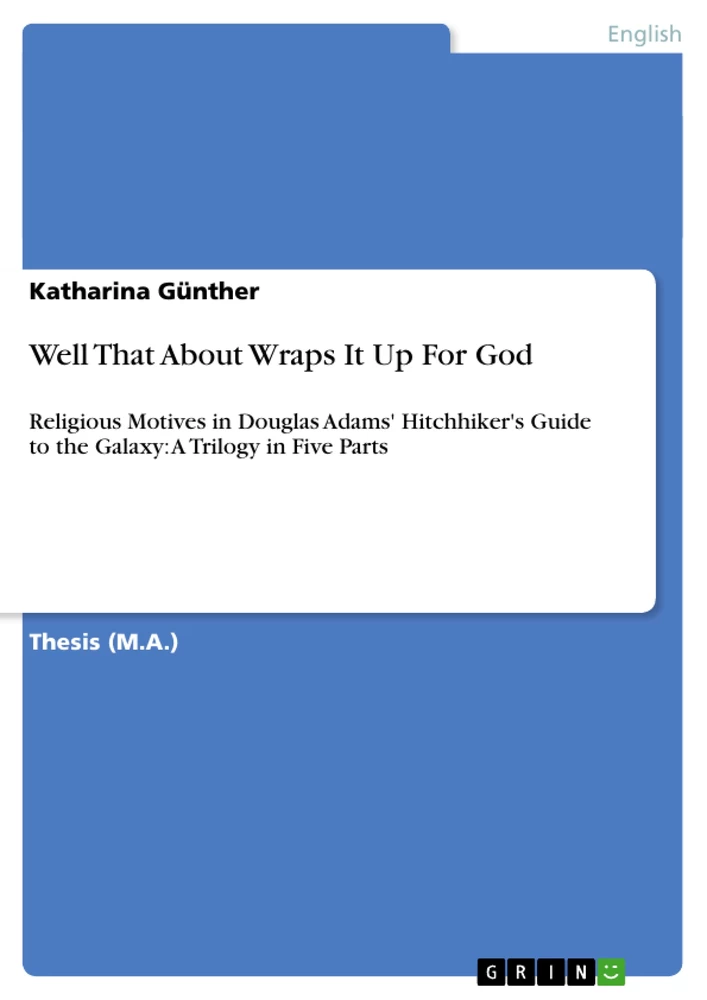
Table of Contents
1. Introduction
2. Classification of The HG
2.1. A Short Introduction to Science Fiction as a Literary Genre
2.2. The HG as (Mock-) Science Fiction
3. Religious Themes in Science Fiction
3.1. The (Non-) Existence of God in Science Fiction
3.2. Creation of the World and Mankind in Science Fiction
3.3. Eschatology and Death in Science Fiction
3.4. The Meaning of Life in Science Fiction
4. For Zarquon’s Sake or The HG and Religion
5. Does it Look as if the Universe is in Very Good Hands? or God in the HG
5.1. The (Non-) Existence of God
5.2. Humanoid Supreme Beings
5.3. Machines as Gods
5.4. The Guide as Holy Book and God
5.5. False Gods
5.6. God’s Final Message to His Creation
6. The Great Green Arkleseizure or Creation in the HG
6.1. The Creation of Life
6.2. The Making of Earth
6.3. The Creation of Mankind by Ancient Astronauts
6.4. Artificial Universes
7. The Restaurant at the End of the Universe or Eschatology & Afterlife in the HG
7.1. The Restaurant at the End of the Universe
7.2. The End of the Earth(s)
7.3. Afterlife
7.4. Immortality
7.5. Reincarnation
7.6. The Death of Arthur Dent
8. 42 or The Meaning of Life
8.1. The Meaning of Life in the Five major Religions
8.2. Insignificance of Man
8.3. Everybody’s Quest for Answers
8.4. Aliens – Bringers of Knowledge?
8.5. The Quest of Arthur Dent
8.6. Answers
8.7. The Dangers of Knowledge
9. Conclusion
Research Objectives and Topics
This thesis aims to analyze the presence of religious motives, ideas, and traditions within the five novels of the Hitchhiker’s Guide to the Galaxy trilogy. It seeks to interpret the function of these religious elements within a Science Fiction context, exploring whether Adams uses them to advocate for spiritual belief or to provide a satirical commentary on the human search for meaning.
- The intersection of Science Fiction and religious themes.
- The literary classification of the Hitchhiker’s Guide as Mock Science Fiction.
- Existential questions regarding the existence of God and the origin of life.
- Eschatological perspectives and the concept of the afterlife in the narrative.
- The role of technology as a substitute for religion.
Excerpt from the Book
The Argument of the Babel fish
The Babel fish [is] probably the oddest thing in the Universe. It feeds on brainwave energy received not from its own carrier but from those around it. It absorbs all unconscious mental frequencies from this brainwave energy to nourish itself with. It then excretes into the mind of its carrier a telepathic matrix formed by combining the conscious thought frequencies with nerve signals picked up from the speech centres of the brain which has supplied them. The practical upshot of all this is that if you stick a Babel fish in your ear you can instantly understand anything said to you in any form of language. (Hitch: 51)
“The argument of the Babel fish as proof for the non-existence of God […] goes something like this” (Hitch: 52):
‘I refuse to prove that I exist,’ says God, ‘for proof denies faith, and without faith I am nothing.’
‘But,’ says Man, ‘the Babel fish is a dead giveaway, isn’t it? It could not have evolved by chance. It proves you exist, and so therefore, by your own arguments, you don’t. QED.’
‘Oh dear,’ says God, ‘I hadn’t thought of that,’ and promptly vanishes in a puff of logic.
‘Oh, that was easy,’ says Man, and for an encore goes on to prove that black is white and gets himself killed on the next zebra crossing. (Hitch: 52)
Summary of Chapters
1. Introduction: Presents the scope of the thesis, introducing the Hitchhiker’s Guide to the Galaxy trilogy and the author's personal atheist perspective.
2. Classification of The HG: Discusses the literary genre of Science Fiction and defines the trilogy as 'Mock Science Fiction'.
3. Religious Themes in Science Fiction: Examines how various religious themes, such as the existence of God and creation myths, are treated within the Science Fiction genre.
4. For Zarquon’s Sake or The HG and Religion: Analyzes the ubiquitous references to religion in Adams’ work and how he uses them for satirical purposes.
5. Does it Look as if the Universe is in Very Good Hands? or God in the HG: Investigates the representation of God and divine figures, including humanoid beings and machines.
6. The Great Green Arkleseizure or Creation in the HG: Looks at parody versions of creation myths and the role of 'Ancient Astronauts' in the narrative.
7. The Restaurant at the End of the Universe or Eschatology & Afterlife in the HG: Explores the trilogy's take on the end of the world, reincarnation, and death.
8. 42 or The Meaning of Life: Discusses the central quest for meaning, the significance of the number 42, and the potential dangers of attaining absolute knowledge.
9. Conclusion: Summarizes the findings, confirming that the work employs religious motives to reinforce its underlying message of humorous nihilism.
Keywords
Douglas Adams, Hitchhiker's Guide to the Galaxy, Science Fiction, Mock Science Fiction, Religion, Atheism, Nihilism, Eschatology, Creation Myths, Ancient Astronauts, Theodicy, Meaning of Life, 42, Satire, Technology.
Frequently Asked Questions
What is the primary focus of this work?
The work examines the appearance of religious motives and themes within Douglas Adams’ Hitchhiker’s Guide to the Galaxy trilogy, analyzing how they serve the author's satirical and nihilistic narrative.
What are the central thematic fields covered in the research?
The research covers four major areas: the existence of God, creation myths, eschatological ideas regarding the end of the world, and the ultimate quest for the meaning of life.
What is the main research question or goal?
The goal is to determine how Adams utilizes and modifies religious traditions to create 'humorous nihilism' and to understand the function of these religious elements within the context of Mock Science Fiction.
Which academic methodology is employed?
The thesis utilizes a literary analysis approach, drawing upon definitions of Science Fiction and comparative literature to interpret how Adams deconstructs traditional religious concepts.
What topics are discussed in the main analytical chapters?
The chapters address specific motifs: God-figures, including machines and humans; the mockery of creation myths; the presentation of the afterlife; and the philosophical implications of searching for 'the' meaning of life.
What characterizes the work according to the defined keywords?
The work is characterized by its blend of scientific skepticism, deep-rooted nihilism, and the use of 'Black Humour' to deconstruct the human need for religious structure.
How does the work interpret the number 42?
The work interprets 42 as a prime example of Adams’ denial of closure, showing that any attempt to derive profound meaning from an arbitrary, 'smallish' number is inherently absurd.
What is the role of the 'Babel fish' in the author's argument?
The Babel fish acts as a central piece of evidence in the author's satirical 'proof' of the non-existence of God, suggesting that logic and faith are mutually exclusive.
Why does the author consider Arthur Dent a representative of humankind?
Arthur Dent is viewed as a representative of humankind because, like the reader, he is constantly confronted with a chaotic, indifferent universe and struggles to find meaning where none is inherently present.
Ende der Leseprobe aus 101 Seiten
- nach oben
- Arbeit zitieren
- Katharina Günther (Autor:in), 2007, Well That About Wraps It Up For God, München, Page::Imprint:: GRINVerlagOHG, https://www.diplomarbeiten24.de/document/75769

neugierig - aktuell - relevant
Entdecken Sie hilfreiche Tipps und Tricks rund ums Studium!

Entdecken Sie hilfreiche Tipps und Tricks rund ums Studium!
Ihre Hausarbeit / Abschlussarbeit:

- - Publikation als E-Book und Buch
- - Hohes Honorar auf die Verkäufe
- - Für Sie komplett kostenlos - mit ISBN
- - Es dauert nur 5 Minuten
- - Jede Arbeit findet Leser

- © GRIN Publishing GmbH.
- Alle Inhalte urheberrechtlich geschützt. Kopieren und verbreiten untersagt.
- info@grin.com
- AGB
- Open Publishing
Der GRIN Verlag hat sich seit 1998 auf die Veröffentlichung akademischer eBooks und Bücher spezialisiert. Der GRIN Verlag steht damit als erstes Unternehmen für User Generated Quality Content. Die Verlagsseiten GRIN.com, Hausarbeiten.de und Diplomarbeiten24 bieten für Hochschullehrer, Absolventen und Studenten die ideale Plattform, wissenschaftliche Texte wie Hausarbeiten, Referate, Bachelorarbeiten, Masterarbeiten, Diplomarbeiten, Dissertationen und wissenschaftliche Aufsätze einem breiten Publikum zu präsentieren.
Kostenfreie Veröffentlichung: Hausarbeit, Bachelorarbeit, Diplomarbeit, Dissertation, Masterarbeit, Interpretation oder Referat jetzt veröffentlichen!
Folgen Sie GRIN auf


- GRIN Verlag GmbH
-
- Nymphenburger Str. 86
- 80636
- Munich, Deutschland
- +49 89-550559-0
- +49 89-550559-10
- info@grin.com
-
