
präsentiert von

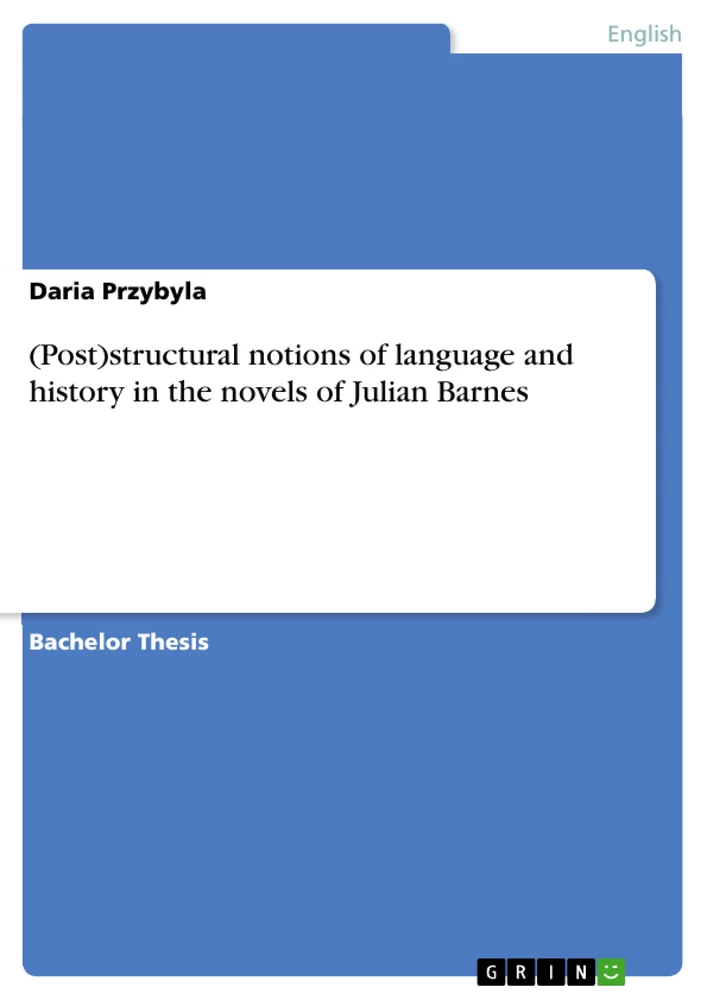
Table of Contents
Introduction
CHAPTER ONE Language as Identity and Difference
CHAPTER TWO History in Time and Space
Conclusion
Objectives and Thematic Focus
This thesis examines the literary output of Julian Barnes, specifically focusing on the novels Metroland, Flaubert’s Parrot, A History of the World in 10 ½ Chapters, and Cross Channel, to explore his treatment of language and history within the context of post-structuralist and postmodern literary theory.
- The construction and limitations of language as a tool for identity and expression.
- The deconstruction of historical master-narratives and the role of individual narratives.
- The intersection of power relations, ideology, and social domination in discourse.
- The destabilization of traditional religious and historical iconography.
- The exploration of human subjectivity and authorial identity in a postmodern landscape.
Excerpt from the Book
Language as Identity and Difference
Barnesian conception of language is formulated mainly on the ground of cultural codes transmission. He concentrates on the semiotic and semantic intricacies of everyday language with an emphasis laid on the parallel distinction between French and English. Whereas the former represents the flexible and figurative quality of socio-cultural discourse, the latter stands for culture-referential convention. Having made a comparative depiction of semiotic interactions in respective cultures, Barnes proceeds to the re-evaluation of the condition of language. He challenges the prescriptive notions imposed on language putting forth the idea of rejecting some of the common modes of thinking about it.
Throughout his novels, Barnes makes several points as to this subject matter- some of which are of relative frequency. First, he assumes the rejection of translation for the sake of linguistic autonomy which resists conceptual absorption into the target-language. The ensuing acculturation of the translated terms causes the reduction of meaning as well as the conventionalisation of the usage. Second, he suggests the rejection of domestic homogeneity and verbal schematics in favour of hybrid anarchy of speech. Barnes portrays otherness in terms of linguistic subculture. And ultimately, he postulates the rejection of dictionaries and the authority of lexicographer, in exchange of which, Barnes purports the abolition of long-established canons of meaning. He exhibits the linguistic conventions as violating both the rules of pluralism and the logic of language itself. The core components of his discussion oscillate between structural and poststructural literary theory- often taking deconstruction for their point of departure.
Summary of Chapters
Introduction: This section introduces Julian Barnes as a significant post-war author whose narrative techniques and thematic diversity challenge exact literary classification, setting the stage for the analysis of his four selected novels.
CHAPTER ONE Language as Identity and Difference: This chapter analyzes how Barnes portrays language as a socio-cultural construct, examining the distinction between French and English and the role of linguistic subcultures in challenging hegemonic, bourgeois structures.
CHAPTER TWO History in Time and Space: This chapter explores Barnes’s critical approach to history, investigating the tension between objective historical science and personal narratives, as well as the deconstruction of Judeo-Christian symbols and temporal/spatial limits.
Conclusion: The conclusion synthesizes the findings, reiterating that Barnes’s work employs a multiverse of meanings to invite difference and multiplicities, while maintaining a severe criticism of western perceptions of reality and hierarchies of values.
Key Words
Julian Barnes, language, history, postmodernism, post-structuralism, identity, master-narrative, discourse, deconstruction, linguistics, ideology, subculture, sociolects, power relations, Christianity.
Frequently Asked Questions
What is the fundamental focus of this thesis?
The work provides a critical analysis of Julian Barnes’s literary output, specifically examining how he navigates the complex themes of language and history within his novels using contemporary literary theory.
What are the central thematic fields explored in this study?
The study centers on the deconstruction of language as a rigid system, the subversion of historical master-narratives, the influence of political and religious ideology, and the fragmentation of identity.
What is the primary research goal or question?
The research aims to outline the repetitive motifs in Barnes’s work to show how his characters attempt to challenge the dominance of structured social discourses and revise western hierarchies of values.
Which scientific methodology is utilized?
The author employs a theoretical framework deeply rooted in French criticism, post-structuralist thought, and the works of thinkers such as Michel Foucault, Jacques Derrida, Mikhail Bakhtin, and Julia Kristeva.
What topics are covered in the main body?
The main body is divided into two primary sections: one analyzing language as a tool for identity and difference, and a second analyzing the representation of history within temporal and spatial constraints.
Which keywords define the work?
Core keywords include Julian Barnes, post-structuralism, postmodernism, master-narrative, deconstruction, linguistics, identity, and ideology.
How does Barnes use the French language in his novels?
Barnes uses French as a counter-cultural tool and a language of rebellion, contrasting it with English to highlight how the dominant English discourse often enforces specific, rigid ideological and cultural norms.
What role do animals play in Barnes’s historical narratives?
Animals are used as figures of 'the margins' and bestiality to deconstruct human-centric master-narratives, offering a perspective that is spatial rather than temporal, thus challenging the Judeo-Christian tradition of human superiority.
How does the author characterize the 'author' in Barnes’s novels?
The author argues that in Barnes’s work, particularly in Flaubert’s Parrot, the concept of the author is destabilized, depicting the author as an unfulfilled figure who is inextricably linked to, and defined by, the act of reading and re-interpreting.
Ende der Leseprobe aus 62 Seiten
- nach oben
- Arbeit zitieren
- Master of Arts Daria Przybyla (Autor:in), 2005, (Post)structural notions of language and history in the novels of Julian Barnes, München, Page::Imprint:: GRINVerlagOHG, https://www.diplomarbeiten24.de/document/77070

neugierig - aktuell - relevant
Entdecken Sie hilfreiche Tipps und Tricks rund ums Studium!

Entdecken Sie hilfreiche Tipps und Tricks rund ums Studium!
Ihre Hausarbeit / Abschlussarbeit:

- - Publikation als E-Book und Buch
- - Hohes Honorar auf die Verkäufe
- - Für Sie komplett kostenlos - mit ISBN
- - Es dauert nur 5 Minuten
- - Jede Arbeit findet Leser

- © GRIN Publishing GmbH.
- Alle Inhalte urheberrechtlich geschützt. Kopieren und verbreiten untersagt.
- info@grin.com
- AGB
- Open Publishing
Der GRIN Verlag hat sich seit 1998 auf die Veröffentlichung akademischer eBooks und Bücher spezialisiert. Der GRIN Verlag steht damit als erstes Unternehmen für User Generated Quality Content. Die Verlagsseiten GRIN.com, Hausarbeiten.de und Diplomarbeiten24 bieten für Hochschullehrer, Absolventen und Studenten die ideale Plattform, wissenschaftliche Texte wie Hausarbeiten, Referate, Bachelorarbeiten, Masterarbeiten, Diplomarbeiten, Dissertationen und wissenschaftliche Aufsätze einem breiten Publikum zu präsentieren.
Kostenfreie Veröffentlichung: Hausarbeit, Bachelorarbeit, Diplomarbeit, Dissertation, Masterarbeit, Interpretation oder Referat jetzt veröffentlichen!
Folgen Sie GRIN auf


- GRIN Verlag GmbH
-
- Nymphenburger Str. 86
- 80636
- Munich, Deutschland
- +49 89-550559-0
- +49 89-550559-10
- info@grin.com
-
