
präsentiert von

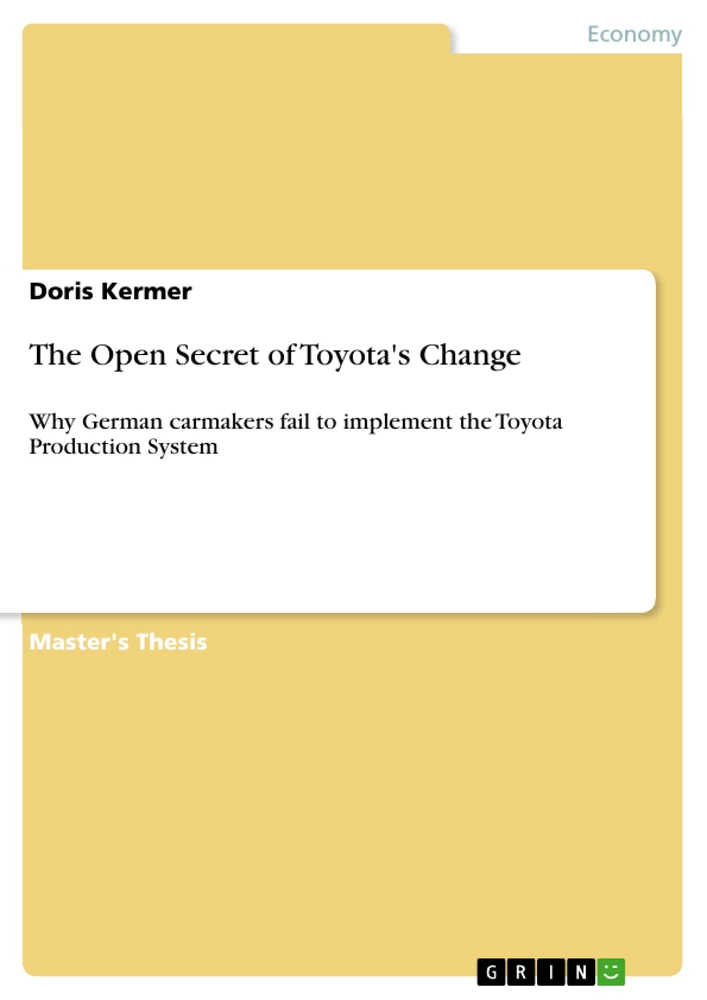
Table of Contents
1 Introduction
1.1 Background
1.2 Problem definition
1.3 Objective
1.4 Methodology
1.5 Determination leads to longlasting success
1.6 Preliminary results
1.7 Directed backing information
1.8 Utility analysis
2 Results and Conclusion
3 Outlook
Research Objectives and Themes
This master thesis investigates why, despite the widespread availability and known benefits of the Toyota Production System (TPS), many German automobile manufacturers struggle to achieve the same level of operational success as Toyota. The study seeks to uncover whether the elusive "open secret" of Toyota's performance lies beyond technical implementation and is instead deeply rooted in intangible aspects of corporate culture and human-centric management.
- Analysis of the Toyota Production System (TPS) as a technical vs. cultural paradigm.
- Evaluation of German automotive production practices compared to lean principles.
- Examination of corporate culture as the "missing link" in successful lean implementations.
- Assessment of the role of human-centric values in sustaining long-term competitiveness.
- Utility analysis of management commitment to value-added processes and transparency.
Excerpt from the Book
1.1 Background
This Master thesis explores the organisational change, as performed by Toyota after World War II which, within decades, made this company the most successful automobile producer in the world and a model of corporate governance.
Forced by historic circumstances, Toyota, which started as a company producing automated looms, underwent a dramatic and sweeping revolution, which finally made it number two of the most successful car manufacturers in the world regarding sales volume.
Following World War II, Japan could not afford mass production as was commonly in place elsewhere. A tiny domestic market that demanded for a wide range of vehicles, new labour laws introduced by the Americans that strenghthened the workers’ negotiation position, a post-war economy that was starved for capital and foreign exchange (and thus offered no way of acquiring expensive machinery for mass production), and pressure from huge foreign motor vehicle producers who wanted to defend their markets against Japanese exports made a new way to satisfy the Japanese domestic market inevitable.
Summary of Chapters
1 Introduction: Provides the historical context of Toyota's rise, defines the central research problem regarding why other manufacturers struggle to replicate TPS success, and outlines the methodology for the thesis.
2 Results and Conclusion: Synthesizes the findings from the literature review and utility analysis, concluding that corporate culture and the "Toyota way" are the decisive factors in their sustained competitive advantage.
3 Outlook: Discusses the future of the automotive industry, suggests paths for German carmakers to evolve their corporate cultures, and reflects on the human being as the most important resource.
Keywords
Toyota Production System, TPS, Lean Production, Corporate Culture, Automotive Industry, Value Added, Kaizen, Just-in-Time, Human Resources, Management Strategy, Operational Excellence, Organizational Change, Competitiveness, Worker Participation, Process Optimization.
Frequently Asked Questions
What is the core subject of this master thesis?
The thesis explores the organizational and cultural reasons behind Toyota's global dominance in the automotive industry and why German car manufacturers face difficulties in successfully implementing the Toyota Production System.
What are the central thematic fields covered?
The study centers on lean management, corporate culture, employee participation, supply chain dynamics, and the contrast between technical process implementation and cultural values.
What is the primary research objective?
The main objective is to identify the "open secret"—the hidden or overlooked aspects of TPS—that explains why Toyota consistently outperforms its competitors despite the system's public availability.
Which scientific methodology is applied?
A deductive approach is used, involving an initial literature review to form hypotheses, followed by the development of a questionnaire for industry experts and a utility analysis to evaluate production system implementation.
What topics are discussed in the main part of the thesis?
The main part covers the background of TPS, the importance of continuous improvement (Kaizen), the role of transparency, the critical necessity of employee participation, and the distinction between technical tools and a foundational corporate philosophy.
Which keywords characterize this work?
Key terms include Toyota Production System (TPS), Lean Production, Corporate Culture, Value Added, Kaizen, Just-in-Time, and Human-centric Management.
Why do German companies often fail to achieve Toyota-like results?
According to the thesis, German companies often focus solely on the "technical" side of TPS as a set of instruments, failing to adopt the underlying philosophical values and the specific corporate culture that prioritizes people and sustainable trust.
What role does the "Toyota Way" play in this context?
The "Toyota Way" is identified as an ethically governed philosophy that prioritizes long-term sustainable growth and mutual trust, which serves as the nervous system for the organization and distinguishes it from mass production models.
Ende der Leseprobe aus 50 Seiten
- nach oben
- Arbeit zitieren
- M. A., MBA Doris Kermer (Autor:in), 2006, The Open Secret of Toyota's Change, München, Page::Imprint:: GRINVerlagOHG, https://www.diplomarbeiten24.de/document/83057

neugierig - aktuell - relevant
Entdecken Sie hilfreiche Tipps und Tricks rund ums Studium!

Entdecken Sie hilfreiche Tipps und Tricks rund ums Studium!
Ihre Hausarbeit / Abschlussarbeit:

- - Publikation als E-Book und Buch
- - Hohes Honorar auf die Verkäufe
- - Für Sie komplett kostenlos - mit ISBN
- - Es dauert nur 5 Minuten
- - Jede Arbeit findet Leser

- © GRIN Publishing GmbH.
- Alle Inhalte urheberrechtlich geschützt. Kopieren und verbreiten untersagt.
- info@grin.com
- AGB
- Open Publishing
Der GRIN Verlag hat sich seit 1998 auf die Veröffentlichung akademischer eBooks und Bücher spezialisiert. Der GRIN Verlag steht damit als erstes Unternehmen für User Generated Quality Content. Die Verlagsseiten GRIN.com, Hausarbeiten.de und Diplomarbeiten24 bieten für Hochschullehrer, Absolventen und Studenten die ideale Plattform, wissenschaftliche Texte wie Hausarbeiten, Referate, Bachelorarbeiten, Masterarbeiten, Diplomarbeiten, Dissertationen und wissenschaftliche Aufsätze einem breiten Publikum zu präsentieren.
Kostenfreie Veröffentlichung: Hausarbeit, Bachelorarbeit, Diplomarbeit, Dissertation, Masterarbeit, Interpretation oder Referat jetzt veröffentlichen!
Folgen Sie GRIN auf


- GRIN Verlag GmbH
-
- Nymphenburger Str. 86
- 80636
- Munich, Deutschland
- +49 89-550559-0
- +49 89-550559-10
- info@grin.com
-
