
präsentiert von

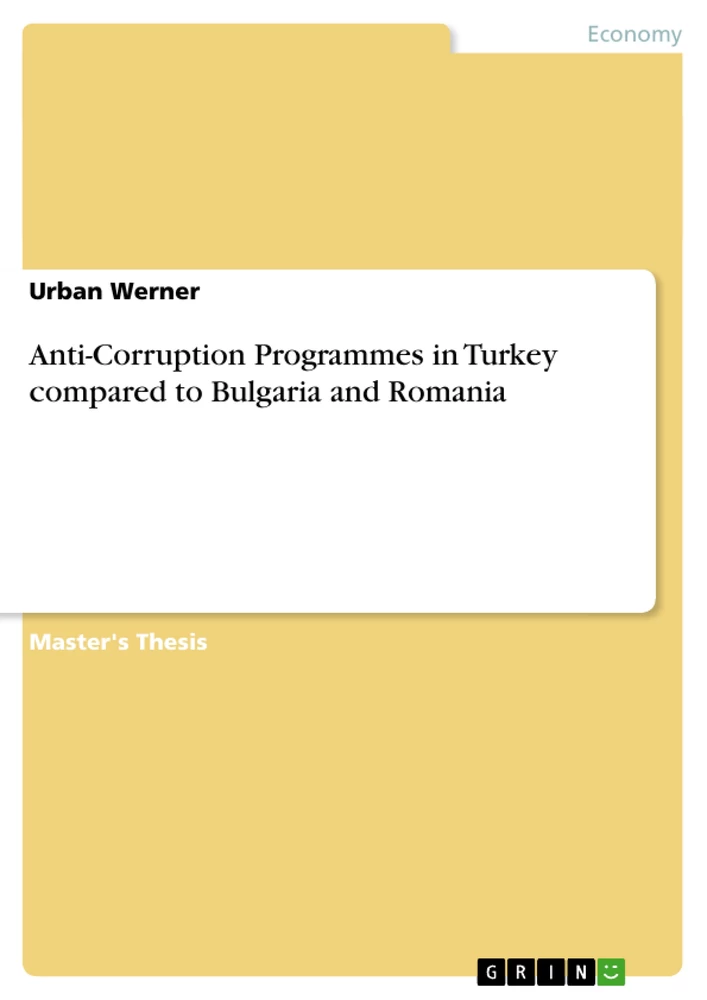
Table of Contents
1 Introduction
2 Corruption Theory
2.1 DEFINITION AND NATURE
2.2 SCOPE AND FORMS OF CORRUPTION
2.3 IS CORRUPTION MEASURABLE?
2.4 CAUSES
2.5 COSTS
2.6 IS CORRUPTION ALWAYS BAD?
3 Anti-Corruption Programmes
3.1 REQUIREMENTS
3.2 TYPES
3.3 COMBATING CORRUPTION IN BULGARIA
3.3.1 EXTENT OF CORRUPTION
3.3.2 COUNTRY-SPECIFIC CAUSES
3.3.3 REFORM PROGRAMMES
3.3.4 PLAYERS AND INVOLVEMENT
3.3.5 OBSTACLES, WEAKNESSES AND FUTURE CHALLENGES
3.4 COMBATING CORRUPTION IN ROMANIA
3.4.1 EXTENT OF CORRUPTION
3.4.2 COUNTRY-SPECIFIC CAUSES
3.4.3 REFORM PROGRAMMES
3.4.4 PLAYERS AND INVOLVEMENT
3.4.5 Obstacles, Weaknesses and Future Challenges
3.5 COMBATING CORRUPTION IN TURKEY
3.5.1 EXTENT OF CORRUPTION
3.5.2 COUNTRY SPECIFIC CAUSES
3.5.3 REFORM PROGRAMMES
3.5.4 PLAYERS AND INVOLVEMENT
3.5.5 OBSTACLES, WEAKNESSES AND FUTURE CHALLENGES
4 Can Turkey learn from Bulgaria and Romania?
4.1 THE QUESTION OF COMPARABILITY
4.1.1 IS THE SITUATION COMPARABLE?
4.1.2 ARE THE PROGRAMMES COMPARABLE?
4.2 DIFFERENCES AND LEARNING EFFECTS
4.3 WHAT IS THE BEST STRATEGY FOR REFORM PROGRAMMES IN TURKEY?
5 Conclusion
Objectives and Topics
The main question of this thesis is whether Turkey can learn from the anti-corruption efforts of Bulgaria and Romania, given that all three are in the process of EU accession. The research analyzes whether the situational and programmatic contexts of these countries are comparable enough to derive lessons that could inform a suitable anti-corruption strategy for Turkey.
- Theoretical foundations of corruption, including its definition, causes, and costs.
- Comparative analysis of national anti-corruption strategies in Bulgaria, Romania, and Turkey.
- Assessment of the role of political leadership, civil society, and international organizations in anti-corruption efforts.
- Evaluation of reform implementation, institutional frameworks, and challenges in the three countries.
- Identification of best practices and potential learning effects for Turkish anti-corruption policy.
Excerpt from the Book
2.1 DEFINITION AND NATURE
Corruption is commonly defined as the use (or abuse) of public office for private gain. By defining the notion closer, we find that it is an illegal action between at least one public employee and at least one non-public player. An important pre-condition is that the official holds a high position which gives him discretionary power and thus a monopoly in economic terms. A corrupt transaction can be regarded as a trade which occurs voluntarily or by using force and is agreed by the at least two involved players. The transaction bears high risks for both players.
A monetary or similar gain from this illegal behavior has to be weighed with certain factors like the moral/psychological fear of getting caught, losing the position or job, etc. Corruption is often reduced to bribery, but this ignores theft of public resources. These resources can be diminished, for instance, by a public official who unrightfully claims that he is sick or by a minister’s use of state owned airplanes for reaching his holiday domicile. The number of potential players in this trade is limited due to moral market entry barriers, which construes a subjective criterion in order to initiate a trade. Furthermore, the public official has to possess a tradable asset as an objective criterion and the counterpart has to be equipped with sufficient return. The clandestine process and the relatively low number of potential players results in huge costs in order to find an appropriate counterpart if it is a single transaction. The involved parties are furthermore deterred by controls inside the organization which leads to a principal-agent problem. Corruption markets tend towards bilateral monopolies due to the fear of being discovered.
Summary of Chapters
1 Introduction: Introduces the study's timeframe (mid-90s to 2005) and the core objective of assessing whether Turkey can learn from the anti-corruption experiences of Bulgaria and Romania.
2 Corruption Theory: Establishes the theoretical framework, defining corruption, its forms (bribery, embezzlement, etc.), causes, and economic costs, while questioning whether corruption can ever be beneficial.
3 Anti-Corruption Programmes: Provides an overview of anti-corruption requirements and types, followed by detailed, separate analyses of the corruption landscape and reform efforts in Bulgaria, Romania, and Turkey.
4 Can Turkey learn from Bulgaria and Romania?: Examines the comparability of the three countries' situations and programs, identifies differences and learning effects, and proposes a strategic approach for Turkey.
5 Conclusion: Summarizes the findings, affirming that Turkey can indeed learn from its counterparts, particularly regarding the need for an overall, long-term, and sustained anti-corruption strategy.
Keywords
Corruption, Anti-Corruption, Turkey, Bulgaria, Romania, EU Accession, Public Sector, Reform Programmes, Bribery, Embezzlement, Political Commitment, Civil Society, Transparency, Institution Building, Governance
Frequently Asked Questions
What is the central research question of this study?
The core question is whether Turkey can draw lessons from the anti-corruption efforts of Bulgaria and Romania to improve its own strategies, assuming that a general comparability between the three nations can be established.
What are the primary thematic areas covered?
The work covers the theory of corruption, specific national anti-corruption programs, the influence of EU and NATO accession processes, and the comparative analysis of political, economic, and institutional factors in the three countries.
Which scientific methodology is used?
The methodology is primarily based on a programmatic comparison. This involves analyzing national perspectives—including the extent of corruption, causes, key players, and specific obstacles—to gain a comprehensive picture before addressing the overall research question in a final synthesis.
What is the main argument regarding Turkey's reform strategy?
The study argues that Turkey currently lacks a cohesive, long-term anti-corruption strategy, relying instead on piecemeal legislative reforms. It suggests adopting a more holistic approach, similar to the "omnibus" strategies seen in Bulgaria and Romania, involving political consensus and independent oversight bodies.
How is corruption defined in the context of this thesis?
Corruption is defined as the use, or abuse, of public office for private gain, characterized as an illegal transaction between at least one public employee and at least one non-public player, typically involving the abuse of discretionary power.
What is the "grease-the-wheels" argument discussed in the book?
It is the argument that bribery can potentially act as an efficient tool to bypass burdensome regulations and ineffective legal codes in countries with poor regulatory environments, though the author notes that this view is contested and often leads to further corruption.
How does parliamentary immunity affect anti-corruption efforts in Turkey?
Parliamentary immunity is identified as a major obstacle to "frying big fishes," as it protects high-level officials and ministers from prosecution, thereby undermining the credibility of the government's anti-corruption claims and allowing alleged corrupt acts to remain uninvestigated.
What role does the EU play in the anti-corruption efforts of these countries?
The EU acts as a primary driving force through its accession requirements. By assessing progress in regular reports, it sets benchmarks and demands transparency and institutional reforms, which significantly accelerate the implementation of anti-corruption measures in candidate countries.
Ende der Leseprobe aus 108 Seiten
- nach oben
- Arbeit zitieren
- Urban Werner (Autor:in), 2005, Anti-Corruption Programmes in Turkey compared to Bulgaria and Romania, München, Page::Imprint:: GRINVerlagOHG, https://www.diplomarbeiten24.de/document/83180

neugierig - aktuell - relevant
Entdecken Sie hilfreiche Tipps und Tricks rund ums Studium!

Entdecken Sie hilfreiche Tipps und Tricks rund ums Studium!
Ihre Hausarbeit / Abschlussarbeit:

- - Publikation als E-Book und Buch
- - Hohes Honorar auf die Verkäufe
- - Für Sie komplett kostenlos - mit ISBN
- - Es dauert nur 5 Minuten
- - Jede Arbeit findet Leser

- © GRIN Publishing GmbH.
- Alle Inhalte urheberrechtlich geschützt. Kopieren und verbreiten untersagt.
- info@grin.com
- AGB
- Open Publishing
Der GRIN Verlag hat sich seit 1998 auf die Veröffentlichung akademischer eBooks und Bücher spezialisiert. Der GRIN Verlag steht damit als erstes Unternehmen für User Generated Quality Content. Die Verlagsseiten GRIN.com, Hausarbeiten.de und Diplomarbeiten24 bieten für Hochschullehrer, Absolventen und Studenten die ideale Plattform, wissenschaftliche Texte wie Hausarbeiten, Referate, Bachelorarbeiten, Masterarbeiten, Diplomarbeiten, Dissertationen und wissenschaftliche Aufsätze einem breiten Publikum zu präsentieren.
Kostenfreie Veröffentlichung: Hausarbeit, Bachelorarbeit, Diplomarbeit, Dissertation, Masterarbeit, Interpretation oder Referat jetzt veröffentlichen!
Folgen Sie GRIN auf


- GRIN Verlag GmbH
-
- Nymphenburger Str. 86
- 80636
- Munich, Deutschland
- +49 89-550559-0
- +49 89-550559-10
- info@grin.com
-
