
präsentiert von

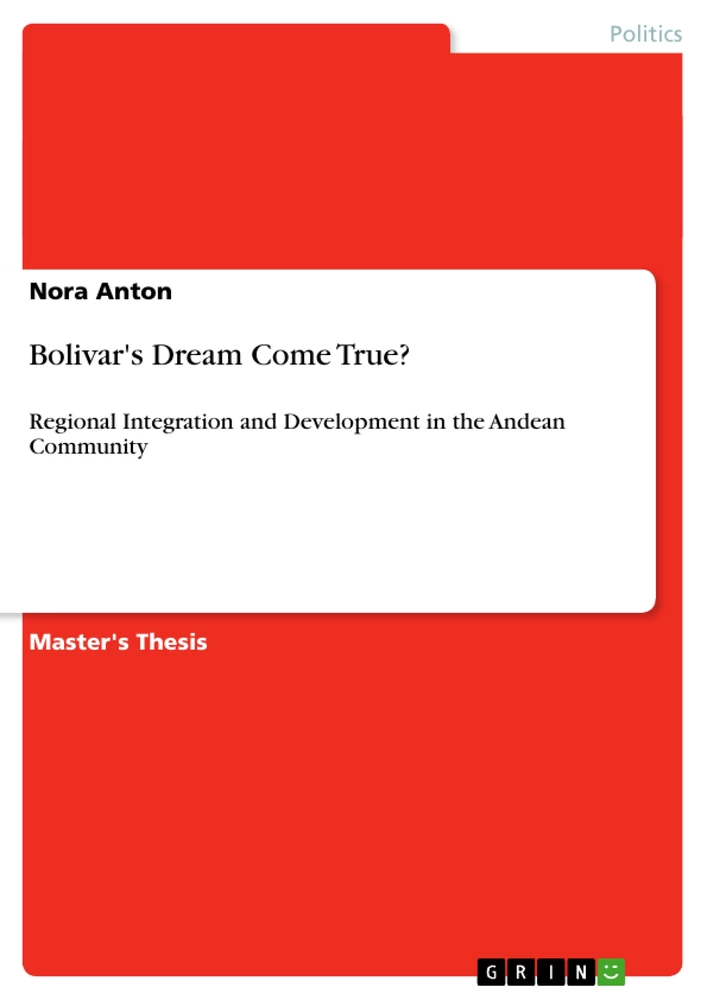
Table of Contents
Chapter 1 - Introduction
1.1 INTRODUCTION
1.2 PREVIOUS RESEARCH
1.3 METHODOLOGY
Chapter 2 - Concepts, Explanations and Consequences of Regional Integration and a Theorisation of the Treaty of Cartagena
2.1 THEORIES OF REGIONAL INTEGRATION
2.1.1 Some Remarks about International Co-operation
2.1.2 Political Integration Theory
2.1.2.1 Intergovernmentalism
2.1.2.2 Neofunctionalism
2.1.3 Economic and Social Effects of Integration
2.1.3.1 Classical Trade Theory
2.1.3.2 Convergence or Divergence?
2.1.3.3 South-South Integration and Development
2.1.3.4 The Relation between Economic and Social Development
2.2 A THEORISATION OF THE CARTAGENA AGREEMENT
2.3 SUBCONCLUSION
Chapter 3 - The Andean Community
3.1 THE REGION
3.2 HISTORY AND ACHIEVEMENTS OF ANDEAN INTEGRATION
3.3 THE INSTITUTIONAL STRUCTURE OF THE ANDEAN COMMUNITY
3.4 SUBCONCLUSION
Chapter 4 - Integration and Economic Development in the CAN
4.1. CONDITIONS FOR EXPORT-ORIENTED ECONOMIC DEVELOPMENT IN THE CAN
4.2. THE REMAINING PROBLEMS
4.2.1 Economic barriers
4.2.2 Political Barriers
4.2.3 Physical Barriers
4.3 THE RESULTS: DEVELOPMENT OF CROSS-BORDER TRADE AND INVESTMENT IN THE CAN
4.3.1 Integration and Trade
4.3.1.1 Static Effects
4.3.1.2 Dynamic Effects
4.3.2 Integration and Investment
4.4 POLITICAL PARTICIPATION OF THE PRIVATE SECTOR IN THE CAN
4.5 SUBCONCLUSION
Chapter 5 - Integration and Social Development
5.1 THE SOCIO-ECONOMIC SITUATION IN THE ANDEAN STATES
5.2 THE SOCIAL EFFECTS OF INTEGRATION – CONVERGENCE OR DIVERGENCE?
5.3 NATIONAL AND SUPRANATIONAL SOCIAL AND REGIONAL POLICY
5.3.1 Policies in the Member States
5.3.2 Supranational Policies
5.4 CIVIL SOCIETY AND THE CAN
5.5 SUBCONCLUSION
Chapter 6 - Conclusion
Research Objective and Core Topics
This thesis examines the effectiveness of the Andean Community (CAN) as a project for regional integration, specifically evaluating why the process has faced significant obstacles and often been perceived as a failure. It explores the relationship between regional integration, economic growth, and social development, questioning whether the institutional framework—modelled on European structures—is suitable for the Andean socio-economic context.
- Integration theories, particularly Neofunctionalism and its applicability to developing nations.
- The logic of the Cartagena Agreement and its intended path from economic to social development.
- Economic outcomes including trade creation, FDI, and infrastructure limitations.
- The political role of the private sector and civil society within the Andean integration framework.
- The persistent impact of poverty, socio-economic inequality, and political instability on the integration process.
Excerpt from the Book
2.1.2 Political Integration Theory
Regional integration can be seen as a type of international institution in the sense that countries opt for co-operation, jointly dealing with problems which concern them all. However, it is obviously more than just co-operation in a given issue area.
Integration theory has been developing in close relationship with the European integration process as the first and most evolved “specimen” of regional integration schemes, evolved to such an extent that is pictured as a phenomenon sui generis by most authors (n=1 problem). During the history of integration, diverse approaches of conceptualising the EU have appeared. The first ones, developed from the 1960s onwards, focus on explaining integration outcomes. A second broad stream of integration which came up in the 1980s in the context of a deepening of integration focused more on the analysis of governance.
Summary of Chapters
Chapter 1 - Introduction: Defines the scope of the thesis and the definition of "success" regarding the Andean Community, introducing Neofunctionalism as the theoretical framework.
Chapter 2 - Concepts, Explanations and Consequences of Regional Integration and a Theorisation of the Treaty of Cartagena: Reviews major integration theories and proposes a model of how the Cartagena Agreement aims to link economic and social development.
Chapter 3 - The Andean Community: Provides an overview of the member states, their geographical and socio-economic challenges, and the institutional structure of the Andean integration system.
Chapter 4 - Integration and Economic Development in the CAN: Analyzes the impact of the integration project on trade and FDI, highlighting the role and constraints of the private sector.
Chapter 5 - Integration and Social Development: Evaluates the causal link between regional integration and social improvements, examining if policies have effectively addressed widespread poverty and inequality.
Chapter 6 - Conclusion: Synthesizes the findings, confirming that the Andean Community struggles due to structural socio-economic barriers and a lack of the "demand" condition required for successful regional integration.
Keywords
Andean Community, Regional Integration, Neofunctionalism, Cartagena Agreement, Economic Development, Social Development, FDI, Trade Liberalisation, Civil Society, Poverty, Inequality, Institutional Framework, Political Stability, Intra-regional Trade, Sustainable Development
Frequently Asked Questions
What is the core focus of this Master Thesis?
The thesis explores the reasons behind the perceived failure and the limited success of the Andean Community's regional integration project since its inception in 1969.
What are the primary themes discussed?
The core themes include the application of integration theories to developing nations, the role of economic development in facilitating integration, and the socio-economic impacts on the population.
What is the main research question of this study?
The study asks why the Andean integration process has been slow and often labeled a failure, and how the actual results of the integration impact the potential deepening of the Community.
Which scientific methodology does the author apply?
The author applies neofunctionalist integration theory and its variants, critically evaluating whether the preconditions for such a transition are present in the Andean region.
What is covered in the main section of the document?
The main sections delve into the history of Andean integration, the economic consequences on trade and private investment, and the social effects regarding poverty and regional inequality.
Which keywords best characterize this work?
The work is defined by terms such as Andean Community, regional integration, neofunctionalism, poverty, economic development, and institutional structure.
Why did the author analyze the Cartagena Agreement specifically?
The author uses the Cartagena Agreement as a normative framework to theorize how the region intended for economic development to trigger social progress, and contrasts this model with real-world outcomes.
How does the author view the role of civil society in the Andean Community?
The author argues that civil society participation has been historically minimal and that this lack of involvement is a logical consequence of citizens failing to see tangible personal benefits from the integration process.
Ende der Leseprobe aus 101 Seiten
- nach oben
- Arbeit zitieren
- Nora Anton (Autor:in), 2006, Bolivar's Dream Come True?, München, Page::Imprint:: GRINVerlagOHG, https://www.diplomarbeiten24.de/document/85361

neugierig - aktuell - relevant
Entdecken Sie hilfreiche Tipps und Tricks rund ums Studium!

Entdecken Sie hilfreiche Tipps und Tricks rund ums Studium!
Ihre Hausarbeit / Abschlussarbeit:

- - Publikation als E-Book und Buch
- - Hohes Honorar auf die Verkäufe
- - Für Sie komplett kostenlos - mit ISBN
- - Es dauert nur 5 Minuten
- - Jede Arbeit findet Leser

- © GRIN Publishing GmbH.
- Alle Inhalte urheberrechtlich geschützt. Kopieren und verbreiten untersagt.
- info@grin.com
- AGB
- Open Publishing
Der GRIN Verlag hat sich seit 1998 auf die Veröffentlichung akademischer eBooks und Bücher spezialisiert. Der GRIN Verlag steht damit als erstes Unternehmen für User Generated Quality Content. Die Verlagsseiten GRIN.com, Hausarbeiten.de und Diplomarbeiten24 bieten für Hochschullehrer, Absolventen und Studenten die ideale Plattform, wissenschaftliche Texte wie Hausarbeiten, Referate, Bachelorarbeiten, Masterarbeiten, Diplomarbeiten, Dissertationen und wissenschaftliche Aufsätze einem breiten Publikum zu präsentieren.
Kostenfreie Veröffentlichung: Hausarbeit, Bachelorarbeit, Diplomarbeit, Dissertation, Masterarbeit, Interpretation oder Referat jetzt veröffentlichen!
Folgen Sie GRIN auf


- GRIN Verlag GmbH
-
- Nymphenburger Str. 86
- 80636
- Munich, Deutschland
- +49 89-550559-0
- +49 89-550559-10
- info@grin.com
-
