
präsentiert von

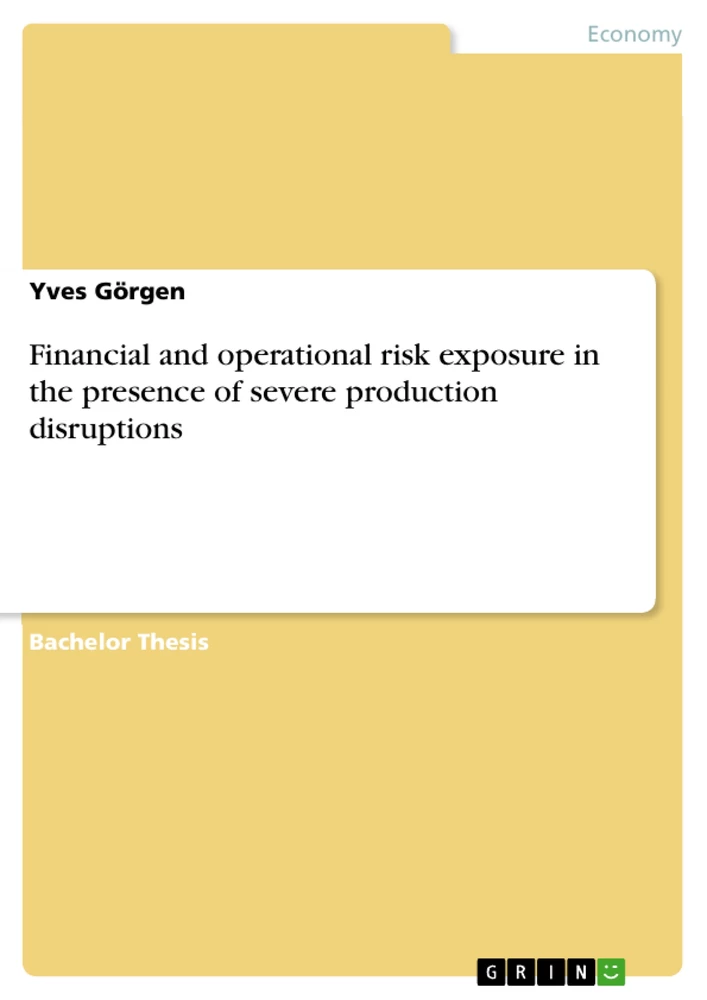
Table of Contents
1 Introduction
2 Background and Review of Related Literature
2.1 The Importance of Inventories
2.2 Overview of Supply chain Disruptions
2.3 Assessing the Impact of Supply chain Disruptions
2.4 Managing and Mitigating Supply chain Disruptions
3 Case study: An Aseptic Production process of a Pharma-ceutical company
4 Methodology
4.1 Description of the Base Model
4.2 Simulation Methodology and Production Disruption measures
5 Analysis and Results
5.1 Illustration of the Risk Exposure
5.2 Sensitivity Analysis
5.3 Risk Management Strategies based on different Scenarios
6 Conclusion and Outlook
6.1 Conclusion and Discussion of the Results
6.2 Limitations and Outlook for further Research
Objectives and Research Themes
This thesis investigates the financial and operational consequences of severe production disruptions within a pharmaceutical supply chain, specifically focusing on a high-margin product over its market cycle. The core research objective is to quantify these risks using Monte Carlo simulation and to evaluate how different inventory policies and risk management strategies—tailored to various risk preferences—can mitigate potential performance losses and protect against downside risks.
- Quantification of operational and financial performance impacts under stochastic production disruptions.
- Evaluation of safety stock policies as a proactive mitigation strategy against supply chain volatility.
- Integration of risk-averse decision-making models into supply chain inventory management.
- Simulation of long-term demand consequences resulting from service level degradation during disruption periods.
- Scenario-based sensitivity analysis to identify robust inventory strategies across varying disruption intensities.
Auszug aus dem Buch
1 Introduction
In 2011, the nuclear crisis in Japan, caused by the earthquake and tsunami, leading to a production drop at Toyota by 40,000 vehicles, and costing the company $72 million in profits per day (Pettit, Croxton, & Fiksel, 2013). Just recently, in September 2019, the United Auto Workers’ 40-day strike caused in General Motor’s plants in Mexico and Canada temporary shutdowns and consequently, a loss of about 300,000 units in production. The strike is expected to cost the firm up to $4 billion in 2019, and also its suppliers will be significantly affected (Wayland, 2019). These are just two examples illustrating which tremendous impact supply chain disruptions can have on a firm’s operational and financial performance. Empirical research by Hendrick and Singhal (2003; 2005a; 2005b) has demonstrated that even small disruptions can have a negative and often long-term effect on sales growth, stock price performance, and shareholder wealth. Consequently, supply chain disruptions constitute a substantial risk for corporations.
However, history has demonstrated that firms can effectively manage supply chain risks and mitigate the impact of disruptions enormously. A famous example is the case of the telecommunication equipment manufacturers Ericsson and Nokia during the beginning of the 21st century. In March 2000, a fire destroyed parts of the production line at a semiconductor plant in Albuquerque, New Mexico (USA), of Philips Electronics, a supplier of significant importance for both firms. While Nokia was able to mitigate the consequences by temporally switching production to alternative plants and suppliers, Ericsson incurred lost sales of $ 400 M (Latour, 2001).
Summary of Chapters
1 Introduction: This chapter highlights the significance of supply chain disruptions for corporate performance and outlines the motivation, research objectives, and structure of the thesis.
2 Background and Review of Related Literature: This section provides theoretical foundations on inventory management and reviews academic literature concerning the causes, impacts, and mitigation strategies for supply chain disruptions.
3 Case study: An Aseptic Production process of a Pharma-ceutical company: The chapter describes the practical scenario of a pharmaceutical firm producing a high-margin aerosol, detailing the specific production process, contamination risks, and regulatory requirements.
4 Methodology: This section explains the periodic-review inventory model used as the base and details the simulation methodology employed to model production disruptions and evaluate performance.
5 Analysis and Results: This chapter presents the simulation findings, illustrating risk exposures and performing sensitivity analyses to evaluate the effectiveness of various inventory strategies across different scenarios.
6 Conclusion and Outlook: The final chapter summarizes the research findings regarding optimal inventory policies for risk-averse firms and suggests avenues for future research, including potential improvements to the model assumptions.
Keywords
Supply Chain Disruptions, Monte Carlo Simulation, Risk Management, Safety Stock, Inventory Policy, Pharmaceutical Industry, Operational Risk, Financial Performance, Value at Risk, Service Level, Lead Time, Stochastic Modeling, Mitigation Strategies, Periodic Review Model, Downside Risk.
Frequently Asked Questions
What is the primary focus of this research?
This thesis examines the financial and operational impact of severe production disruptions on a high-margin pharmaceutical product over its entire market cycle.
Which central topics are addressed in the study?
Key topics include supply chain vulnerability, the importance of inventory buffers, stochastic disruption modeling, and the trade-off between lean operations and risk mitigation.
What is the main research objective?
The goal is to quantify financial and operational risk exposure and to identify optimal inventory strategies that protect the firm against severe disruption scenarios.
Which methodology is employed to reach the findings?
The study utilizes a periodic-review inventory model combined with Monte Carlo simulation (MCS) to analyze performance under varying disruption probabilities and durations.
What does the main body cover?
It covers a detailed case study of an aseptic pharmaceutical production process, the development of a simulation model, scenario-based analysis, and the testing of inventory-based mitigation tactics.
Which keywords characterize this thesis?
The work is characterized by terms such as Supply Chain Disruptions, Monte Carlo Simulation, Inventory Policy, Value at Risk, and Risk Mitigation.
How does the pharmaceutical production process contribute to the risk profile of the case study?
The process involves strict aseptic requirements where positive "media-fill" test results lead to significant production halts, causing immediate production loss and long-term negative effects on demand due to customer switching.
Does a single optimal inventory policy exist for all situations?
No, the study concludes that there is no one-size-fits-all inventory policy; the optimal strategy is highly dependent on specific disruption parameters, product characteristics, and the risk preference of the decision-maker.
Why are conservative inventory policies often advantageous for the studied product?
Given the high contribution margin of the product relative to inventory holding costs, conservative policies (higher safety stocks) effectively mitigate downside risks with minimal negative impact on expected profits.
Ende der Leseprobe aus 38 Seiten
- nach oben
- Arbeit zitieren
- Yves Görgen (Autor:in), 2020, Financial and operational risk exposure in the presence of severe production disruptions, München, Page::Imprint:: GRINVerlagOHG, https://www.diplomarbeiten24.de/document/888726

neugierig - aktuell - relevant
Entdecken Sie hilfreiche Tipps und Tricks rund ums Studium!

Entdecken Sie hilfreiche Tipps und Tricks rund ums Studium!
Ihre Hausarbeit / Abschlussarbeit:

- - Publikation als E-Book und Buch
- - Hohes Honorar auf die Verkäufe
- - Für Sie komplett kostenlos - mit ISBN
- - Es dauert nur 5 Minuten
- - Jede Arbeit findet Leser

- © GRIN Publishing GmbH.
- Alle Inhalte urheberrechtlich geschützt. Kopieren und verbreiten untersagt.
- info@grin.com
- AGB
- Open Publishing
Der GRIN Verlag hat sich seit 1998 auf die Veröffentlichung akademischer eBooks und Bücher spezialisiert. Der GRIN Verlag steht damit als erstes Unternehmen für User Generated Quality Content. Die Verlagsseiten GRIN.com, Hausarbeiten.de und Diplomarbeiten24 bieten für Hochschullehrer, Absolventen und Studenten die ideale Plattform, wissenschaftliche Texte wie Hausarbeiten, Referate, Bachelorarbeiten, Masterarbeiten, Diplomarbeiten, Dissertationen und wissenschaftliche Aufsätze einem breiten Publikum zu präsentieren.
Kostenfreie Veröffentlichung: Hausarbeit, Bachelorarbeit, Diplomarbeit, Dissertation, Masterarbeit, Interpretation oder Referat jetzt veröffentlichen!
Folgen Sie GRIN auf


- GRIN Verlag GmbH
-
- Nymphenburger Str. 86
- 80636
- Munich, Deutschland
- +49 89-550559-0
- +49 89-550559-10
- info@grin.com
-
