
präsentiert von

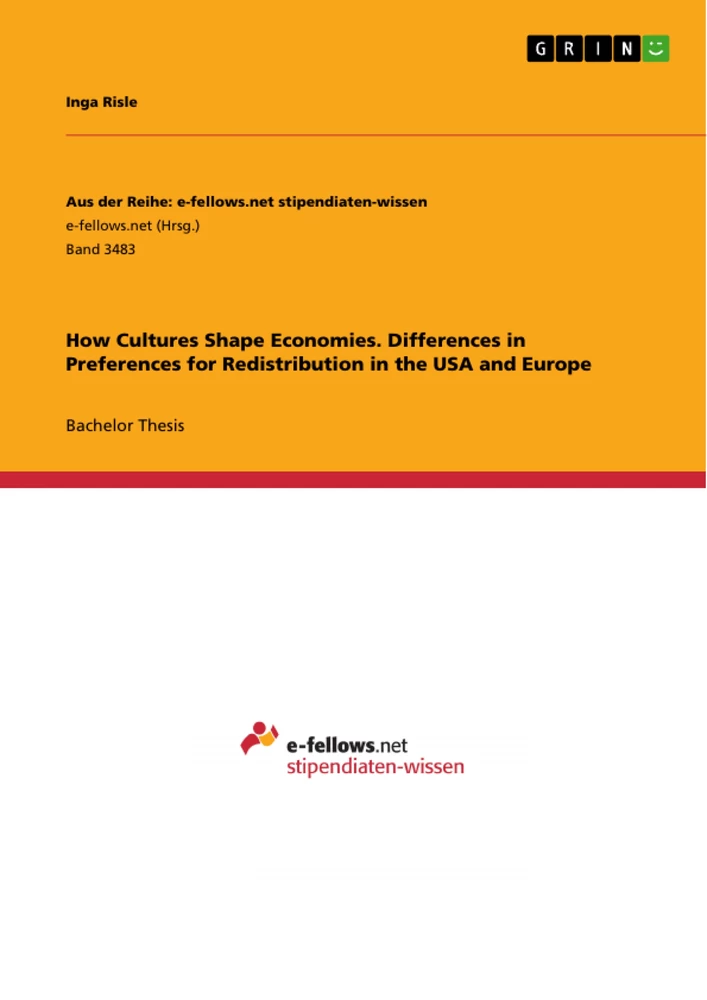
Table of Contents
1. Introduction
2. Key Terminology of Distributive Justice and Equality
2.1 Distributive Justice
2.2 Fairness: Equality Versus Inequality
3. Culture
3.1. Definition of Culture
3.2. American Cultural Concepts
4. Alesina, A. and G.M. Angeletos: Fairness and Redistribution
5. Alesina, A. et al.: Why Doesn’t the United States Have a European-Style Welfare State?
6. Almås, I. et al.: Cutthroat Capitalism versus Cuddly Socialism: Are Americans More Meritocratic and Efficiency-Seeking than Scandinavians?
7. Conclusion
Research Objectives & Key Themes
The primary objective of this thesis is to examine how cultural imprints and values influence individual preferences for economic redistribution, specifically contrasting the USA and Europe. The study explores whether differences in social beliefs and cultural concepts can explain why the demand for redistribution remains markedly lower in the United States compared to most European nations.
- The role of cultural values in shaping distributive justice preferences.
- The impact of "American Exceptionalism" and the "American Dream" on self-reliance and meritocratic beliefs.
- Theoretical and experimental analysis of fairness views (egalitarian, meritocratic, libertarian).
- The connection between beliefs about income mobility and the perceived necessity of redistribution.
- The "Robin Hood paradox" and the influence of political institutions on redistributive policies.
Excerpt from the Book
3.1. Definition of Culture
The term culture is a very broad one that, at least colloquially, conveys a multitude of meanings ranging from agricultural terminology to Fine Arts to differences in lifestyles. Generally, there is the idea that culture is what differentiates humans from animals, which can already be observed in the Latin origins of the word. The verb colo, colui, cultus can be translated as “to cultivate” as well as “to worship” which evidently are two very distinct meanings that, however, both describe activities that are typical for humans. Humans cultivate their land and believe in Gods, performing religious rituals which, to our knowledge, animals do not. On the basis of this very simple definition, that culture stands in contrast to nature and can only be possessed by humankind with consciousness of their own doing and rationality, there are many approaches to an academic definition of the term.
Hansen describes culture as collective customs that result in standardisation of acting, thinking and feeling. This means that within a certain culture people share beliefs and perceive situations the same way, which will, in turn, influence their thinking, their values and thus their preferences. This standardisation happens automatically during a person’s socialisation when she internalises the culture surrounding her and adapts to this culture by imitating it. National culture, which is what will be examined in this paper, is not the only way to differentiate cultures, but it is possible to find distinct cultures belonging to certain nationalities and these tend to be fairly stable within the borders of their territory. Thus, it is possible to talk about American culture in contrast to European culture.
Summary of Chapters
1. Introduction: Presents the research question regarding the divergence in redistributive preferences between the USA and Europe, highlighting the role of cultural characteristics.
2. Key Terminology of Distributive Justice and Equality: Defines core concepts of justice, fairness, and the historical shift in perceptions of poverty and inequality.
3. Culture: Provides a theoretical framework for culture using definitions by Hansen, Hofstede, and Williams, and examines specific American cultural concepts.
4. Alesina, A. and G.M. Angeletos: Fairness and Redistribution: Analyzes the theoretical model linking income composition, luck, and tax rates to the demand for redistribution.
5. Alesina, A. et al.: Why Doesn’t the United States Have a European-Style Welfare State?: Discusses additional factors like income mobility, altruism, and political representation in the context of the welfare state.
6. Almås, I. et al.: Cutthroat Capitalism versus Cuddly Socialism: Are Americans More Meritocratic and Efficiency-Seeking than Scandinavians?: Evaluates an experimental study comparing American and Norwegian social preferences.
7. Conclusion: Summarizes the findings, emphasizing that cultural imprints, fairness views, and historical developments are crucial for understanding the differences in redistributive preferences.
Keywords
Redistribution, Distributive Justice, Culture, Fairness, American Exceptionalism, Income Inequality, Welfare State, Meritocracy, Social Mobility, Individualism, Luck, Political Economy, Preferences, Altruism, Self-Reliance.
Frequently Asked Questions
What is the core focus of this thesis?
The work investigates the reasons for the significant differences in preferences for economic redistribution between the USA and Europe, specifically focusing on the influence of culture and social values.
What are the central themes discussed in the paper?
Key themes include the definition of distributive justice, the role of cultural narratives like the "American Dream," the impact of fairness views on policy support, and the divergence in income inequality.
What is the primary research question?
The paper asks how cultural imprints can explain the observable differences in redistributive preferences, given that historical and cultural backgrounds significantly shape individual social beliefs.
Which scientific methods are utilized?
The thesis employs a combination of theoretical model analysis (such as the Meltzer-Richard model) and an evaluation of experimental social preference studies to examine how people perceive inequality.
What topics are addressed in the main body of the text?
The main body covers the theoretical definitions of culture, the analysis of seminal research papers regarding fairness and redistribution, and an experimental comparison between the USA and Norway.
Which keywords best characterize the work?
The research is characterized by terms such as redistribution, culture, distributive justice, American Exceptionalism, and fairness views.
How does the author define the "Robin Hood paradox"?
The paradox describes the empirical observation that countries with the highest levels of pre-tax inequality often redistribute the least, contrasting with simple theoretical models that suggest inequality should drive higher demand for redistribution.
Why is "luck" a crucial factor in this analysis?
Luck is identified as a critical determinant of whether an individual views income inequality as "just" or "unjust." Beliefs about whether poverty stems from bad luck versus lack of effort strongly correlate with political support for redistributive measures.
What is the significance of the experiment between the USA and Norway?
The experiment demonstrates that while Americans and Norwegians may not differ significantly in their overall meritocratic leanings, their divergent fairness views (libertarian versus egalitarian) lead to different implementation of inequality.
Ende der Leseprobe aus 38 Seiten
- nach oben
- Arbeit zitieren
- Inga Risle (Autor:in), 2020, How Cultures Shape Economies. Differences in Preferences for Redistribution in the USA and Europe, München, Page::Imprint:: GRINVerlagOHG, https://www.diplomarbeiten24.de/document/902700

neugierig - aktuell - relevant
Entdecken Sie hilfreiche Tipps und Tricks rund ums Studium!

Entdecken Sie hilfreiche Tipps und Tricks rund ums Studium!
Ihre Hausarbeit / Abschlussarbeit:

- - Publikation als E-Book und Buch
- - Hohes Honorar auf die Verkäufe
- - Für Sie komplett kostenlos - mit ISBN
- - Es dauert nur 5 Minuten
- - Jede Arbeit findet Leser

- © GRIN Publishing GmbH.
- Alle Inhalte urheberrechtlich geschützt. Kopieren und verbreiten untersagt.
- info@grin.com
- AGB
- Open Publishing
Der GRIN Verlag hat sich seit 1998 auf die Veröffentlichung akademischer eBooks und Bücher spezialisiert. Der GRIN Verlag steht damit als erstes Unternehmen für User Generated Quality Content. Die Verlagsseiten GRIN.com, Hausarbeiten.de und Diplomarbeiten24 bieten für Hochschullehrer, Absolventen und Studenten die ideale Plattform, wissenschaftliche Texte wie Hausarbeiten, Referate, Bachelorarbeiten, Masterarbeiten, Diplomarbeiten, Dissertationen und wissenschaftliche Aufsätze einem breiten Publikum zu präsentieren.
Kostenfreie Veröffentlichung: Hausarbeit, Bachelorarbeit, Diplomarbeit, Dissertation, Masterarbeit, Interpretation oder Referat jetzt veröffentlichen!
Folgen Sie GRIN auf


- GRIN Verlag GmbH
-
- Nymphenburger Str. 86
- 80636
- Munich, Deutschland
- +49 89-550559-0
- +49 89-550559-10
- info@grin.com
-
