
präsentiert von

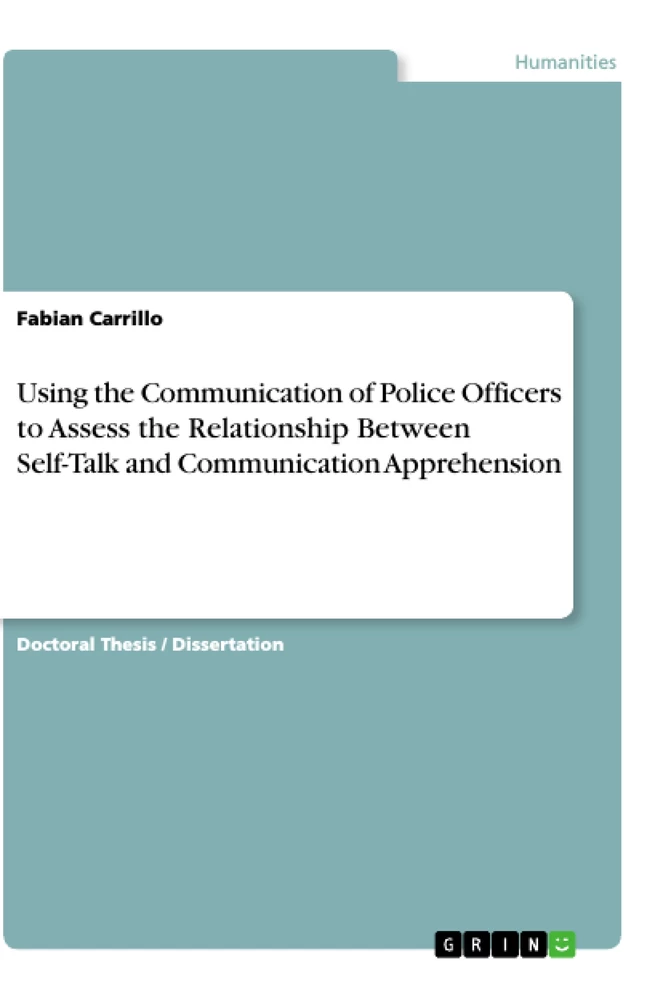
Table of Contents
Chapter 1: Introduction to the Study
Introduction
Background of the Study
Problem Statement
Purpose of This Study
Research Questions and Hypotheses
Variables of interest in this study.
Research questions and hypotheses
Answering the research questions.
Advancing Scientific Knowledge and Significance of Study
Advancing scientific knowledge.
Significance of the study.
Rationale of Methodology
Nature of the Research Design for the Study
Definitions of Terms
Assumptions, Limitations, Delimitations
Assumptions.
Limitations.
Delimitations.
Summary and Organization of the Remainder of the Study
Chapter 2: Literature Review
Introduction to the Chapter and Background to the Problem
Identification of the Gap
Theoretical Foundations.
Self-talk.
Communication apprehension
Police officer communication
Communication accommodation theory
Predictions
Research questions.
Review of the Literature
Self-talk.
What is self-talk?
Communication apprehension.
Police officer communication.
Methodologies.
Tools.
Summary
Chapter 3: Methodology
Introduction
Statement of the Problem.
Research Questions and Hypotheses
Measured variables.
Research questions and hypotheses
Answering the research questions.
Research Methodology
Research Design.
Choosing Kendall’s tau-b (τb) correlation analysis.
Not focusing on causation.
Identifying communication patterns using a correlational analysis.
Self-talk and communication apprehension and their possible relationship.
How data were collected.
Population and Sample Selection.
Population.
Sample size.
Type of sampling.
Collecting data.
Instrumentation
Self-talk scale.
The personal report of communication apprehension.
Validity
Reliability.
Data Collection and Management.
Data Analysis Procedures
Ethical Considerations
Belmont report principles.
Data management and disposal.
Limitations and Delimitations.
Limitations
Delimitations.
Summary
Chapter 4: Data Analysis and Results.
Introduction.
Descriptive Findings
Data Analysis Procedures
Results.
Results for research questions.
Summary
Chapter 5: Summary, Conclusions, and Recommendations.
Introduction and Summary of Study.
Summary of Study.
Summary of Findings and Conclusion.
Results for research question number one – i.e. RQ1.
Results for research question number two – i.e. RQ2.
Conclusion.
Implications.
Theoretical implications.
Practical implications.
Future implications.
Strengths and weaknesses of the study.
Recommendations.
Recommendations for future research.
Recommendations for future practice.
References.
Study Objectives and Core Themes
This quantitative correlational study aims to assess the relationship between self-talk and communication apprehension among police officers in a western city police department, utilizing the communication accommodation theory to understand how officers may use self-talk to manage apprehension in high-stress social interactions.
- Correlation between self-talk and overall communication apprehension.
- Correlation between self-talk and public speaking apprehension.
- Role of self-talk as a cognitive strategy for performance improvement.
- Application of communication accommodation theory in policing.
- Impact of high-stress scenarios on police officer communication.
Auszug aus dem Buch
Background of the Study
Self-talk is believed to be associated with the confidence of an individual when performing a task (Shi et al., 2015). As a phenomenon, self-talk is described as a silent or vocalized dialog with one’s own self that can be used to boost confidence and self-efficacy, maintain focus and clear distractions, and to conquer social anxiety relating to fear of communication (Shi et al., 2015). Additionally, as discussed by the work of Shi et al. (2015), self-talk can potentially have a positive individual impact in improving communication, specifically apprehension surrounding public speaking.
Communication apprehension occurs when an individual encounters social anxiety when anticipating social interactions (Shi et al., 2015). Individuals who find themselves in daily high-stress scenarios may frequently encounter communication apprehension during a social interaction as they aim to communicate effectively. To avoid social anxiety, individuals may mentally prepare to build their confidence levels to avoid negative outcomes from occurring in public arenas (Helgadottir, Menzies, Onslow, Packman, & O’Brian, 2014). Mentally preparing can be done in the form of self-talk. As a result, a significant correlation can be hypothesized to exist between self-talk and communication apprehension.
Summary of Chapters
Chapter 1: Introduction to the Study: Presents the purpose of this quantitative correlational study, which examines the relationship between self-talk and communication apprehension within a western city police department.
Chapter 2: Literature Review: Provides a comprehensive overview of existing literature on self-talk, communication apprehension, and police officer communication, while identifying current gaps in research.
Chapter 3: Methodology: Details the research design, including the use of Kendall’s tau-b correlation analysis to examine data collected from 50 police officers using the Self-Talk Scale and Personal Report of Communication Apprehension.
Chapter 4: Data Analysis and Results: Reports the statistical findings derived from the correlational analysis, including descriptive data and the results concerning the established research questions.
Chapter 5: Summary, Conclusions, and Recommendations: Interprets the research findings, discusses theoretical and practical implications, and offers recommendations for future research and professional practice.
Keywords
communication apprehension, police officers, public speaking, self talk, correlational study, self-efficacy, cognitive strategy, communication accommodation theory, performance, social anxiety, mental preparation, interpersonal communication, quantitative analysis, Kendall’s tau-b, police communication.
Frequently Asked Questions
What is the core focus of this research?
The research examines the relationship between self-talk and communication apprehension specifically among police officers working in a high-stress urban environment.
What are the primary themes discussed in the work?
Key themes include the use of self-talk as a cognitive performance strategy, the impact of communication apprehension on professional duties, and how officers use self-assessments to navigate public interactions.
What is the primary goal of the study?
The study aims to determine the strength, direction, and significance of the correlation between an officer's usage of self-talk and their levels of communication apprehension.
Which scientific methods were employed?
The researcher conducted a quantitative correlational study using the Self-Talk Scale and the Personal Report of Communication Apprehension to gather data, analyzed via Kendall’s tau-b correlation coefficients.
What is covered in the main body of the work?
The main body explores the theoretical foundations of self-talk and apprehension, details the methodology and instrument validity, and presents the statistical analysis of the relationships between variables.
Which keywords define this study?
The study is characterized by keywords such as communication apprehension, police officers, public speaking, self talk, self-efficacy, and quantitative analysis.
How does the communication accommodation theory relate to the police population?
The theory explains that individuals adjust their communication to minimize social differences, and police officers use these adjustments and self-talk to build trust and rapport with the public.
Why was a convenience sample of 50 officers chosen?
The sample size was limited by the researcher's local agency access and time constraints; although smaller than the ideal size of 84, it was deemed acceptable for the chosen non-parametric Kendall’s tau-b analysis.
Are there inconsistent findings regarding public speaking?
Yes, while self-talk was found to have a negative correlation with general communication apprehension, it surprisingly showed a positive correlation with the public speaking component, suggesting a potential area for further investigation.
Ende der Leseprobe aus 199 Seiten
- nach oben
- Arbeit zitieren
- Fabian Carrillo (Autor:in), 2020, Using the Communication of Police Officers to Assess the Relationship Between Self-Talk and Communication Apprehension, München, Page::Imprint:: GRINVerlagOHG, https://www.diplomarbeiten24.de/document/902840

neugierig - aktuell - relevant
Entdecken Sie hilfreiche Tipps und Tricks rund ums Studium!

Entdecken Sie hilfreiche Tipps und Tricks rund ums Studium!
Ihre Hausarbeit / Abschlussarbeit:

- - Publikation als E-Book und Buch
- - Hohes Honorar auf die Verkäufe
- - Für Sie komplett kostenlos - mit ISBN
- - Es dauert nur 5 Minuten
- - Jede Arbeit findet Leser

- © GRIN Publishing GmbH.
- Alle Inhalte urheberrechtlich geschützt. Kopieren und verbreiten untersagt.
- info@grin.com
- AGB
- Open Publishing
Der GRIN Verlag hat sich seit 1998 auf die Veröffentlichung akademischer eBooks und Bücher spezialisiert. Der GRIN Verlag steht damit als erstes Unternehmen für User Generated Quality Content. Die Verlagsseiten GRIN.com, Hausarbeiten.de und Diplomarbeiten24 bieten für Hochschullehrer, Absolventen und Studenten die ideale Plattform, wissenschaftliche Texte wie Hausarbeiten, Referate, Bachelorarbeiten, Masterarbeiten, Diplomarbeiten, Dissertationen und wissenschaftliche Aufsätze einem breiten Publikum zu präsentieren.
Kostenfreie Veröffentlichung: Hausarbeit, Bachelorarbeit, Diplomarbeit, Dissertation, Masterarbeit, Interpretation oder Referat jetzt veröffentlichen!
Folgen Sie GRIN auf


- GRIN Verlag GmbH
-
- Nymphenburger Str. 86
- 80636
- Munich, Deutschland
- +49 89-550559-0
- +49 89-550559-10
- info@grin.com
-
