
präsentiert von

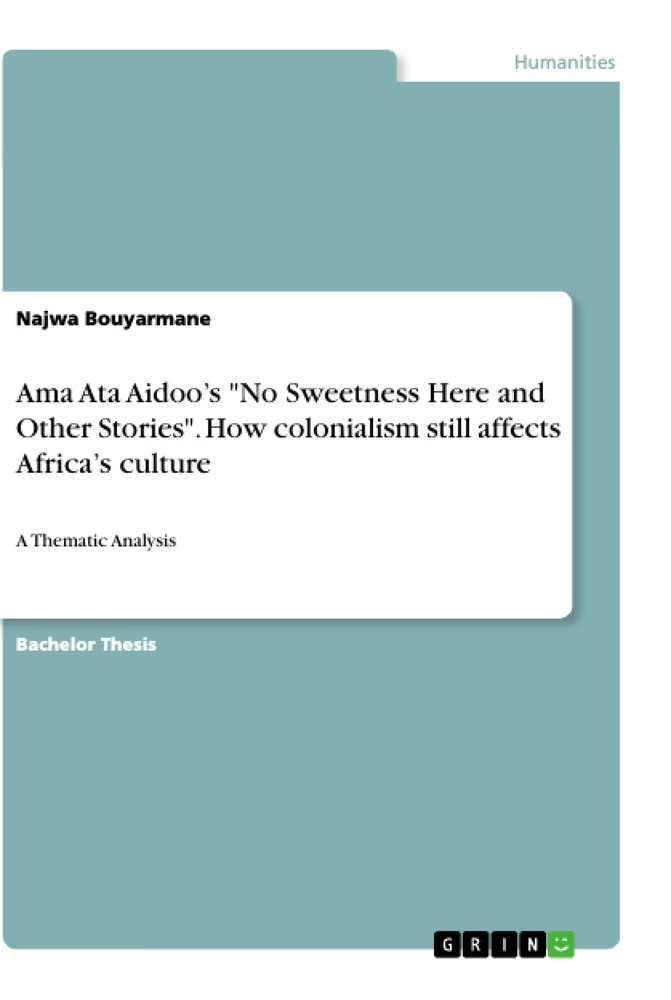
Table of Contents
Introduction
PART ONE:
POSTCOLONIALISM AND AFRICAN LITERATURE: THEORETICAL FRAME WORK
A. Postcolonialism
1. As a Political Movement
2. As a Literary and Critical Movement
3. Postcolonial Literary Theory
B. Postcolonial African Literature
1. African Literature
2. Ghanaian Literature
PART TWO:
AMA ATA AIDOO’S NO SWEETNESS HERE AND OTHER STORIES
A. An African Literary Figure
1. Ama Ata Aidoo: Elements of Biography
2. Aidoo: As a Women Writer
B. Ama Ata Aidoo’s Works
1.. The Plays
a. Dilemma of a Ghost (1964)
b. Anowa (1970)
2. The Novels
a. Our Sister Killjoy (1977)
b. Changes (1991)
3. The Oral Tradition
PART THREE:
THEMATIC ANALYSIS OF THE SHORT STORIES
Introduction
A. “Everything Counts”
B. “For Whom Things Did Not Change”
C. “In the Cutting of a Drink”
D. “The Message”
E. “No Sweetness Here”
F. “Two Sisters”
G. “The Late Bud”
H. “Something to Talk about on the Way to the Funeral”
Research Objectives & Core Themes
This monograph provides a thematic analysis of Ama Ata Aidoo's short story collection "No Sweetness Here and Other Stories," examining how the author critiques the socio-economic and political aftermath of post-colonialism in Ghana, specifically focusing on the lives and struggles of female characters within a shifting traditional and modern society.
- The impact of colonialism and post-independence disillusionment on Ghanaian identity.
- The challenges faced by women regarding marriage, education, and economic survival.
- The conflict between traditional African values and Western-influenced modernity.
- The role of orality and narrative technique in Aidoo’s storytelling.
- The critique of the corruption and hypocrisy within the new national bourgeoisie.
Excerpt from the Book
A. “Everything Counts”
“Everything Counts” is Ama Ata Aidoo’s first story in the collection of No Sweetness Here and Other Stories. In it, Aidoo portrays Sissie, the protagonist, who is a young Ghanaian woman who returns to Africa from Europe, and works as a lecturer in economics.
Being part of the educated elite, Sissie notices the economic impact of imperialism, referring to the economic problems that occur due to second-rate African experts giving first hand, dangerous advice.31
Sissie first encounters problems with her family, because as Sissie was in Europe, her relatives expected her to bring them luxuries and gifts from there, as fridges, televisions and so on.
What car are you bringing home, Sissie? We hope it is not one of those little coconut shells with two doors, heh? ...And oh, we hope you brought a refrigerator, because you simply cannot find one here these days. And if you do, it costs so much…(p.6)
Summary of Chapters
Introduction: Outlines the collection's focus on post-colonial impact in Africa, highlighting the disillusionment following independence and the central role of female characters.
PART ONE: POSTCOLONIALISM AND AFRICAN LITERATURE: THEORETICAL FRAME WORK: Defines the postcolonial period as both a political and literary movement and discusses the evolution of postcolonial literary theory.
PART TWO: AMA ATA AIDOO’S NO SWEETNESS HERE AND OTHER STORIES: Provides a biography of Aidoo, analyzes her plays and novels, and emphasizes the importance of the oral tradition in her writing style.
PART THREE: THEMATIC ANALYSIS OF THE SHORT STORIES: Conducts a detailed thematic exploration of the individual short stories, focusing on alienation, gender roles, and the clash between tradition and modernity.
Conclusion: Summarizes Aidoo’s contribution as a significant African woman writer and reaffirms her role in critiquing the neo-colonial realities of post-independent Ghana.
Keywords
Ama Ata Aidoo, Postcolonialism, Ghanaian Literature, African Women, No Sweetness Here, Oral Tradition, Decolonization, Alienation, Modernity, Tradition, Bourgeoisie, National Identity, Feminism, Socio-economic struggles.
Frequently Asked Questions
What is the primary focus of this academic work?
This monograph focuses on a thematic analysis of Ama Ata Aidoo’s short story collection "No Sweetness Here and Other Stories," exploring the socio-political impact of post-colonialism on the lives of Ghanaians.
What are the central thematic fields addressed in the analysis?
The core themes include the condition of women in post-independence Ghana, the clash between tradition and modernity, cultural alienation, and the disillusionment with the post-colonial national leadership.
What is the author's primary research objective?
The goal is to examine how Aidoo uses her short stories to critique the failure of the national struggle for independence and to highlight the ongoing struggles for survival and identity among the Ghanaian people.
Which scientific or analytical approach does the author apply?
The author applies a thematic literary analysis, examining narrative techniques, characters, and recurring motifs in the context of postcolonial theory and the African oral tradition.
What topics are covered in the book's main section?
The main section includes a theoretical framework on postcolonialism, a biographical overview of Ama Ata Aidoo, and a detailed thematic analysis of the eleven short stories in the collection.
Which keywords best describe this academic monograph?
Key terms include Ama Ata Aidoo, Postcolonialism, Ghanaian Literature, Oral Tradition, Alienation, Feminism, and post-independence disillusionment.
How does the "yam" parable function in Aidoo’s narratives?
The yam serves as a symbolic reference to the state of the nation; rotting yams represent the corrupt and failing socio-economic situation in modern Ghana, while fresh yams suggest potential hope.
What is the significance of the "wig" in the story "Everything Counts"?
The wig acts as a symbol of cultural alienation and the obsession with Western standards of beauty, representing how the elite class often adopts foreign ideals instead of embracing their own identity.
Ende der Leseprobe aus 69 Seiten
- nach oben
- Arbeit zitieren
- Najwa Bouyarmane (Autor:in), 2006, Ama Ata Aidoo’s "No Sweetness Here and Other Stories". How colonialism still affects Africa’s culture, München, Page::Imprint:: GRINVerlagOHG, https://www.diplomarbeiten24.de/document/903250

neugierig - aktuell - relevant
Entdecken Sie hilfreiche Tipps und Tricks rund ums Studium!

Entdecken Sie hilfreiche Tipps und Tricks rund ums Studium!
Ihre Hausarbeit / Abschlussarbeit:

- - Publikation als E-Book und Buch
- - Hohes Honorar auf die Verkäufe
- - Für Sie komplett kostenlos - mit ISBN
- - Es dauert nur 5 Minuten
- - Jede Arbeit findet Leser

- © GRIN Publishing GmbH.
- Alle Inhalte urheberrechtlich geschützt. Kopieren und verbreiten untersagt.
- info@grin.com
- AGB
- Open Publishing
Der GRIN Verlag hat sich seit 1998 auf die Veröffentlichung akademischer eBooks und Bücher spezialisiert. Der GRIN Verlag steht damit als erstes Unternehmen für User Generated Quality Content. Die Verlagsseiten GRIN.com, Hausarbeiten.de und Diplomarbeiten24 bieten für Hochschullehrer, Absolventen und Studenten die ideale Plattform, wissenschaftliche Texte wie Hausarbeiten, Referate, Bachelorarbeiten, Masterarbeiten, Diplomarbeiten, Dissertationen und wissenschaftliche Aufsätze einem breiten Publikum zu präsentieren.
Kostenfreie Veröffentlichung: Hausarbeit, Bachelorarbeit, Diplomarbeit, Dissertation, Masterarbeit, Interpretation oder Referat jetzt veröffentlichen!
Folgen Sie GRIN auf


- GRIN Verlag GmbH
-
- Nymphenburger Str. 86
- 80636
- Munich, Deutschland
- +49 89-550559-0
- +49 89-550559-10
- info@grin.com
-
