
präsentiert von

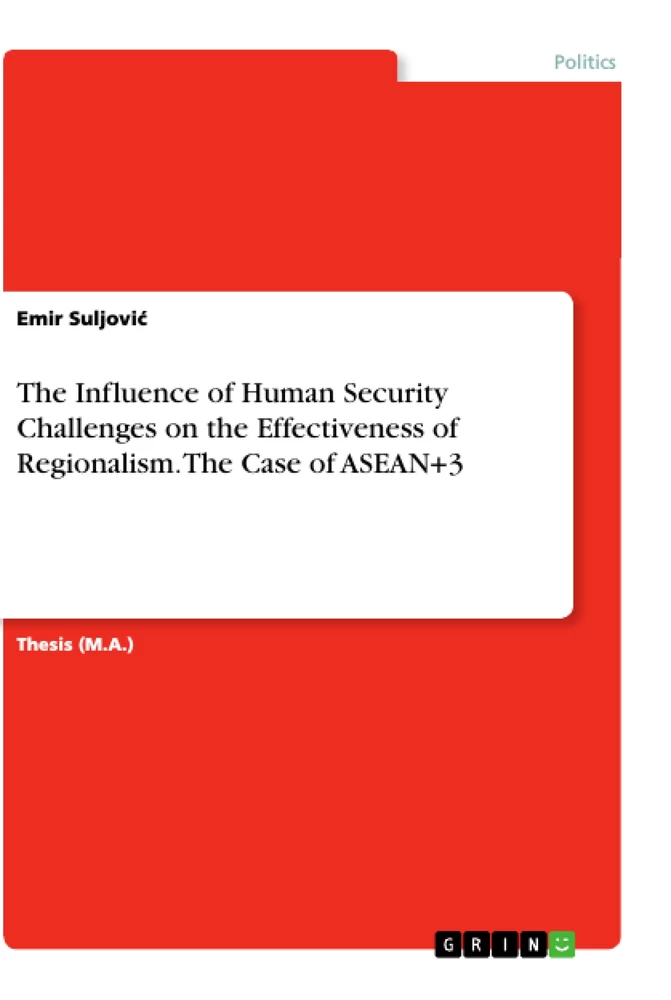
Table of Contents
1. What is Human Security?
1.1 UN about Human Security
1.2 Research about Human Security
2. Effectiveness or Performance of Regional International Organisations?
3. Human security (challenges) and ASEAN+3
3.1 Human security and ASEAN+3
3.2 Human security challenges and ASEAN+3
4. Methodology
5. Case Studies Introduction
5.1 Case Study 1: Myanmar’s Human Security
5.2 Case Study 2: Korean Human Security
5.3 Case Study 3: South China Sea Dispute
6. Analysis
6.1 Case Study 1: Rohingya Crises – Analysis
6.2 Case Study 2: Korean Peninsula Crises – Analysis
6.3 Case Study 3: South China Sea Dispute – Analysis
5.4 Effectiveness of ASEAN+3 in Case Study 1
5.5 Effectiveness of ASEAN+3 in Case Study 2
5.6 Effectiveness of ASEAN+3 in Case Study 3
6. Conclusion and Discussion
Research Objectives and Key Themes
This thesis investigates the effectiveness of regionalism within the ASEAN+3 framework by shifting the analytical focus from traditional state-centric security to a human-centric approach, specifically evaluating how regional organizations address multidimensional human security challenges.
- Critique of state-centric versus human-centric security paradigms.
- Evaluation of ASEAN+3's effectiveness in addressing non-traditional security threats.
- Comparative analysis of three case studies: The Rohingya Crisis, the Korean Peninsula, and the South China Sea Dispute.
- Development of a qualitative framework to grade regional effectiveness against human security benchmarks.
- Identification of policy deficits and recommendations for institutional reform within ASEAN.
Auszug aus dem Buch
6.1 Case Study 1: Rohingya Crises – Analysis
The on-going conflict between the majority of Burmese-Rakhine and the minority of Rohingya only reflects the limbo of security in the country in any of its dimensions and forms. Sub-regions as the Rakhine State in the northern part of the country and the home of Buddhist and Muslims from several ethnic groups, transformed in an area of exclusion, discrimination and ethnic prosecutions. Subsequently, the intercommunal violence led to large-scale fleeing of minority communities to countries as Bangladesh or Thailand (United Nations Trust Fund for Human Security, 2017). The Constitution from 2008, however, created a space for the Myanmar armed forces to gain administrative and political positions in public services of the country exercising systematic ethnic cleansing as seen before in Cambodia (The Border Consortium, 2018, p. 6).
Thereby, instead of approaching security threats using a integrative and multi-dimensional security solutions, the focal point of the military-led government was and still is regime and state security. Consequently, the state failed to understand that regime and state sovereignty is not merely related to the authority over population and territory but also to the responsibility to provide equality, inclusion, and protection to all its ethnic groups within the country. Nevertheless, the state-centric policy thereby focuses only on (even though forced) national unity, sovereignty and territorial integrity, which is mainly implemented and supported by a small elite group of Myanmar (Howe & Jang, 2013, p. 133; Kerr, 2003). In the meantime, ethnic and systematic targeting of minorities led to degradation and forced displacement of over 700.000 people since 2017 (incl. more than 400.000 children) (UNOCHA, 2018).
Summary of Chapters
1. What is Human Security?: This chapter defines the concept of human security through UN perspectives and academic research, establishing a multidimensional framework for the analysis.
2. Effectiveness or Performance of Regional International Organisations?: This chapter explores the theoretical distinctions between the effectiveness and performance of regional international organizations, establishing criteria for measuring success.
3. Human security (challenges) and ASEAN+3: This chapter analyzes the relationship between ASEAN+3 policies and the concept of human security, highlighting existing limitations in official documents.
4. Methodology: This chapter outlines the qualitative content analysis framework and the grading system used to evaluate ASEAN+3’s effectiveness across different security dimensions.
5. Case Studies Introduction: This chapter introduces the three specific case studies: the Rohingya crisis, the situation on the Korean Peninsula, and the South China Sea dispute.
6. Analysis: This chapter provides an in-depth evaluation of each case study, applying the human security framework to assess the impact of these challenges and ASEAN+3's institutional response.
6. Conclusion and Discussion: This chapter synthesizes the findings, confirming the deficit in ASEAN+3’s human security approach and providing concrete policy recommendations for reform.
Keywords
Human Security, Human Security Challenges, Regionalism, Regional Integration, Effectiveness of Regionalism, ASEAN, ASEAN+3, Myanmar, Rohingya Crisis, Korean Peninsula, South China Sea, Non-Interference, State-Centric Security, Human Rights, Policy Analysis
Frequently Asked Questions
What is the core focus of this research?
The research focuses on evaluating the effectiveness of regionalism in the ASEAN+3 region by examining how the organization addresses human security challenges, shifting the referent object from the state to the individual.
What are the central thematic areas covered in this work?
The work covers human security theory, the institutional performance of regional organizations, non-traditional security threats, and the practical application of these concepts in Southeast and East Asian geopolitics.
What is the primary research question of this thesis?
The primary research question is: "How do human security challenges influence the effectiveness of regionalism? The Case of ASEAN+3."
Which scientific methodology is employed?
The thesis utilizes a conceptual framework paired with qualitative content analysis, involving a grading system that evaluates ASEAN+3's effectiveness based on its communicated objectives and observed outcomes in specific cases.
What topics are discussed in the main analysis?
The main analysis provides a detailed breakdown of three specific case studies—the Rohingya crisis in Myanmar, the security issues on the Korean Peninsula, and the dispute in the South China Sea—and grades ASEAN+3's performance in each.
How would you characterize the keywords of this work?
The keywords reflect a blend of regional studies, international relations, and human security, emphasizing the tension between traditional state-centric policies and modern human-centric security needs.
How does the ASEAN "non-interference" policy affect the organization's performance?
The research argues that the "ASEAN Way" of consensus and non-interference acts as a significant barrier, limiting the organization's capacity to intervene in human security crises, which undermines its stated objectives regarding human rights and peace.
What is the primary conclusion regarding ASEAN+3's effectiveness?
The conclusion indicates that ASEAN+3 currently struggles to uphold human security principles, as its rigid institutional structures and state-centric focus prevent effective action during humanitarian crises or regional instability.
Ende der Leseprobe aus 60 Seiten
- nach oben
- Arbeit zitieren
- Emir Suljović (Autor:in), 2019, The Influence of Human Security Challenges on the Effectiveness of Regionalism. The Case of ASEAN+3, München, Page::Imprint:: GRINVerlagOHG, https://www.diplomarbeiten24.de/document/903526

neugierig - aktuell - relevant
Entdecken Sie hilfreiche Tipps und Tricks rund ums Studium!

Entdecken Sie hilfreiche Tipps und Tricks rund ums Studium!
Ihre Hausarbeit / Abschlussarbeit:

- - Publikation als E-Book und Buch
- - Hohes Honorar auf die Verkäufe
- - Für Sie komplett kostenlos - mit ISBN
- - Es dauert nur 5 Minuten
- - Jede Arbeit findet Leser

- © GRIN Publishing GmbH.
- Alle Inhalte urheberrechtlich geschützt. Kopieren und verbreiten untersagt.
- info@grin.com
- AGB
- Open Publishing
Der GRIN Verlag hat sich seit 1998 auf die Veröffentlichung akademischer eBooks und Bücher spezialisiert. Der GRIN Verlag steht damit als erstes Unternehmen für User Generated Quality Content. Die Verlagsseiten GRIN.com, Hausarbeiten.de und Diplomarbeiten24 bieten für Hochschullehrer, Absolventen und Studenten die ideale Plattform, wissenschaftliche Texte wie Hausarbeiten, Referate, Bachelorarbeiten, Masterarbeiten, Diplomarbeiten, Dissertationen und wissenschaftliche Aufsätze einem breiten Publikum zu präsentieren.
Kostenfreie Veröffentlichung: Hausarbeit, Bachelorarbeit, Diplomarbeit, Dissertation, Masterarbeit, Interpretation oder Referat jetzt veröffentlichen!
Folgen Sie GRIN auf


- GRIN Verlag GmbH
-
- Nymphenburger Str. 86
- 80636
- Munich, Deutschland
- +49 89-550559-0
- +49 89-550559-10
- info@grin.com
-
