
präsentiert von

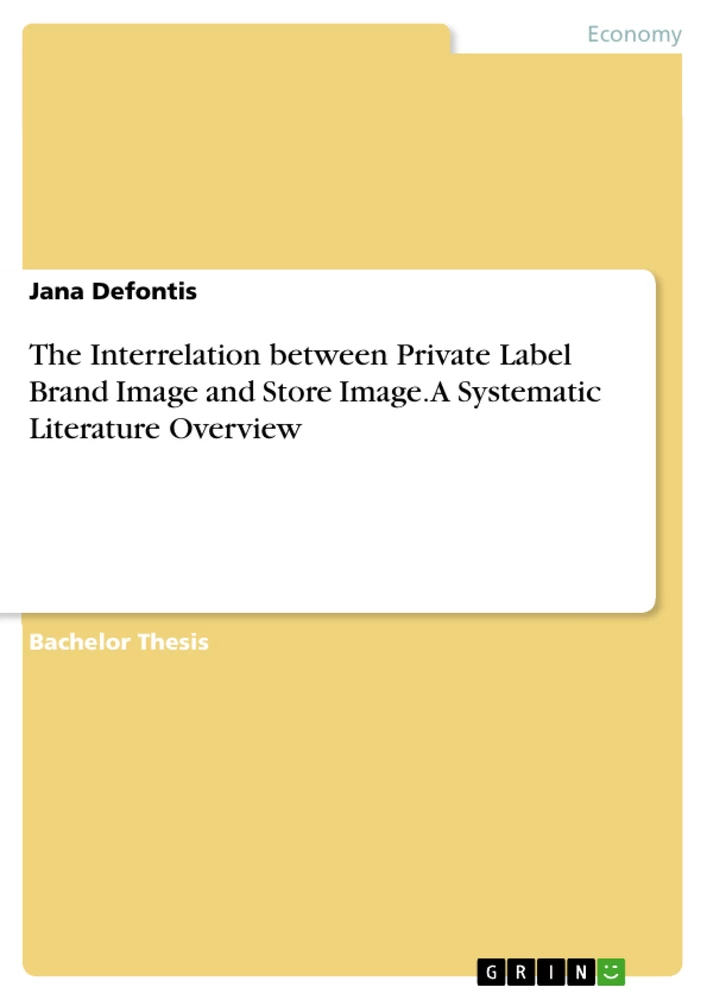
Table of Contents
1 Chapter 1: Introduction
1.1 Introduction
1.2 Structure of Thesis
2 Chapter 2: Literature Review on Private Label Brand Image
2.1 Private Label Brand Image
2.2 Consumer Attitudes towards Private Label Brands
2.3 Moderators of Private Label Brand Image
3 Chapter 3: Literature Review on Store Image
3.1 Store Image
3.2 Dimensions of Store Image
3.3 Moderators of Store Image
4 Chapter 4: The Interrelationship between Private Label Brand Image and Store Image
4.1 The Impact of Private Label Brand Image on Store Image
4.2 The Impact of Store Image on Private Label Brand Image
4.3 Reflective Abstract of the Interrelation between Private Label Brand Image and Store Image
5 Chapter 5: Conclusion and Implications for Future Research
5.1 Conclusion
5.2 Implications for Future Research
6 References
Research Objectives and Core Topics
The primary objective of this thesis is to provide a comprehensive literature review exploring the complex interrelationship between Private Label Brand (PLB) image and store image. It aims to determine how these two constructs influence one another, identifying whether a positive store image can enhance the perception of private labels and, conversely, how private labels serve as instruments for store differentiation and loyalty, ultimately shaping the retailer's overall market position.
- The theoretical conceptualization of Private Label Brand Image and its determinants.
- The multidimensional nature of Store Image and key attributes influencing consumer perception.
- Moderator variables affecting consumer attitudes toward both PLBs and store environments.
- The reciprocal impact and direct link between private label quality/image and store branding.
Excerpt from the Book
1.1 Introduction
Private label brands (PLBs) have gained tremendously in significance over the past decades. While at their first appearance in the market place in 1920 they only had to face little competition (Rothe and Lamont 1973), by now numerous large wholesalers (e.g. Wal-Mart, Carrefour, Costco) offer private labels in a large number of product categories. Since competition has intensified retailers have become more engaged in developing an efficient differentiation strategy (Frank 1967). In this context it has been found that the implementation of a private label program can contribute to a number of benefits for retailers as well as for consumers (e.g. Frank 1967). Alongside an improved bargaining power vis-à-vis manufacturers resulting in lower wholesale prices for national brands (NBs) (e.g. Mills 1995; Narasimhan and Wilcox 1998; Sethuraman 2009), private label brands can account for higher margins compared to NBs (Ailawadi and Harlam 2004) and they furthermore have the potential to serve as a significant determinant for store differentiation (e.g. Collins-Dodd and Lindley 2003) by expanding a retailers' merchandise (Mason 1990) with a unique alternative that is store specific and thus can contribute to increased store traffic (e.g. Pauwels and Srinivasan 2004) and ultimately to more customers being loyal towards a certain store (e.g. Ailawadi et al. 2001; Corstjens and Lal 2000; Laaksonen and Reynolds 1994).
Summary of Chapters
Chapter 1: Introduction: This chapter outlines the growing importance of private labels in retail and establishes the research goal of examining the bidirectional relationship between private label image and store image.
Chapter 2: Literature Review on Private Label Brand Image: This section defines private labels, discusses consumer attitudes towards these products, and examines variables that moderate the perception of private label brands.
Chapter 3: Literature Review on Store Image: This chapter reviews the definition and dimensions of store image, including factors like service, product quality, assortment, and store atmosphere.
Chapter 4: The Interrelationship between Private Label Brand Image and Store Image: This section synthesizes existing research on how private label image affects store perception and vice versa, concluding that they are mutually interdependent constructs.
Chapter 5: Conclusion and Implications for Future Research: This chapter summarizes key findings and suggests that future research should focus on the impact of online retail environments and social media on store and brand perceptions.
Keywords
Private Label Brands, Store Image, Retail Strategy, Consumer Behavior, Brand Differentiation, Store Loyalty, Merchandise Quality, Price-Quality Schema, Retail Management, Store Atmosphere, National Brands, Consumer Perception, Brand Image, Market Competition, Attribution Theory
Frequently Asked Questions
What is the primary focus of this thesis?
The thesis explores the interrelationship between private label brand image and store image, investigating how each construct influences the other and how they jointly contribute to store loyalty and differentiation.
What are the central themes covered in the research?
Key themes include the evolution of private label brands, the dimensions of store image (such as service, atmosphere, and assortment), and the role of moderator variables in shaping consumer perceptions.
What is the main objective of this study?
The objective is to provide a systematic overview of existing literature to identify how private label brands serve as a strategic tool for retailers to create unique store images and build customer loyalty.
What scientific methodology is applied?
The study utilizes an extensive literature review, synthesizing academic research, empirical studies, and conceptual frameworks from the last several decades to build a theoretical foundation.
What topics are discussed in the main body?
The main body covers the conceptualization of private labels, the drivers of store image, the impact of store image on private label perception, and the strategic importance of this interplay for retailers.
Which keywords best describe this research?
Primary keywords include Private Label Brands, Store Image, Consumer Behavior, Retail Strategy, and Brand Differentiation.
How do PLBs act as a tool for store differentiation?
PLBs allow retailers to offer unique products that are store-specific, which helps in creating a distinct market identity and increasing customer traffic compared to retailers relying solely on national brands.
What role do moderator variables play in consumer perception?
Moderator variables, such as demographic factors (income, age) and psychographic factors, significantly influence how consumers evaluate and perceive the quality of both private labels and the stores themselves.
How might online environments affect future research in this field?
Future studies are expected to examine how online storefronts, digital social platforms, and influencer endorsements replace or modify traditional physical dimensions like store atmosphere and personal service.
Ende der Leseprobe aus 35 Seiten
- nach oben
- Arbeit zitieren
- Jana Defontis (Autor:in), 2017, The Interrelation between Private Label Brand Image and Store Image. A Systematic Literature Overview, München, Page::Imprint:: GRINVerlagOHG, https://www.diplomarbeiten24.de/document/915008

neugierig - aktuell - relevant
Entdecken Sie hilfreiche Tipps und Tricks rund ums Studium!

Entdecken Sie hilfreiche Tipps und Tricks rund ums Studium!
Ihre Hausarbeit / Abschlussarbeit:

- - Publikation als E-Book und Buch
- - Hohes Honorar auf die Verkäufe
- - Für Sie komplett kostenlos - mit ISBN
- - Es dauert nur 5 Minuten
- - Jede Arbeit findet Leser

- © GRIN Publishing GmbH.
- Alle Inhalte urheberrechtlich geschützt. Kopieren und verbreiten untersagt.
- info@grin.com
- AGB
- Open Publishing
Der GRIN Verlag hat sich seit 1998 auf die Veröffentlichung akademischer eBooks und Bücher spezialisiert. Der GRIN Verlag steht damit als erstes Unternehmen für User Generated Quality Content. Die Verlagsseiten GRIN.com, Hausarbeiten.de und Diplomarbeiten24 bieten für Hochschullehrer, Absolventen und Studenten die ideale Plattform, wissenschaftliche Texte wie Hausarbeiten, Referate, Bachelorarbeiten, Masterarbeiten, Diplomarbeiten, Dissertationen und wissenschaftliche Aufsätze einem breiten Publikum zu präsentieren.
Kostenfreie Veröffentlichung: Hausarbeit, Bachelorarbeit, Diplomarbeit, Dissertation, Masterarbeit, Interpretation oder Referat jetzt veröffentlichen!
Folgen Sie GRIN auf


- GRIN Verlag GmbH
-
- Nymphenburger Str. 86
- 80636
- Munich, Deutschland
- +49 89-550559-0
- +49 89-550559-10
- info@grin.com
-
