
präsentiert von

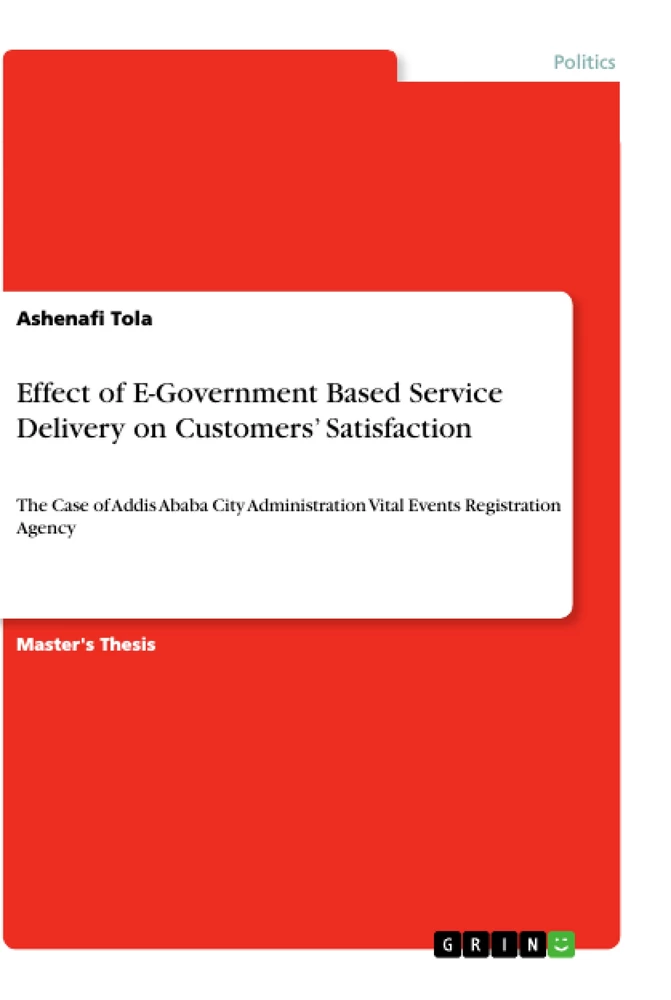
Table of Contents
1.1. Introduction
1.2. Background of the study
1.3. Statement of the Problem
1.4. Objectives of the study
1.4.1. General objectives
1.4.2. Specific objectives
1.5. Research questions
1.6. Hypothesis of the study
1.7. Significances of the study
1.8. Scope of the study
1.9. Limitations of the study
1.10. Definitions of key terms
1.11. Organization of the study
2.1. Introduction
2.2. Theoretical Review
2.2.1. Conceptualizing e-government and e-governance
2.2.2. Evolution of e-government
2.2.3. Development stages of e-government
2.2.4. Modalities of e-government initiatives
2.2.5. Benefit and Role of e-government
2.2.6. E- Government system
2.2.7. E-government in Vital Events Registration System
2.2.8. Technology Acceptance Model (TAM)
2.2.9. Quality Service delivery
2.2.10. SERVQUAL Model
2.2.11. Customers’ satisfaction
2.3. Empirical Review
2.3.1. E-Government trends and experiences
2.3.1.1. E-Government in Global Trend
2.3.1.2. E-government experience in Africa
2.3.1.3. E-Government in Ethiopia
2.3.2. Empirical Studies on E-Government
2.4. Research Gaps
2.5. Conceptual Framework of the Study
3.1. Introduction
3.2. Research design
3.3. Description of Study Area
3.4. Target population
3.5. Sampling design
3.5.1. Sampling frame
3.5.2. Sampling unit
3.5.3. Sample size
3.5.4. Sampling methods/technique
3.6. Data collection
3.6.1. Data Sources
3.6.2. Data gathering technique
3.7. Data analysis
3.8. Data quality controls
3.8.1. Reliability
3.8.2. Validity
4.1. Introduction
4.2. Response rate
4.3. Demographic Data analysis and Discussion
4.3.1. Analysis and discussion of AAVERA Customers Profile
4.3.2. Analysis about AAVERA Employees Demographic Data
4.4. Research Question 1 - Analysis and discussion on E-government based Service Quality Gaps
4.4.1. Descriptive Analysis and Discussions
4.4.2. Qualitative Data Interpretations
4.5. Research Question 2 - Inferential Statistics and Qualitative Data Discussions & Analysis about Effects of E-governance on Customers’ Perceived Service Delivery
4.5.1. Standard Multiple Regressions Result Analysis
4.5.2. Qualitative Data Interpretation
4.6. Research Question 3 - Inferential Statistics and Qualitative Data Discussion and Analysis about Perceived Service Delivery and Customers Satisfaction
4.6.1. Logistic regression analysis of the effect of perceived service Delivery on customers
4.6.2. Qualitative Data Interpretation
4.7. Research Question 4 - Major Challenges and Additional Measures to Improve the Service Delivery with E-Government
5.1. Introduction
5.2. Summary
5.3. Conclusion
5.4. Recommendations
5.4.1. Recommendations from the study
5.4.2. Recommendations for Further Study
Research Objectives and Core Themes
This research aims to examine the effect of e-government based service delivery on customer satisfaction at the Addis Ababa City Administration Vital Events Registration Agency (AAVERA), utilizing the TAM and SERVQUAL models to analyze service quality gaps, user perception, and performance impacts.
- The influence of e-government platforms on perceived service delivery and quality.
- Application of the SERVQUAL model to measure service quality gaps (Expectation vs. Perception).
- The predictive relationship between perceived service delivery and overall customer satisfaction.
- Identification of technical and administrative challenges affecting the implementation of e-government in a local government setting.
- Development of strategic recommendations for enhancing digital service infrastructure and institutional capacity.
Excerpt from the Book
1.2. Background of the study
Over the last decade, the Internet has become one of the most important means of communication in all social areas. The success of Web technology adoption in the private sector has put pressures on the public sector to adopt the Internet to present information and service resources. The concept of creating more efficient and convenient interaction between government and the interacting parties using Internet technology is referred to as electronic government (Yining, Chen, Ching, and Huang, 2009). Even though E-government was being practiced by the private sectors in some time ago to enhance the service delivery, but now it is realized as an important tool for public sector too in transforming the bureaucratic internal process to deliver effective services for citizens. For this reason, e-government has progressed to the point where it is now a force for effective governance and citizen participation, both at national and local levels (United Nations E-Government Survey, 2010).
In general, E-government refers to the intensive use of information and communication technologies in providing the citizens an improved access to information related to public administrations as well as in providing them outstanding service quality (Spremic and Brzica, 2008). The use of ICT is becoming a key for governments to enhance and fit their service delivery with the dynamic demands of citizens, (Pani & Mishra, 2009). Even the technology must be flexible enough so as to be adjusted easily with the growing needs of the people and the required service delivery. So, the traditional government service delivery is not fitting, due to its time consuming, and transparency deficiency, and leads to citizen and business dissatisfaction. By putting government services online, e-government reduces bureaucracy and enhances the quality of services in terms of time, content and accessibility (The World Bank, 2015).
Summary of Chapters
CHAPTER ONE: INTRODUCTION: This chapter outlines the foundation of the study, covering the background of e-government, the statement of the problem regarding manual service delivery, research objectives, and defined key terms used throughout the thesis.
CHAPTER TWO: LITERATURE REVIEW: This chapter provides a theoretical exploration of e-government and e-governance, examining frameworks like TAM and SERVQUAL to establish a conceptual basis for measuring service quality and customer satisfaction.
CHAPTER THREE: RESEARCH METHODOLOGY: This section details the research design, employing a convergent parallel mixed methods approach to combine quantitative and qualitative data gathered from AAVERA staff and customers.
CHAPTER FOUR: RESULTS AND DISCUSSION: This chapter presents the data analysis, discussing demographic profiles, calculating service quality gaps via SERVQUAL, and utilizing regression analysis to determine the impact of e-government on service delivery.
CHAPTER FIVE: SUMMARY, CONCLUSION AND RECOMMENDATIONS: The final chapter synthesizes the findings, confirming the positive impact of e-government on service quality while identifying persistent gaps, and proposes recommendations for technical and administrative improvements.
Keywords
E-Government (ICT), SERVQUAL, Customers’ Satisfaction, Technology Acceptance Model (TAM), Vital Events Registration, Expected service, Perceived service, Service delivery, Public administration, Digital transformation, Ethiopia, Addis Ababa, ICT infrastructure, Service quality gaps, Data-driven governance.
Frequently Asked Questions
What is the core focus of this research?
The research examines the impact of e-government-based service delivery on customer satisfaction, specifically focusing on the Addis Ababa City Administration Vital Events Registration Agency (AAVERA).
What are the central thematic fields?
The study centers on e-government implementation, service quality assessment (using the SERVQUAL model), technology adoption behavior (using the TAM model), and public sector institutional reform in Ethiopia.
What is the primary research goal?
The primary goal is to determine if and how digital service delivery tools enhance customer satisfaction and to identify the specific quality gaps between expected and perceived service delivery.
Which scientific methodology is applied?
The researcher uses a convergent parallel mixed methods design, which integrates quantitative data from statistical analysis (regressions, ANOVA) and qualitative data from interviews and focus group discussions.
What topics are discussed in the main body?
The main body covers the theoretical evolution of e-government, a thorough SERVQUAL gap analysis, regression models exploring the relationship between ICT platforms and perceived service quality, and an assessment of organizational challenges.
Which keywords characterize this work?
Key terms include E-Government, SERVQUAL, Customer Satisfaction, Technology Acceptance Model (TAM), and Vital Events Registration.
How does AAVERA currently handle vital events registration?
AAVERA has transitioned from traditional paper-based systems to the Vital Events Registration and Service Issuance System (VERSIS), an integrated, intranet-based web system.
What are the major challenges identified for the agency?
Challenges include poor ICT infrastructure (e.g., internet speed, power stability), a lack of sufficient skilled IT personnel at the Woreda level, and a need for greater public awareness and employee incentives.
Does e-government actually improve satisfaction in this case study?
Yes, the study concludes that e-government platforms have a significant positive impact on service delivery and customer satisfaction, although there are still gaps that require further technical and administrative refinement.
Ende der Leseprobe aus 113 Seiten
- nach oben
- Arbeit zitieren
- Ashenafi Tola (Autor:in), 2020, Effect of E-Government Based Service Delivery on Customers’ Satisfaction, München, Page::Imprint:: GRINVerlagOHG, https://www.diplomarbeiten24.de/document/915677

neugierig - aktuell - relevant
Entdecken Sie hilfreiche Tipps und Tricks rund ums Studium!

Entdecken Sie hilfreiche Tipps und Tricks rund ums Studium!
Ihre Hausarbeit / Abschlussarbeit:

- - Publikation als E-Book und Buch
- - Hohes Honorar auf die Verkäufe
- - Für Sie komplett kostenlos - mit ISBN
- - Es dauert nur 5 Minuten
- - Jede Arbeit findet Leser

- © GRIN Publishing GmbH.
- Alle Inhalte urheberrechtlich geschützt. Kopieren und verbreiten untersagt.
- info@grin.com
- AGB
- Open Publishing
Der GRIN Verlag hat sich seit 1998 auf die Veröffentlichung akademischer eBooks und Bücher spezialisiert. Der GRIN Verlag steht damit als erstes Unternehmen für User Generated Quality Content. Die Verlagsseiten GRIN.com, Hausarbeiten.de und Diplomarbeiten24 bieten für Hochschullehrer, Absolventen und Studenten die ideale Plattform, wissenschaftliche Texte wie Hausarbeiten, Referate, Bachelorarbeiten, Masterarbeiten, Diplomarbeiten, Dissertationen und wissenschaftliche Aufsätze einem breiten Publikum zu präsentieren.
Kostenfreie Veröffentlichung: Hausarbeit, Bachelorarbeit, Diplomarbeit, Dissertation, Masterarbeit, Interpretation oder Referat jetzt veröffentlichen!
Folgen Sie GRIN auf


- GRIN Verlag GmbH
-
- Nymphenburger Str. 86
- 80636
- Munich, Deutschland
- +49 89-550559-0
- +49 89-550559-10
- info@grin.com
-
