
präsentiert von

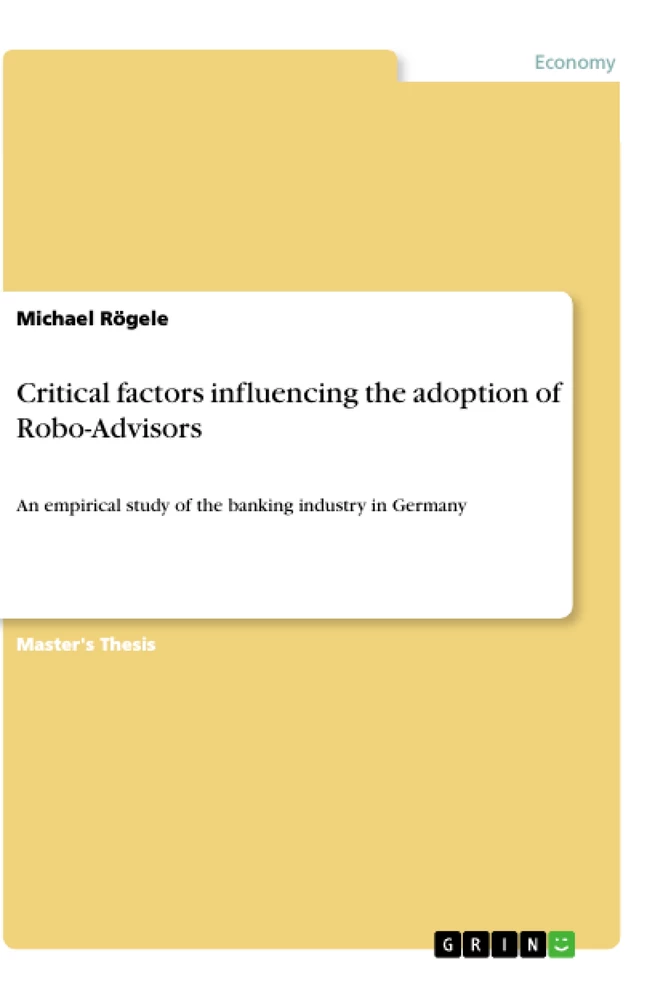
Table of Contents
Chapter I: Introduction
1.1 Background
1.2 Case Study of a German bank adopting a Robo Advisory solution
1.3 Research Purpose and Questions
1.4 Importance of Research
1.5 Scope of Research
1.6 Organization of the Paper
Chapter II: Literature Review
2.1 Robo Advisory Landscape and Market Situation in Germany
2.2 Robo Advisory – Definition and Characteristics
2.3 Introduction of TEO (Technology Environment and Organization theory)
2.3.1 The Technological Context
2.3.2 The Organizational Context
2.3.3 The Environmental Context
2.3.4 Conclusion
2.4 Previous Research and Findings about adoption of New Technology and its application in the implementation of Robo Advisory solutions
2.4.1 Crucial Factors of Implementation
2.4.2 Organizational Dimension
2.4.3 Project-Planning Dimension
2.4.4 Environmental Dimension
Chapter III: Research Framework
3.1 Research Framework
3.2 Research Hypotheses and Variables
3.2.1 Organizational Dimension
3.2.2 Project-Planning Dimension
3.2.3 Environmental Dimension
Chapter IV: Survey and Data Collection
4.1 Research Survey Design
4.2 Survey Objectives
4.3 Selection of Survey´s Participants
Chapter V: Data Analysis and Results
5.1 Data Analysis
5.2 Analysis of the Status Quo
5.3 Exploratory Factor Analysis (EFA) with SPSS
5.3.1 Preliminary Analysis
5.3.2 Factor Extraction
5.4 Confirmatory Factor Analysis (CFA) with SmartPLS
5.4.1 Preliminary Analysis
5.4.2 Reliability and Validity Analysis
5.4.3 Hypothesis Testing
Chapter VI: Discussion of Findings and Conclusions
6.1 Discussion of Findings
6.1.1 Characteristics of Cooperating/Acquirable Robo Advisory Companies
6.1.2 Regulatory Issues regarding Robo Advisors
6.1.3 IT, Conversational and Coordination Skills of the Project Team and Top Management Support
6.2 Implications of the Study
6.3 Limitations and Directions for Future Study
Research Objectives and Core Themes
The primary objective of this study is to identify the current adoption status of Robo Advisory solutions within the German banking industry and to determine the critical success factors that traditional financial institutions must consider when implementing these technologies, whether through acquisition, internal development, or strategic cooperation.
- Analysis of the Robo Advisory landscape and current market situation in Germany.
- Application of the Technology-Organization-Environment (TOE) framework to digital transformation in banking.
- Empirical investigation of implementation factors via a survey of German banking professionals.
- Evaluation of selection criteria for Robo Advisory partners, including technological capability and information sharing.
- Identification of challenges related to IT-infrastructure compatibility and organizational integration.
Extract from the Book
2.3.1 The Technological Context
Talking about the availability of technology, we need to think about the technologies that are already in use of the firm and about those that are available on the market, but not in use yet. The technologies that are currently used by a company are of essential importance in the adoption process of Robo Advisory solutions, because they limit the scope and pace of technological change, which is feasible for the bank. On the other hand, there are innovations on the market that are not in use yet by a given company, but they can also influence innovation. In particular, it can show what the status of technological innovation is and more practical, how they can leverage these technologies in order to improve their existing processes.
Innovations available on the market can be classified in three different categories. An innovation can create either incremental, synthetic or discontinuous changes. Incremental change means the introduction of new features or versions and are associated with the least amount of risk taken among the three categories, but also the smallest level of change within the adopting organization. Synthetic change represents a moderate level of change, while existing ideas or technologies are combined in a novel context. Third, discontinuous change causes radical or revolutionary innovations that significantly differ from the current technology or process. An example from recent history would be the adoption of cloud computing beginning in the early 2000s. Technologies causing discontinuous change are considered “competence-enhancing or “competence-destroying”. While competence-enhancing innovations facilitate gradual changes based on increasing expertise, competence-destroying innovations often revolutionize existing technologies and turn previously important expertise obsolete.
Summary of Chapters
Chapter I: Introduction: Outlines the rise of Fintechs and the resulting competitive pressure on traditional banks, defining the focus on Robo Advisory in the German market.
Chapter II: Literature Review: Provides a theoretical foundation using the TOE framework and reviews existing research on technology adoption and Robo Advisory characteristics.
Chapter III: Research Framework: Develops the study's research model and specific hypotheses concerning organizational, project-planning, and environmental dimensions.
Chapter IV: Survey and Data Collection: Describes the methodology, including the design of the questionnaire and the selection criteria for participating banking employees in Germany.
Chapter V: Data Analysis and Results: Presents the findings from the survey data using SPSS for factor analysis and SmartPLS for confirmatory model testing.
Chapter VI: Discussion of Findings and Conclusions: Evaluates the empirical results against the research hypotheses and offers managerial implications for banks considering Robo Advisory integration.
Keywords
Robo Advisory, Banking Industry, Adoption of Technology, Fintech, TOE Framework, Digital Transformation, Asset Management, Organizational Support, IT Competence, Regulatory Environment, Business Competition, Market Consolidation, Empirical Study, Strategic Cooperation, Innovation Management.
Frequently Asked Questions
What is the core focus of this research?
The research examines the critical factors influencing the adoption of Robo Advisory systems within traditional German banks, specifically focusing on the challenges and strategic choices institutions face.
What are the primary themes discussed?
The study covers the technological landscape, organizational readiness, regulatory constraints, and the strategic importance of choosing the right Robo Advisory partner.
What is the main objective of the thesis?
The goal is to provide a set of empirical criteria and actionable advice to help traditional banks successfully navigate the integration of automated investment tools.
Which scientific methodology is employed?
The author uses a quantitative approach, collecting data through a survey of banking employees, followed by Exploratory Factor Analysis (EFA) and Confirmatory Factor Analysis (CFA) using SmartPLS.
What topics are covered in the main section of the paper?
The main part analyzes the status quo of Robo Advisory adoption, the preferences for acquisition vs. cooperation, and the statistical validation of organizational and environmental factors.
How would you describe the main keywords?
The study centers on technological innovation (Robo Advisory), organizational change management, market competition, and digital strategy in the German financial sector.
Why is the "Willingness to share information" identified as critical?
Empirical findings suggest that because Fintechs often want to keep innovations within their ecosystem, a partner's willingness to share sufficient information is vital for the long-term success of bank-Fintech collaborations.
What role does the IT-infrastructure play in the adoption process?
The study highlights that many traditional banks face issues due to outdated IT-infrastructure, which is often incompatible with the modern, API-driven technology offered by Robo Advisory firms.
Ende der Leseprobe aus 97 Seiten
- nach oben
- Arbeit zitieren
- Michael Rögele (Autor:in), 2020, Critical factors influencing the adoption of Robo-Advisors, München, Page::Imprint:: GRINVerlagOHG, https://www.diplomarbeiten24.de/document/916119

neugierig - aktuell - relevant
Entdecken Sie hilfreiche Tipps und Tricks rund ums Studium!

Entdecken Sie hilfreiche Tipps und Tricks rund ums Studium!
Ihre Hausarbeit / Abschlussarbeit:

- - Publikation als E-Book und Buch
- - Hohes Honorar auf die Verkäufe
- - Für Sie komplett kostenlos - mit ISBN
- - Es dauert nur 5 Minuten
- - Jede Arbeit findet Leser

- © GRIN Publishing GmbH.
- Alle Inhalte urheberrechtlich geschützt. Kopieren und verbreiten untersagt.
- info@grin.com
- AGB
- Open Publishing
Der GRIN Verlag hat sich seit 1998 auf die Veröffentlichung akademischer eBooks und Bücher spezialisiert. Der GRIN Verlag steht damit als erstes Unternehmen für User Generated Quality Content. Die Verlagsseiten GRIN.com, Hausarbeiten.de und Diplomarbeiten24 bieten für Hochschullehrer, Absolventen und Studenten die ideale Plattform, wissenschaftliche Texte wie Hausarbeiten, Referate, Bachelorarbeiten, Masterarbeiten, Diplomarbeiten, Dissertationen und wissenschaftliche Aufsätze einem breiten Publikum zu präsentieren.
Kostenfreie Veröffentlichung: Hausarbeit, Bachelorarbeit, Diplomarbeit, Dissertation, Masterarbeit, Interpretation oder Referat jetzt veröffentlichen!
Folgen Sie GRIN auf


- GRIN Verlag GmbH
-
- Nymphenburger Str. 86
- 80636
- Munich, Deutschland
- +49 89-550559-0
- +49 89-550559-10
- info@grin.com
-
