
präsentiert von

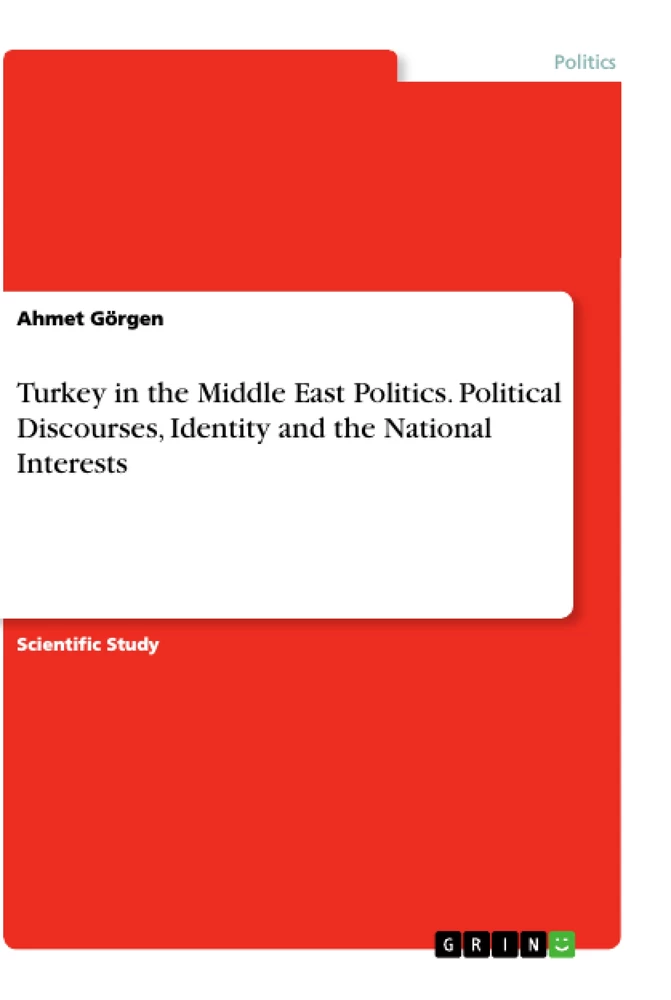
Table of Contents
Introduction
I. The Review on Turkish Foreign Policy Towards the Middle East
I.1 Turkish Foreign Policy and Turkey's Approach to the Middle East after the 1980s
I.1.1 Theoretical Debate on Turkey's Approach to the Middle East
I.1.2 Policy Analysis in Turkish Foreign Policy towards the Middle East
I.2 Limitations of Existing Research
II. Theoretical Framework and Methodology
II.1 Realist Approaches
II.1.1 Limitations of Realist Approaches
II.2 Constructivism
II.2.1 Identity, Interest and Foreign Policy
II.3 Analysis of the Sources and Research Methods
III. The Middle East and Turkish Foreign Policy (1923-1980)
III.1 Ottoman Governance Strategies in the Middle East
III.2 The Emergence of Arab Nationalism and the West in the Middle East
III.3 Turkey's Early Middle East Policy and the West Oriented Foreign Policy Trend
III.4 The Political Ideology Factor on Foreign Policy Setting in Turkey
IV. Turkish Foreign Policy in the Post-Cold War Period
IV.1 Transformation of Turkish Foreign Policy after the 1980s
IV.2 Neo-Ottomanism as Turkey's Foreign Policy Strategy
IV.3 The Approach of Turkey towards the Middle East
V. Turkey in the Middle East as a Regional Power
V.1 Turkey in Palestine Problem: the Change in Regional Dynamics
V.1.1 Turkey's Involvement in Israeli-Palestinian Peace Process
V.1.2 Turkey and Palestine Problem after Israel's Gaza Operation
V.2 The Position of Iraq in Turkey's Neo-Ottomanist Foreign Policy Approach
V.2.1 Turkey and the Gulf War in the Context of Foreign Policy Transformation
V.2.2 Turkey - Iraq Relations after Iraq War
VI. Conclusion
Objectives and Topics
This work evaluates the transformation of Turkish foreign policy towards the Middle East post-1980s, shifting from a rationalist, West-oriented perspective to a multidimensional, identity-based "Neo-Ottomanist" approach. The primary research question explores how changing identities and socio-political dynamics influenced Turkey's ability to act as a significant regional power and mediator.
- Transformation of Turkish foreign policy from the Cold War to the post-1980s period.
- Application of Social Constructivism to explain Turkey's regional identity.
- Analysis of Neo-Ottomanism as a framework for regional engagement.
- Case studies on Turkey's involvement in the Palestinian question and Iraqi politics.
- The impact of domestic socio-political developments on international policy settings.
Excerpt from the Book
I.1.2 Policy Analysis in Turkish Foreign Policy towards the Middle East
This section covers the policy analysis of Turkish foreign policy towards the Middle East, including different approaches by considering them as useful or not for the content of the book. Concrete studies have been putting the policy transformation of Turkey at the core of their research since the 1980s. While the early foreign policy of Turkey was analyzed mainly on national interest factors, the Cold War period was analyzed both with the national interests and dependency of Turkey to the West by living under the hegemony of the US. In addition, the identity factor in the Turkish foreign policy analysis was mainly included after the 1980s. In this context, research to date has confirmed the idea of this book that Turkish foreign policy towards the Middle East after the 1980s can be best analyzed using the identity factor.
The analysis shows that with the foundation of republic, Turkey had arranged its political system according to the western values and followed the policy developments, which were originated from the West in international politics. This has been the continuation of the late Ottoman political system based on the Westernization. Moreover, because of Turkey was established as a nation-state, national interests were the main driving force of Turkey's policy actions since the establishment (Gönlübol and Kürkçüoğlu, 1985: 462). In this context, Turkey had cooperation first with the United Soviet Socialist Republics (USSR) against the threat of the West starting from the national liberation war. Then, with France and the United Kingdom (UK) against the threat of Germany in the World War II (WWII), when Germany occupied the Albania (Hurewitz, 1959: 226-228). In the Cold War, because of the threats coming from the USSR, Turkey moved to the Western alliance and joined in the North Atlantic Treaty Organization (NATO) in 1952 after the successful operations in the Korean War in the 1950. In addition, Turkey received the aids from the West with Truman Doctrine for the development and modernization of the country, which was the rational choice of political elites (See Ekinci, 1997).
Summary of Chapters
I. The Review on Turkish Foreign Policy Towards the Middle East: Provides an overview of existing literature on Turkey's foreign policy transition and discusses the limitations of rationalist research approaches.
II. Theoretical Framework and Methodology: Introduces realist and social constructivist theories to frame the study and outlines the qualitative research methods used.
III. The Middle East and Turkish Foreign Policy (1923-1980): Examines the historical background of Ottoman governance, the rise of Arab nationalism, and Turkey's early Western-oriented policy.
IV. Turkish Foreign Policy in the Post-Cold War Period: Investigates the empirical transformation of Turkish policy after the 1980s and the conceptualization of Neo-Ottomanism.
V. Turkey in the Middle East as a Regional Power: Analyzes Turkey’s active diplomatic and political involvement in the Israeli-Palestinian conflict and the reconstruction of post-war Iraq.
VI. Conclusion: Summarizes the key findings regarding Turkey’s identity-based foreign policy shift and its effectiveness in increasing regional influence.
Keywords
Turkish Foreign Policy, Middle East, Neo-Ottomanism, Social Constructivism, Identity, National Interest, Palestine, Iraq, Regional Power, Diplomacy, Arab Nationalism, Westernization, Gulf War, Soft Power.
Frequently Asked Questions
What is the fundamental focus of this research?
The book examines the shift in Turkish foreign policy towards the Middle East since the 1980s, specifically moving from a strictly realist, West-centric approach to one driven by identity, historical connections, and Neo-Ottomanism.
What are the central thematic fields covered?
The central themes include the evolution of Turkish political identity, the regional impact of Neo-Ottomanist strategies, and Turkey’s role as a mediator in Middle Eastern conflicts.
What is the primary objective of this work?
The primary goal is to evaluate the success of the post-1980s Turkish foreign policy transformation by analyzing how identity-based policy actions increased Turkey's political sphere of influence.
Which scientific methodology is employed?
The research utilizes a qualitative methodology, drawing on social constructivism to interpret political discourses and empirical data regarding Turkey's interactions with regional actors.
What is covered in the main body of the text?
The main body covers historical developments from the Ottoman era through the Cold War, the empirical analysis of post-1980s policy changes, and specific case studies involving Palestine and Iraq.
Which keywords characterize the work?
Key terms include Turkish Foreign Policy, Middle East, Neo-Ottomanism, Identity, Social Constructivism, and Regional Power.
How does the author define Neo-Ottomanism in the context of this study?
The author views Neo-Ottomanism as a policy strategy that leverages Turkey's historical, cultural, and religious ties with former Ottoman territories to assert influence and promote stability in the Middle East.
What role does the Palestinian conflict play in Turkey's foreign policy?
The Palestinian issue serves as a primary case study for how Turkey utilizes soft power and identity-based diplomacy to align itself with regional public opinion while attempting to mediate peace.
How has the "Davutoğlu Doctrine" influenced current policy?
The "Strategic Depth" concept introduced by Ahmet Davutoğlu is identified as a critical factor in conceptualizing Turkey's multidimensional foreign policy, emphasizing proactive engagement with neighboring countries.
Ende der Leseprobe aus 78 Seiten
- nach oben
- Arbeit zitieren
- Ahmet Görgen (Autor:in), 2020, Turkey in the Middle East Politics. Political Discourses, Identity and the National Interests, München, Page::Imprint:: GRINVerlagOHG, https://www.diplomarbeiten24.de/document/916221

neugierig - aktuell - relevant
Entdecken Sie hilfreiche Tipps und Tricks rund ums Studium!

Entdecken Sie hilfreiche Tipps und Tricks rund ums Studium!
Ihre Hausarbeit / Abschlussarbeit:

- - Publikation als E-Book und Buch
- - Hohes Honorar auf die Verkäufe
- - Für Sie komplett kostenlos - mit ISBN
- - Es dauert nur 5 Minuten
- - Jede Arbeit findet Leser

- © GRIN Publishing GmbH.
- Alle Inhalte urheberrechtlich geschützt. Kopieren und verbreiten untersagt.
- info@grin.com
- AGB
- Open Publishing
Der GRIN Verlag hat sich seit 1998 auf die Veröffentlichung akademischer eBooks und Bücher spezialisiert. Der GRIN Verlag steht damit als erstes Unternehmen für User Generated Quality Content. Die Verlagsseiten GRIN.com, Hausarbeiten.de und Diplomarbeiten24 bieten für Hochschullehrer, Absolventen und Studenten die ideale Plattform, wissenschaftliche Texte wie Hausarbeiten, Referate, Bachelorarbeiten, Masterarbeiten, Diplomarbeiten, Dissertationen und wissenschaftliche Aufsätze einem breiten Publikum zu präsentieren.
Kostenfreie Veröffentlichung: Hausarbeit, Bachelorarbeit, Diplomarbeit, Dissertation, Masterarbeit, Interpretation oder Referat jetzt veröffentlichen!
Folgen Sie GRIN auf


- GRIN Verlag GmbH
-
- Nymphenburger Str. 86
- 80636
- Munich, Deutschland
- +49 89-550559-0
- +49 89-550559-10
- info@grin.com
-
