
präsentiert von

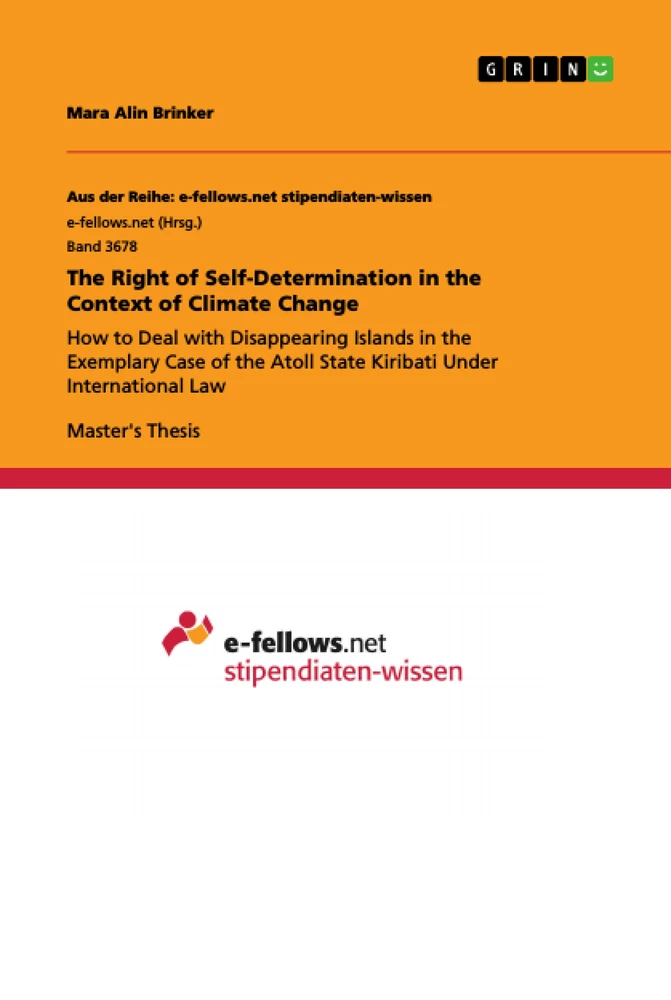
Table of Contents
Introduction
Chapter 1: The Right of Self-Determination
1. Preliminary Words
2. What is the Right of Self-Determination?
3. Classification of the Right of Self-Determination
4. The aims of the Right of Self-Determination
5. Differentiation between Statehood and Self-Determination
5.1. Statehood as an implementation of Self-Determination
5.2. Definition of Statehood
6. Conclusion
Chapter 2: New Challenge for the Right of Self-Determination in the light of Climate Change
1. Preliminary Words
2. Inundations caused by Climate Change
3. I-Kiribati recognized as “people”
4. Inundations caused by Climate Change: A threat to Self-Determination
5. The necessity of a legal rule concerning the atoll island populations
6. The protection for the Self-Determination of I-Kiribati
7. Conclusion
Chapter 3: The existing Solutions: what offers the international Law to the “Disappearing Island States”?
1. Preliminary Words
2. Planned Migration and cede of territory
2.1. Does Displacement mean Migration?
2.2. Ceding of Territory
2.2.1. Theoretical Problems
2.2.2. Practical problems
2.3. Conclusion
3. Is Statehood still necessary?: the retreat and other entities
3.1. Right of Self-Determination in the context of the retreat of Statehood
3.2. Free Association
3.3. Federalism
3.4. Other non-territorial autonomy arrangements
3.5. The Retreat of Statehood as the solution?
3.6. Conclusion
Chapter 4: The innovative solution: The idea of the “de-territorialized Nation-States”
1. Preliminary Words
2. The minimum threshold account of Statehood
2.1. Population
2.2. Government
2.3. Independence
2.4. Territory
3. Statelessness as unacceptable approach
4. The de-territorialized Nation-State as a new shape of the international entity
5. The Right of Self-Determination in de-territorialized States
6. Conclusion
7. Final remarks to the solutions
Closing Considerations
Research Objectives and Themes
This work examines how the international legal framework, specifically the Right of Self-Determination, can address the existential threat posed to island states like Kiribati by climate change-induced sea-level rise. It investigates whether current definitions of statehood are sufficiently flexible to maintain the sovereignty and rights of populations when their physical territory disappears, and explores innovative legal solutions to ensure the continued existence of such entities.
- Legal analysis of the Right of Self-Determination for disappearing island states.
- Evaluation of the classical Montevideo Convention criteria in the context of climate change.
- Critical review of existing solutions like migration, land cession, and free association.
- Proposing the concept of "de-territorialized nation-states" as an innovative legal framework.
Excerpt from the Book
The de-territorialized Nation-State as a new shape of the international entity
In continuing the above-developed approach, the Montevideo criteria are mostly “based on the principle of effectiveness among territorial units.” The idea of Statehood based on the conclusion, that the International Law entitles an entity to the right to be a State, depending on a full governmental power with respect to some area of territory.
However, in the International Law, other recognized entities besides the States are found, such as Taiwan and The European Union, which are awarded a functional sovereignty of the international level. Moreover, the expression of “other entity” is used in numerous treaties, for example, the UN Fish Stock Agreement. So, the International Law leaves room for configurations of Statehood and adaptation to unforeseeable circumstances in the international framework. In sum, the Montevideo definition simply is “the best-known formulation of the basic criteria of Statehood”, besides that, it is room for generous definitions of Statehood.
In developing that approach, we start with the classical understanding of Statehood, “there must be a territory in which the people are settled.” To go further, there are two theories, which explain the relationship of the State to its territory, the property and the competence theory. The first theory defines the connection as the relationship between an individual and its property. The second one considers the territory more as a “vehicle for maintaining exclusive jurisdiction and exploitation of resources.” In particular, the last theory shows that the attribute of the territory is not postulated with absolute certainty. However, at least a territorial base where the government can be installed is demanded. In the words of Wong, “the leg [of territory] may be bent, but it must exist.”
Summary of Chapters
Chapter 1: The Right of Self-Determination: This chapter defines the fundamental legal principle of self-determination, distinguishing between internal and external facets and establishing it as a human right for cohesive peoples rather than just a state-based legal construct.
Chapter 2: New Challenge for the Right of Self-Determination in the light of Climate Change: The focus shifts to the specific threat of climate change, confirming the I-Kiribati people as legitimate holders of the Right of Self-Determination in the face of environmental disasters.
Chapter 3: The existing Solutions: what offers the international Law to the “Disappearing Island States”?: This chapter analyzes current approaches such as forced migration, the ceding of territory, and the retreat of statehood, highlighting their practical and theoretical limitations.
Chapter 4: The innovative solution: The idea of the “de-territorialized Nation-States”: The final chapter proposes a novel legal framework for a de-territorialized state that can maintain international recognition and statehood despite the loss of habitable land.
Keywords
Self-Determination, Climate Change, Statehood, Kiribati, International Law, Territory, Sovereignty, Human Rights, Disappearing Island States, De-territorialized Nation-State, Migration, Montevideo Convention, Atoll Islands, Environmental Policy, Collective Autonomy
Frequently Asked Questions
What is the core focus of this research?
The work explores how international law can protect the Right of Self-Determination for populations whose territories are threatened with total inundation due to climate change, specifically looking at the case of Kiribati.
What are the primary thematic fields addressed?
The research integrates international legal theory, environmental law, statehood criteria (Montevideo Convention), human rights, and political science regarding sovereignty and territory.
What is the main research question?
The paper asks how statehood can be defined without territory in the context of disappearing island states and how the Right of Self-Determination can be applied to ensure their survival as entities.
Which scientific method is utilized?
The author employs a normative and doctrinal legal analysis, evaluating international treaties, court decisions (ICJ), UN resolutions, and scholarly literature to construct a new legal interpretation for de-territorialized states.
What is covered in the main section of the book?
The body of the work covers the classification of self-determination, the specific threats posed by climate change, an evaluation of existing solutions like migration and land cession, and a proposal for a de-territorialized nation-state model.
Which keywords best describe the study?
The key concepts include Self-Determination, Climate Change, Statehood, International Law, and De-territorialized Nation-States.
How does the author define the "people" in this context?
The author suggests that a "people" is defined by a collective identity and a shared destiny, necessitating protection by international law regardless of the existence of a traditional, fixed territory.
Why is the "territory" requirement under the Montevideo Convention being challenged?
The author argues that in a globalized, interdependent world, the physical territory is no longer a strictly essential prerequisite for statehood, and that legal and political continuity should be preserved to protect human rights.
Ende der Leseprobe aus 73 Seiten
- nach oben
- Arbeit zitieren
- Mara Alin Brinker (Autor:in), 2020, The Right of Self-Determination in the Context of Climate Change, München, Page::Imprint:: GRINVerlagOHG, https://www.diplomarbeiten24.de/document/920732

neugierig - aktuell - relevant
Entdecken Sie hilfreiche Tipps und Tricks rund ums Studium!

Entdecken Sie hilfreiche Tipps und Tricks rund ums Studium!
Ihre Hausarbeit / Abschlussarbeit:

- - Publikation als E-Book und Buch
- - Hohes Honorar auf die Verkäufe
- - Für Sie komplett kostenlos - mit ISBN
- - Es dauert nur 5 Minuten
- - Jede Arbeit findet Leser

- © GRIN Publishing GmbH.
- Alle Inhalte urheberrechtlich geschützt. Kopieren und verbreiten untersagt.
- info@grin.com
- AGB
- Open Publishing
Der GRIN Verlag hat sich seit 1998 auf die Veröffentlichung akademischer eBooks und Bücher spezialisiert. Der GRIN Verlag steht damit als erstes Unternehmen für User Generated Quality Content. Die Verlagsseiten GRIN.com, Hausarbeiten.de und Diplomarbeiten24 bieten für Hochschullehrer, Absolventen und Studenten die ideale Plattform, wissenschaftliche Texte wie Hausarbeiten, Referate, Bachelorarbeiten, Masterarbeiten, Diplomarbeiten, Dissertationen und wissenschaftliche Aufsätze einem breiten Publikum zu präsentieren.
Kostenfreie Veröffentlichung: Hausarbeit, Bachelorarbeit, Diplomarbeit, Dissertation, Masterarbeit, Interpretation oder Referat jetzt veröffentlichen!
Folgen Sie GRIN auf


- GRIN Verlag GmbH
-
- Nymphenburger Str. 86
- 80636
- Munich, Deutschland
- +49 89-550559-0
- +49 89-550559-10
- info@grin.com
-
