
präsentiert von

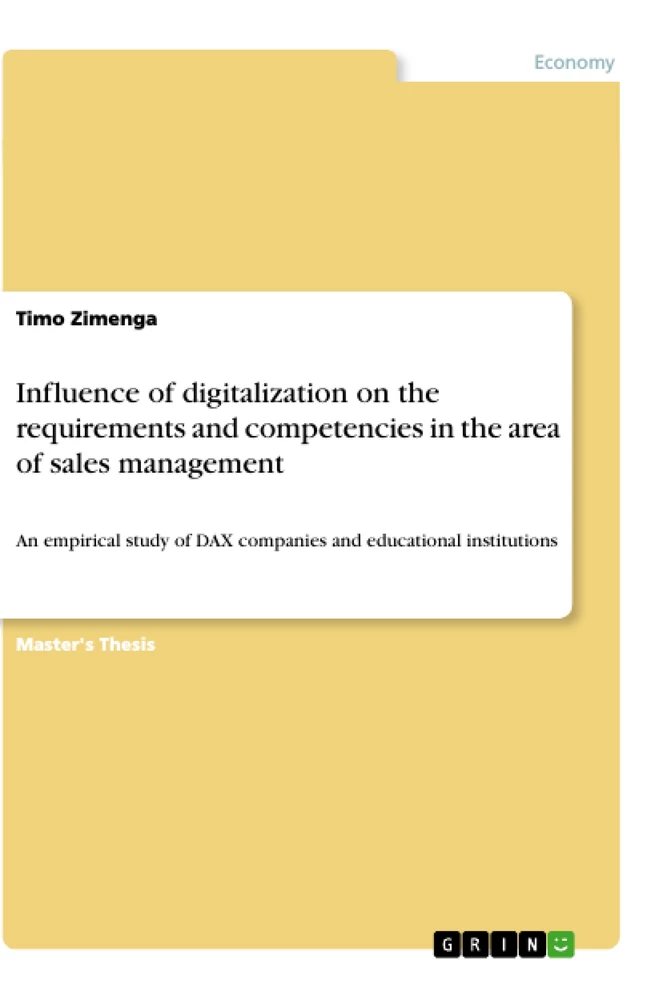
Table of Contents
1 Introduction
1.1 Relevance of the topic
1.2 Problem and objective target
1.3 Course of action & Methodology
2 A theoretical approach
2.1 Digitalization as a mega trend
2.1.1 Industry 4.0
2.1.2 Digital transformation
2.1.2.1 Artificial intelligence
2.1.2.2 Cyber-physical systems
2.2 Leadership
2.2.1 Definition
2.2.2 Leadership 4.0 – Expected changes due to digitalization
2.2.3 Competences
2.3 Displacement of competences from human to intelligent system
2.4 Intermediate conclusion
3 Empirical study
3.1 Research questions & topics
3.2 Questionnaire
3.2.1 Target group
3.2.2 Operationalization
3.2.3 Development
3.2.4 Pretest
3.2.5 Implementation
3.3 Type of evaluation
4 Result evaluation
4.1 Summary of collected data
4.2 Evaluation and testing of research topic
4.2.1 Results from literature review
4.2.2 Data analysis combined as overview
4.2.3 Data analysis of the companies
4.2.4 Data analysis of the educational institutes
4.2.5 Data analysis of the most important competences
5 Discussion
6 Conclusion & Outlook
Research Objectives and Themes
This master's thesis aims to identify potential shifts in competence requirements for leadership roles in the sales management sector caused by the digital revolution. By utilizing an empirical study involving DAX companies and leading German educational institutions, the research investigates the extent to which human competences are being displaced or augmented by intelligent systems and artificial intelligence.
- Impact of digitalization and the "Industry 4.0" paradigm on leadership roles.
- Identification of core competence shifts from human to machine.
- Analysis of competence requirements at top DAX companies and educational institutions.
- Evaluation of future-proof leadership skills in a VUCA environment.
- Development of a competence structure for leaders acting in the digital age.
Excerpt from the Book
2.1.1 Industry 4.0
"Smart Robots, Smart Workplace, Augmented Reality (AR), and Virtual Reality (VR), Machine Learning, Virtual Personal Assistants or Internet of Things (IoT) are [...] only excerpts from a long list of technological innovations that are already in use [...] or will be developed in the next five to ten years [...]".
Industry 4.0 describes the networking of individual industrial infrastructures such as people, plants and products to digitally controlled systems that work completely autonomously, without human intervention, only on the basis of information and communication technologies (e.g. internet or data). Industry 4.0 focuses on the development of intelligent products and processes and, in some areas, on intelligent services such as predictive maintenance. According to Jäger et al., industry 4.0 is divided into three sub-areas:
- Cloud computing,
- Cyber-physical systems and
- Smart Factory.
Cloud computing, the first large sub-area, is the supply of data stored on central servers, regardless of location and time, and the processing of this data including analyses. The combination of this data, which comes from people, machines, equipment and material resources and is stored on cloud-based servers (cloud computing), forms the basis for the combination of the real and digital world in cyber-physical systems. By further networking the individual CPSs, an intelligently controlled factory is created, called Smart Factory, the third sub-area of Industry 4.0. In the Smart Factory, the aim is to connect cyber-physical systems that allow people, machines, material resources and processes to interact with one another, with the aim of increasing production efficiency and eliminating inefficiencies such as malfunctions before they become serious problems.
Summary of Chapters
1 Introduction: Introduces the research topic of competence shifts in the context of the digital revolution, the relevance within the VUCA framework, and the research objectives.
2 A theoretical approach: Provides foundational knowledge on Industry 4.0, digital transformation, leadership in the digital age, and a detailed framework of professional, methodological, social, and personal competence classes.
3 Empirical study: Details the research methodology, including the design of the questionnaire, target group selection (DAX companies and educational institutions), and the implementation of the empirical survey.
4 Result evaluation: Presents the gathered data, including literature analysis results and the detailed breakdown of the survey results regarding competence shifts in the identified target groups.
5 Discussion: Interprets the empirical findings, contrasts them with the theoretical framework, and identifies correlations and differences in the evaluation between companies and educational institutions.
6 Conclusion & Outlook: Summarizes the key insights of the thesis, confirms the human-centric approach in leadership, and provides final conclusions on the future role of leaders in the digital era.
Keywords
Digitalization, Industry 4.0, Digital Transformation, Sales Management, Leadership, Competence Atlas, Artificial Intelligence, Cyber-Physical Systems, VUCA, Competence Shift, Human-Machine Interaction, DAX, Educational Institutions, Soft Skills, Leadership 4.0.
Frequently Asked Questions
What is the fundamental focus of this thesis?
The thesis investigates how the digital revolution, particularly technologies like artificial intelligence and cyber-physical systems, influences the required competences for leaders in the field of sales management.
What are the central thematic fields covered?
The work explores digital transformation, leadership models in the digital age, and the categorization and displacement of human competences by intelligent technological systems.
What is the primary objective or research question?
The main objective is to determine if a shift in competence requirements exists due to digitalization and to identify which specific competences are becoming more or less important for leaders.
Which scientific methodology is employed?
The research uses a combined methodology: a qualitative literature analysis and a quantitative empirical survey involving DAX companies and leading German educational institutions.
What topics are treated in the main body?
The main body covers theoretical frameworks of Industry 4.0, definitions of leadership, detailed competence models, and an empirical analysis of competence shift perceptions among industry leaders and educational experts.
Which keywords characterize the work?
Key terms include Digitalization, Industry 4.0, Leadership 4.0, Competence Atlas, AI, Cyber-Physical Systems, VUCA, and Human-Machine Interaction.
Do educational institutions and DAX companies agree on leadership competence needs?
The findings show that while there is agreement on the rising importance of personal competences like "willingness to learn," there are notable differences in how companies and universities rank the importance of specific professional and methodological skills.
Can intelligent systems replace human leaders?
The study concludes that while intelligent systems can assume assistance functions, they cannot replace human judgment, empathy, and holistic thinking, which are becoming increasingly important for leaders in the digital age.
Ende der Leseprobe aus 137 Seiten
- nach oben
- Arbeit zitieren
- Timo Zimenga (Autor:in), 2020, Influence of digitalization on the requirements and competencies in the area of sales management, München, Page::Imprint:: GRINVerlagOHG, https://www.diplomarbeiten24.de/document/920755

neugierig - aktuell - relevant
Entdecken Sie hilfreiche Tipps und Tricks rund ums Studium!

Entdecken Sie hilfreiche Tipps und Tricks rund ums Studium!
Ihre Hausarbeit / Abschlussarbeit:

- - Publikation als E-Book und Buch
- - Hohes Honorar auf die Verkäufe
- - Für Sie komplett kostenlos - mit ISBN
- - Es dauert nur 5 Minuten
- - Jede Arbeit findet Leser

- © GRIN Publishing GmbH.
- Alle Inhalte urheberrechtlich geschützt. Kopieren und verbreiten untersagt.
- info@grin.com
- AGB
- Open Publishing
Der GRIN Verlag hat sich seit 1998 auf die Veröffentlichung akademischer eBooks und Bücher spezialisiert. Der GRIN Verlag steht damit als erstes Unternehmen für User Generated Quality Content. Die Verlagsseiten GRIN.com, Hausarbeiten.de und Diplomarbeiten24 bieten für Hochschullehrer, Absolventen und Studenten die ideale Plattform, wissenschaftliche Texte wie Hausarbeiten, Referate, Bachelorarbeiten, Masterarbeiten, Diplomarbeiten, Dissertationen und wissenschaftliche Aufsätze einem breiten Publikum zu präsentieren.
Kostenfreie Veröffentlichung: Hausarbeit, Bachelorarbeit, Diplomarbeit, Dissertation, Masterarbeit, Interpretation oder Referat jetzt veröffentlichen!
Folgen Sie GRIN auf


- GRIN Verlag GmbH
-
- Nymphenburger Str. 86
- 80636
- Munich, Deutschland
- +49 89-550559-0
- +49 89-550559-10
- info@grin.com
-
