
präsentiert von

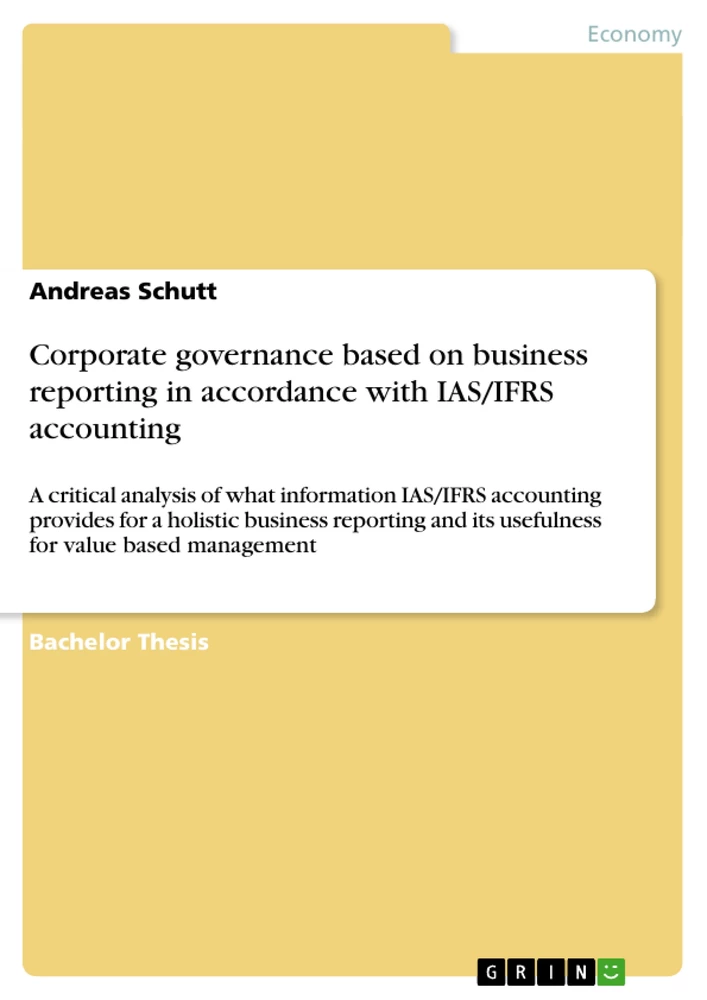
Table of Contents
1 Introduction
1.1 Objective
1.2 Structure
2 Theoretical background
2.1 Corporate governance
2.1.1 Corporation
2.1.1.1 Types of organisations
2.1.1.2 Attributes of corporations
2.1.1.3 Corporate capital structure
2.1.1.4 Corporate management
2.1.2 Corporation’s need for governance
2.1.3 Governance
2.1.3.1 Governance of a corporation
2.1.3.2 Corporate governance objectives
2.1.3.2.1 Shareholder value
2.1.3.2.2 Stakeholder view
2.1.3.2.3 Corporate social responsibility
2.1.4 Corporate governance system
2.1.4.1 Shareholder-oriented corporate governance systems
2.1.4.2 Stakeholder-oriented corporate governance systems
2.1.4.3 Integrated corporate governance systems
2.2 Accounting
2.2.1 Financial accounting vs. management accounting
2.2.2 Information asymmetry and principal-agent theory
2.2.2.1 Problems of information asymmetry according to the principal-agent theory
2.2.2.1.1 Hidden characteristics
2.2.2.1.2 Hidden action and hidden information
2.2.2.1.3 Hidden intention
2.2.2.2 Application of the principal-agent theory on information asymmetry within accounting
2.2.2.2.1 Solutions of the issues from the principal-agent theory
2.2.2.2.2 Application of accounting on the solutions of the issues of the principal-agent theory
2.2.3 Accounting reporting
2.2.3.1 Financial reporting vs. business reporting
2.2.3.2 Holistic business reporting
2.2.4 Internationalisation of accounting
2.2.4.1 Accounting choice
2.2.4.2 Harmonisation and standardisation of accounting
2.2.4.3 International Accounting Standards
2.3 Conclusive summary
3 Analysis of what information International Accounting Standards / International Financial Reporting Standards accounting provides for a holistic business reporting
3.1 Overview of International Accounting Standards / International Financial Reporting Standards
3.1.1 International Accounting Standards / International Financial Reporting Standards
3.1.2 International Accounting Standards Board
3.1.3 International Accounting Standards Board Framework
3.2 Information of International Accounting Standards / International Financial Reporting Standards
3.2.1 Financial information of International Accounting Standards / International Financial Reporting Standards
3.2.1.1 Basic financial information
3.2.1.1.1 Balance sheet and statement of changes in equity
3.2.1.1.2 Income statement
3.2.1.1.3 Cash flow statement
3.2.1.2 Consolidated and financial information
3.2.1.2.1 Individual financial statement and consolidated financial statement
3.2.1.2.2 Interim financial reporting
3.2.1.2.3 Segment reporting
3.2.2 Non-financial information of International Accounting Standards / International Financial Reporting Standards
3.2.2.1 Notes
3.2.2.2 Management commentary
3.3 Conclusive summary
4 Analysis of the decision usefulness of information from holistic business reporting in accordance with International Accounting Standards / International Financial Reporting Standards accounting for corporate governance
4.1 Business case
4.1.1 Organisational structure
4.1.2 Institutionalisation of corporate governance
4.1.3 Financial reporting in accordance with International Accounting Standards / International Financial Reporting Standards
4.1.3.1 Consolidated financial statement
4.1.3.1.1 Consolidated balance sheet
4.1.3.1.2 Consolidated statement of changes in equity
4.1.3.1.3 Consolidated income statement
4.1.3.1.4 Consolidated cash flow statement
4.1.3.1.5 Notes to the consolidated financial statement
4.1.3.1.5.1 Liquid assets
4.1.3.1.5.2 Accounts receivable and other assets
4.1.3.1.5.3 Property, plant and equipment
4.1.3.1.5.4 Revenue Information
4.1.3.1.5.5 Sales and marketing
4.1.3.1.5.6 Income taxes
4.1.3.1.5.7 Supplementary cash flow information
4.1.3.2 Segment report
4.1.3.3 Management commentary
4.1.3.3.1 Nature of business
4.1.3.3.2 Objectives and strategy
4.1.3.3.3 Key resources, risks, opportunities and relationships
4.1.3.3.4 Results and prospects
4.1.3.3.5 Key performance indicators
4.2 Information needs of corporate governance
4.2.1 Entrepreneurial information needs
4.2.1.1 Types of entrepreneurial information
4.2.1.2 Supplying the entrepreneurial information needs
4.2.2 Environmental information needs
4.2.2.1 Types of environmental information
4.2.2.2 Supplying the environmental information needs
4.2.3 Information needs due to interdependence and comparability
4.3 Corporate governance based on holistic business reporting in accordance with International Accounting Standards / International Financial Reporting Standards
4.3.1 Supplying the entrepreneurial information needs of corporate governance by holistic business reporting in accordance with International Accounting Standards / International Financial Reporting Standards
4.3.2 Supplying the environmental information needs of corporate governance by holistic business reporting in accordance with International Accounting Standards / International Financial Reporting Standards
4.3.3 Supplying the information needs of corporate governance due to interdependence and comparability by holistic business reporting in accordance with International Accounting Standards / International Financial Reporting Standards
4.4 Conclusive summary
5 Conclusion
Research Objectives and Key Themes
This thesis examines the relationship between corporate governance and holistic business reporting based on IAS/IFRS standards. It aims to determine if and to what extent information provided by holistic business reporting—as defined by IAS/IFRS standards—can effectively support corporate governance decision-making processes, particularly regarding value-based management and various stakeholder needs.
- Corporate governance systems and their objectives within a for-profit environment.
- The role of information asymmetry and the principal-agent theory in corporate accounting.
- The transition from traditional financial reporting to holistic business reporting frameworks.
- Application of IAS/IFRS accounting information as a tool for corporate governance.
- Evaluation of the decision usefulness of accounting information for diverse stakeholder groups.
Excerpt from the Book
2.1 Corporate governance
The expression “corporate governance” is a frequently discussed topic in economic science, politics, law, and practice. Nevertheless, the corporate governance concept is poorly defined because it covers a lot of distinct phenomena and its definitions have drawn a sophisticated picture depending on the perspective of corporate governance.
Some authors dealing with the subject of corporate governance suppose it at its core as an economical approach to optimise business processes and structures. Others believe that corporate governance is a legal and jurisprudential method to analyse and control business management. Furthermore, there are attempts to compare the meaning of corporate governance with business management, business control or business constitution. This has led to a large number of various definitions which basically reflect special interests in a particular field and make it hard to define corporate governance generally and specific at the same time.
The general question determining an adequate definition of corporate governance is which scope is applicable respectively whether the business management should be based on economic or jurisprudential aspects. The scope of corporate governance predominantly depends on the underlying governance object and its environmental influence factors as well as its aims and its purpose. As the first part of the corporate governance term already indicates, this is the business object corporation.
Therefore, the underlying governance object corporation as well as its special attributes concerning corporate governance are defined first. Subsequently, the need for governance of corporations is affiliated. This leads to the definition of governance in general as well as to the objectives of governing a corporation and finally concludes the definition of an appropriate understanding of a corporate governance system applicable to this thesis.
Summary of Chapters
1 Introduction: This chapter introduces the increasing demand for holistic business reporting and outlines the main goal of the thesis, which is to analyze the utility of IAS/IFRS-based information for corporate governance.
2 Theoretical background: This chapter defines the core concepts of corporate governance and accounting, establishing a framework for how accounting information supports decision-making to resolve information asymmetry.
3 Analysis of what information International Accounting Standards / International Financial Reporting Standards accounting provides for a holistic business reporting: This chapter investigates the structure and content of IAS/IFRS, detailing how financial and non-financial information (such as Management Commentary) contributes to a holistic view of the business.
4 Analysis of the decision usefulness of information from holistic business reporting in accordance with International Accounting Standards / International Financial Reporting Standards accounting for corporate governance: This chapter utilizes a business case study to assess how well IAS/IFRS reporting meets the specific information needs of corporate governance actors.
5 Conclusion: This final chapter synthesizes the research findings, concluding that while IAS/IFRS provides a solid foundation for financial transparency, it only partially satisfies the comprehensive information requirements of integrated corporate governance.
Keywords
Corporate Governance, IAS, IFRS, Holistic Business Reporting, Principal-Agent Theory, Information Asymmetry, Shareholder Value, Stakeholder View, Corporate Social Responsibility, Financial Statements, Management Commentary, Decision Usefulness, Accountability, Value Based Management, Consolidated Financial Statement.
Frequently Asked Questions
What is the core subject of this thesis?
The thesis explores the potential for corporate governance to utilize holistic business reporting based on IAS/IFRS standards to improve decision-making processes and organizational control.
What are the primary thematic areas?
The key themes include the definition of corporate governance systems, the application of principal-agent theory to account for information asymmetry, and the evaluation of how IAS/IFRS financial and non-financial information informs governance.
What is the main research objective?
The goal is to determine to what degree and in what way corporate governance can benefit from the information provided by holistic business reporting in accordance with IAS/IFRS.
Which scientific methods are employed?
The research relies on a theoretical analysis of corporate governance and accounting principles, complemented by the development of a specific business case study (using a multinational corporation model) to test the decision usefulness of information.
What does the main body of the work cover?
The main body examines the theoretical background of corporate governance, the mechanics of IAS/IFRS reporting, and a practical analysis of how this reporting fulfills the information needs of corporate governance in a simulated corporate environment.
Which keywords characterize this work?
The work is characterized by terms such as Corporate Governance, IAS/IFRS, Information Asymmetry, Principal-Agent Theory, and Holistic Business Reporting.
How does the author define an "integrated corporate governance system"?
It is defined as a system of continuing processes by which corporations are strategically coordinated and holistically controlled, in an entrepreneurial way and in a manner appropriate to corporate social responsibility.
Why does the author conclude that IAS/IFRS reporting is only "partially" useful for corporate governance?
The author concludes that while IAS/IFRS provides excellent financial data, it often lacks the comprehensive, inter-stakeholder-focused, and comparative data needed to fully satisfy the complex information requirements of an integrated corporate governance system.
Ende der Leseprobe aus 128 Seiten
- nach oben
- Arbeit zitieren
- Dipl. Wirt.-Inf. (FH), Dipl. Kfm. (FH), BBA Andreas Schutt (Autor:in), 2006, Corporate governance based on business reporting in accordance with IAS/IFRS accounting, München, Page::Imprint:: GRINVerlagOHG, https://www.diplomarbeiten24.de/document/92905

neugierig - aktuell - relevant
Entdecken Sie hilfreiche Tipps und Tricks rund ums Studium!

Entdecken Sie hilfreiche Tipps und Tricks rund ums Studium!
Ihre Hausarbeit / Abschlussarbeit:

- - Publikation als E-Book und Buch
- - Hohes Honorar auf die Verkäufe
- - Für Sie komplett kostenlos - mit ISBN
- - Es dauert nur 5 Minuten
- - Jede Arbeit findet Leser

- © GRIN Publishing GmbH.
- Alle Inhalte urheberrechtlich geschützt. Kopieren und verbreiten untersagt.
- info@grin.com
- AGB
- Open Publishing
Der GRIN Verlag hat sich seit 1998 auf die Veröffentlichung akademischer eBooks und Bücher spezialisiert. Der GRIN Verlag steht damit als erstes Unternehmen für User Generated Quality Content. Die Verlagsseiten GRIN.com, Hausarbeiten.de und Diplomarbeiten24 bieten für Hochschullehrer, Absolventen und Studenten die ideale Plattform, wissenschaftliche Texte wie Hausarbeiten, Referate, Bachelorarbeiten, Masterarbeiten, Diplomarbeiten, Dissertationen und wissenschaftliche Aufsätze einem breiten Publikum zu präsentieren.
Kostenfreie Veröffentlichung: Hausarbeit, Bachelorarbeit, Diplomarbeit, Dissertation, Masterarbeit, Interpretation oder Referat jetzt veröffentlichen!
Folgen Sie GRIN auf


- GRIN Verlag GmbH
-
- Nymphenburger Str. 86
- 80636
- Munich, Deutschland
- +49 89-550559-0
- +49 89-550559-10
- info@grin.com
-
