
präsentiert von

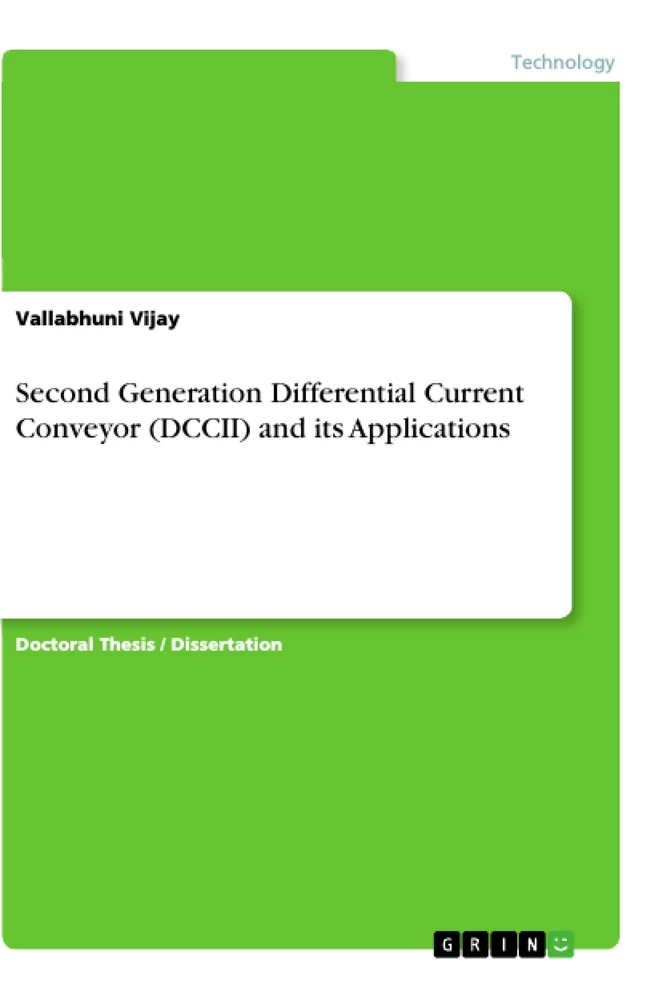
Table of Contents
1. Introduction and background
1.1 Introduction
1.2 Introduction to Current–Mode and Voltage–Mode Circuits
1.3 Thesis Objectives
1.4 Organization of Thesis
2. Second Generation Differential Current Conveyor (DCCII)
2.1 Introduction
2.2 CMOS Second Generation Differential Current Conveyor (DCCII)
2.2.1 Hassan O. Elwan DCCII, 1996
2.2.2 Firat Kacar DCCII, 2010
2.2.3 Reza Chavoshisani DCCII, 2011
2.2.4 BJT-DCCII Implementation, Metin DCCII, 2012
2.2.5 Bilgin Metin DCCII, 2014
2.2.6 Emre Arslan DCCII, 2016
2.2.7 Sajjad Shahsavari DCCII, 2015
2.2.8 Montree Kumngern DCCII, 2014
2.2.9 Sinem Ciftcioglu DCCII, 2005
2.2.10 Hesham F. Hamed DCCII, 2001
2.3 DCCII Implementation Using AD844AN
2.4 Summary
3. Review of Literature
3.1 Introduction
3.2 DCCII Applications
3.3 All-pass Filters Using DCCII
3.4 DCCII Based Band-Pass Filter
3.5 DCCII Based Multiple Output Filter
3.6 DCCII Based Current Comparator
3.7 DCCII Based Inductance Simulator
3.8 DCCII Based Four Quadrant Multiplier
3.9 DCCII Based FDNR Circuit Application
3.10 DCCII Based Frequency Compensation methods
3.11 Summary
4. DCCII Based Waveform Generators And All-Pass Filters
4.1 Introduction
4.2 Square Waveform Generators Using Single DCCII
4.2.1 Proposed Square Waveform Generator 1
4.2.2 Proposed Square Waveform Generator 2
4.2.3 Proposed Square Waveform Generator 3
4.3 All-pass Filter Circuits Using Single DCCII
4.3.1 Proposed All-Pass Filter 1
4.3.2 Proposed All-Pass Filter 2
4.3.3 Proposed All-Pass Filter 3
4.4 Summary
5. DCCII Based Waveform Generators and All-Pass Filters: Simulation Results
5.1 Introduction
5.2 Square Waveform Generators Using Single DCCII
5.2.1 Simulation Results
5.3 All-pass Filter Circuits Using Single DCCII
5.3.1 Simulation Results
5.4 Summary
6. DCCII Based Waveform Generators And All-Pass Filters: Experimental Results
6.1 Introduction
6.2 Square Waveform Generators Using Single DCCII
6.2.1 Experimental Results
6.3 All-pass Filter Circuits Using Single DCCII
6.3.1 Experimental Results
6.4 Summary
7. Conclusions and Scope for Future Work
7.1 Conclusions
7.2 Scope For Future Work
Research Objectives and Key Themes
This thesis focuses on the exploration and implementation of the Second Generation Differential Current Conveyor (DCCII) as an efficient building block for analog circuit design. The primary research objective is to develop new, high-performance, low-voltage, and low-power circuit solutions for waveform generation and frequency-selective signal processing, overcoming the limitations inherent in operational amplifier-based circuits.
- Design and CMOS implementation of high-performance DCCII circuits.
- Development of novel square wave generators using DCCII with minimal passive components.
- Proposing new all-pass filter configurations suitable for integrated circuit realization.
- Validation of theoretical designs through Cadence Spectre simulations and experimental hardware prototyping.
- Analysis of the current-mode approach's advantages in terms of bandwidth, linearity, and power efficiency.
Auszug aus dem Buch
1.1. Introduction
In general, Square wave generators are facing vital role in many electronic applications as a reference input for analog signal handling functions. Those are, in specifically, communication equipments, control modules, signal dispensation appliances, measurement blocks, feedback control circuits for power conversion mechanism, based on operating frequency range used in sensor interfaces, telecommunications and clock for digital structures (J.M. Jacob et al, 2000, S. Franco et al, 2002). All these prerequisites are fulfilled with the operational amplifier (OA) based classical square wave generator (J.M. Jacob et al, 2000). Conversely, OAs has the snag of lower operating frequencies as it bears from lower slew rate and flat gain bandwidth product limitation (H.C. Chien, 2012).
For the last two decades, because of the advantages of high performance and versatility all the electronic applications are being designed using current mode (B. Dalibor et al, 2008). The inevitable reasons for switching from voltage mode to current mode are high slew rate, improved dynamic range, better bandwidth, easiness in circuit realization, power reduction (K.K. Abdalla et al, 2012), (M. Akbari et al, 2015). The waveform generator proposed using Operational transconductance amplifier (OTA) in S.K. Kar et al, 2011, used more active elements in addition to that of possession of more passive components causes more power consumption and occupies even more area besides the advantages of grounded capacitor feature offered. The circuit in A.D. Marcellis et al, 2013 has used only a couple of active elements, but uses seven passive components and also not offering the grounded capacitor. Given circuits in R. Pal et al, 2015, H.C. Chien et al, 2014, S. Malik et al, 2015, A. Srinivasulu et al, 2016, S. Minaei et al, 2012 consists of same glitch of usage of higher number of passive and active devices causes the circuit usage limited to less in IC fabrication. In order to make the circuit simpler and designer’s choice by using only one active and minimum possible usage of passive components with maximum reduction of noise effects and parasitics in designing a waveform generator, a new CM current differencing device is designed.
Summary of Chapters
Chapter I: Introduction and background: Provides an overview of current-mode circuit design and the motivation for using DCCII-based circuits for square wave generation and filtering.
Chapter II: Second Generation Differential Current Conveyor (DCCII): Discusses the theoretical background and various CMOS implementations of the DCCII device, detailing its terminal characteristics and structural design.
Chapter III: Review of Literature: Reviews existing current-mode applications, including filters, oscillators, and multipliers, highlighting the need for the proposed design optimizations.
Chapter IV: DCCII Based Waveform Generators And All-Pass Filters: Introduces the novel proposed circuits for square wave generation and all-pass filtering, including mathematical derivations for their operation.
Chapter V: DCCII Based Waveform Generators and All-Pass Filters: Simulation Results: Presents the Cadence Spectre simulation results that validate the mathematical models and performance metrics of the proposed designs.
Chapter VI: DCCII Based Waveform Generators And All-Pass Filters: Experimental Results: Details the hardware implementation and experimental validation of the proposed circuits using AD844AN ICs on a laboratory breadboard.
Chapter VII: Conclusions and Scope for Future Work: Summarizes the thesis achievements, confirms the performance advantages of the proposed circuits, and outlines future research directions in sub-microvolt and advanced technology node implementation.
Keywords
All-pass filter, Current mode and voltage mode device, Duty Cycle, Linearity, Noise effect, Oscillators, Second Generation Differential Current Conveyor, Signal processing, Square Wave Generators, Voltage Cascading Applications.
Frequently Asked Questions
What is the core focus of this doctoral thesis?
The thesis investigates the Second Generation Differential Current Conveyor (DCCII) as a fundamental building block for creating high-performance, current-mode analog circuits, specifically targeting improved square wave generators and all-pass filters.
What are the primary advantages of the current-mode (CM) approach over traditional voltage-mode (VM) methods?
The CM approach offers superior performance characteristics, including significantly improved bandwidth, higher slew rates, enhanced linearity, reduced power consumption, and greater versatility in circuit realization.
What is the research goal regarding square wave generators?
The research aims to create simpler, high-performance square wave generators that utilize minimal active and passive components while ensuring electronic tunability and stable frequency generation compared to legacy designs.
Which scientific methodology is applied in this research?
The work employs a multi-stage methodology involving theoretical mathematical derivation of circuit behavior, circuit design using Cadence CMOS gpdk 180 nm parameters, simulation validation via SPECTRE, and practical hardware verification using AD844AN ICs.
What does the main body of the work address?
The main body covers the comprehensive study of various DCCII implementations, a literature review of existing current-mode circuits, the proposal of new waveform and filter topologies, and the detailed presentation of simulation and experimental data.
Which key terminology defines this work?
Key terms include DCCII, all-pass filters, square wave generators, current-mode signal processing, and low-power integrated circuit design.
How does the usage of grounded capacitors impact the circuit design?
Grounded capacitors are preferred in this research because they significantly reduce parasitic effects, avoid noise issues associated with floating capacitors, and are easier to integrate during IC manufacturing.
How are the proposed circuits validated in the laboratory?
The proposed circuits are constructed as prototypes on laboratory breadboards using commercially available AD844AN current feedback operational amplifiers (CFOA) and external passive components, allowing for comparison with theoretical and simulation results.
Ende der Leseprobe aus 134 Seiten
- nach oben
- Arbeit zitieren
- Dr. Vallabhuni Vijay (Autor:in), 2017, Second Generation Differential Current Conveyor (DCCII) and its Applications, München, Page::Imprint:: GRINVerlagOHG, https://www.diplomarbeiten24.de/document/934406

neugierig - aktuell - relevant
Entdecken Sie hilfreiche Tipps und Tricks rund ums Studium!

Entdecken Sie hilfreiche Tipps und Tricks rund ums Studium!
Ihre Hausarbeit / Abschlussarbeit:

- - Publikation als E-Book und Buch
- - Hohes Honorar auf die Verkäufe
- - Für Sie komplett kostenlos - mit ISBN
- - Es dauert nur 5 Minuten
- - Jede Arbeit findet Leser

- © GRIN Publishing GmbH.
- Alle Inhalte urheberrechtlich geschützt. Kopieren und verbreiten untersagt.
- info@grin.com
- AGB
- Open Publishing
Der GRIN Verlag hat sich seit 1998 auf die Veröffentlichung akademischer eBooks und Bücher spezialisiert. Der GRIN Verlag steht damit als erstes Unternehmen für User Generated Quality Content. Die Verlagsseiten GRIN.com, Hausarbeiten.de und Diplomarbeiten24 bieten für Hochschullehrer, Absolventen und Studenten die ideale Plattform, wissenschaftliche Texte wie Hausarbeiten, Referate, Bachelorarbeiten, Masterarbeiten, Diplomarbeiten, Dissertationen und wissenschaftliche Aufsätze einem breiten Publikum zu präsentieren.
Kostenfreie Veröffentlichung: Hausarbeit, Bachelorarbeit, Diplomarbeit, Dissertation, Masterarbeit, Interpretation oder Referat jetzt veröffentlichen!
Folgen Sie GRIN auf


- GRIN Verlag GmbH
-
- Nymphenburger Str. 86
- 80636
- Munich, Deutschland
- +49 89-550559-0
- +49 89-550559-10
- info@grin.com
-
