
präsentiert von

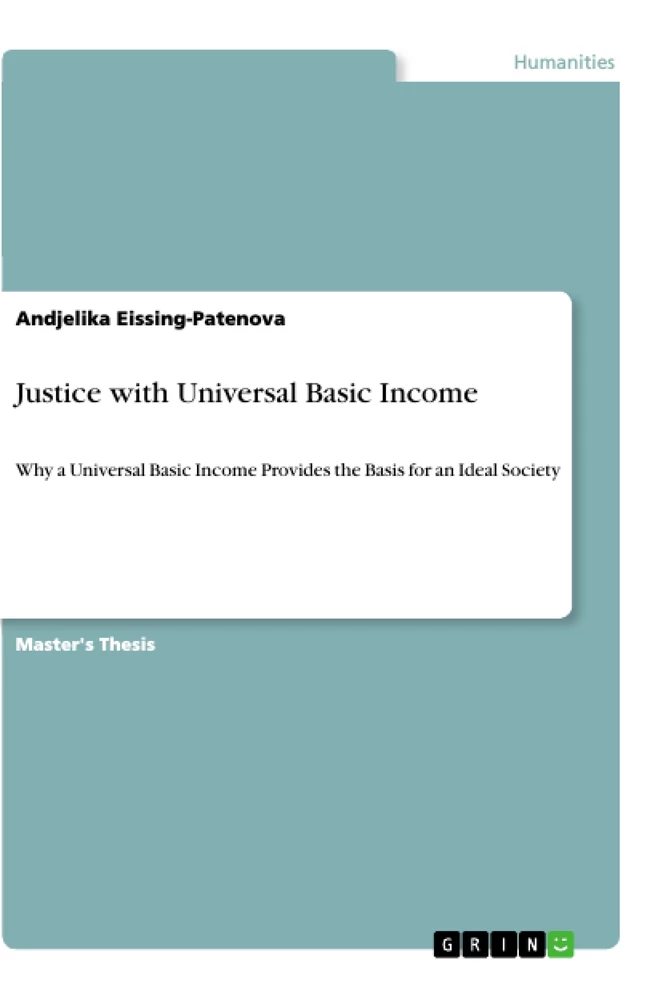
Table of Contents
1 INTRODUCTION
2 AN IDEAL SOCIETY
2.1 WHAT IS AN IDEAL SOCIETY?
2.2 SETTING UP PRINCIPLES OF JUSTICE
2.2.1 FIRST APPROXIMATION
2.2.1.1 THOUGHT EXPERIMENTS
2.2.1.2 A HYPOTHETICAL CONTRACT
2.2.2 MORAL JUSTIFICATION
2.2.2.1 MORALLY IRRELEVANT FACTORS
2.2.2.2 DISCUSSING DISTRIBUTIVE PRINCIPLES
2.2.2.2.1 UTILITARIANISM
2.2.2.2.2 LIBERTARIANISM
2.2.2.2.3 MERITOCRACY
2.2.2.2.4 EGALITARIANISM
3 UNIVERSAL BASIC INCOME FOR AN IDEAL SOCIETY
3.1 WHAT IS A UBI?
3.2 UBI REALISES RAWLS’ PRINCIPLES OF JUSTICE
3.2.1 DIFFERENCE PRINCIPLE
3.2.2 FAIR EQUALITY OF OPPORTUNITY
4 FUNDING SOURCES
4.1 INCOME TAX
4.2 CONSUMPTION TAX
4.3 MIXED MODEL
5 CONCLUSION
Research Objectives & Topics
This thesis examines the philosophical justification for a Universal Basic Income (UBI) as a foundational element of an ideal society, defined through John Rawls’ egalitarian principles of justice. The research aims to demonstrate how a UBI effectively addresses social and economic inequalities by providing claim rights alongside liberty rights, thereby ensuring fair equality of opportunity and promoting dignity for all citizens.
- The theoretical evaluation of distributive justice principles (utilitarian, libertarian, meritocratic, and egalitarian).
- The application of the "original state" and "veil of ignorance" thought experiments to determine just societal structures.
- The analysis of UBI's capacity to realize Rawls' Difference Principle and ensure fair equality of opportunity.
- A philosophical assessment of various funding models, including income taxation, consumption taxation, and mixed strategies.
Excerpt from the Book
2.2.2.2.1 UTILITARIANISM
Utilitarian theory morally assesses objects (in a very broad sense, e.g. intentions, actions, principles etc.) by their consequences or outcomes In particular, the highest utilitarian principle is to maximize utility. (Bentham, 1823, pp. 2 ff.) The understanding of utility reaches from pleasure, advantage, good (Bentham, 1823, p. 3) to happiness (Crisp, 1997, p. 7). Within the discourse of distributive justice, utilitarianism falls under the realm of welfare-based principles. In that context, the best distribution in a society is the one that brings about the most welfare in total. (SEP, 2017a)
What are the implications of that account? Utilitarianism can be interpreted as being collectivist, for its principle is to maximize the utility of the collective – in our context, the welfare of society – as a whole. That doesn’t mean that ‘the collective‘ is to be understood as an own entity. Rather the welfare of the collective is calculated by summing up the (quality of) welfare of the single individuals. (Bentham, 1823, p. 4) But utilitarianism stops at that point. There are no further requirements. And that entails morally unbearable risks: as long as welfare is maximized, utilitarianism leaves open the question of how to achieve that goal. In other words, there are no requirements of how to treat particular individuals in order to attain the greatest welfare in sum. What if the greatest welfare can be attained by establishing slavery? What if the pain of a minority of slaves is worth the even greater pleasure for those who enjoy their services? Another example: what if the general welfare can be maximized by excluding a certain minority – let’s say disabled or old persons – from taking part in daily social life. The majority of young, healthy and productive members may live a much better life without being bothered by the problems of the disabled and old. We see that, in order to maximize the utility of the collective, in some cases a utilitarian system might not only allow for, but even require a restriction of liberties of some (the slaves, disabled, old) for the sake of greater benefits for others.
Summary of Chapters
1 INTRODUCTION: This chapter introduces the utopian vision of a society where individuals are free and financially secure, framing the UBI as a potential tool to approximate this ideal.
2 AN IDEAL SOCIETY: This section defines an ideal society as one providing maximum justice, utilizing thought experiments like the "original state" to derive principles for a fair social structure.
3 UNIVERSAL BASIC INCOME FOR AN IDEAL SOCIETY: This chapter defines the UBI and argues that it is the most effective instrument for realizing John Rawls’ principles of justice, specifically the Difference Principle and Fair Equality of Opportunity.
4 FUNDING SOURCES: This section evaluates the feasibility and fairness of different tax models, including income tax, consumption tax, and mixed systems, against criteria of fairness, simplicity, and efficiency.
5 CONCLUSION: This final chapter synthesizes the core arguments, reaffirming that the UBI provides a necessary ethical foundation for an ideal society characterized by the greatest possible justice.
Keywords
Universal Basic Income, UBI, Justice, John Rawls, Distributive Justice, Ideal Society, Original State, Veil of Ignorance, Difference Principle, Fair Equality of Opportunity, Funding Models, Consumption Tax, Income Tax, Social Equality, Liberty Rights
Frequently Asked Questions
What is the core argument of this thesis?
The author argues that a Universal Basic Income (UBI) provides the ethical basis for an ideal society by ensuring the greatest possible justice through the realization of John Rawls’ principles of distribution.
Which distributive principles are primarily analyzed?
The work examines utilitarianism, libertarianism, meritocracy, and egalitarianism to determine which framework most effectively addresses morally irrelevant factors like birth and natural talent.
What is the ultimate goal regarding social justice?
The primary goal is to establish a society that minimizes the influence of morally irrelevant factors (such as social status or natural endowments) on an individual's life prospects.
What scientific methodology is utilized?
The thesis employs political philosophy methodology, specifically utilizing thought experiments (the original state) and deontological analysis to justify the necessity of claim rights within a liberal society.
How is the UBI defined in the context of this research?
A UBI is defined as a uniform, unconditional, and regular payment to every member of society, intended to cover basic needs and enable social, cultural, and political participation.
Which criteria are used to evaluate funding sources?
Funding models are assessed based on three philosophical and economic criteria: fairness, simplicity, and efficiency.
Why does the author prefer a consumption tax over an income tax for UBI funding?
The author suggests that consumption taxes are more sustainable and fairer in a digitalized future where human labor is increasingly replaced by automation, avoiding the disincentives associated with taxing earned income.
How does the UBI interact with the "Difference Principle"?
The UBI serves as a mechanism to maximize the benefits for the least advantaged, thereby compensating for inequalities arising from natural or social contingencies as required by Rawls' Difference Principle.
Ende der Leseprobe aus 74 Seiten
- nach oben
- Arbeit zitieren
- Andjelika Eissing-Patenova (Autor:in), 2020, Justice with Universal Basic Income, München, Page::Imprint:: GRINVerlagOHG, https://www.diplomarbeiten24.de/document/934428

neugierig - aktuell - relevant
Entdecken Sie hilfreiche Tipps und Tricks rund ums Studium!

Entdecken Sie hilfreiche Tipps und Tricks rund ums Studium!
Ihre Hausarbeit / Abschlussarbeit:

- - Publikation als E-Book und Buch
- - Hohes Honorar auf die Verkäufe
- - Für Sie komplett kostenlos - mit ISBN
- - Es dauert nur 5 Minuten
- - Jede Arbeit findet Leser

- © GRIN Publishing GmbH.
- Alle Inhalte urheberrechtlich geschützt. Kopieren und verbreiten untersagt.
- info@grin.com
- AGB
- Open Publishing
Der GRIN Verlag hat sich seit 1998 auf die Veröffentlichung akademischer eBooks und Bücher spezialisiert. Der GRIN Verlag steht damit als erstes Unternehmen für User Generated Quality Content. Die Verlagsseiten GRIN.com, Hausarbeiten.de und Diplomarbeiten24 bieten für Hochschullehrer, Absolventen und Studenten die ideale Plattform, wissenschaftliche Texte wie Hausarbeiten, Referate, Bachelorarbeiten, Masterarbeiten, Diplomarbeiten, Dissertationen und wissenschaftliche Aufsätze einem breiten Publikum zu präsentieren.
Kostenfreie Veröffentlichung: Hausarbeit, Bachelorarbeit, Diplomarbeit, Dissertation, Masterarbeit, Interpretation oder Referat jetzt veröffentlichen!
Folgen Sie GRIN auf


- GRIN Verlag GmbH
-
- Nymphenburger Str. 86
- 80636
- Munich, Deutschland
- +49 89-550559-0
- +49 89-550559-10
- info@grin.com
-
