
präsentiert von

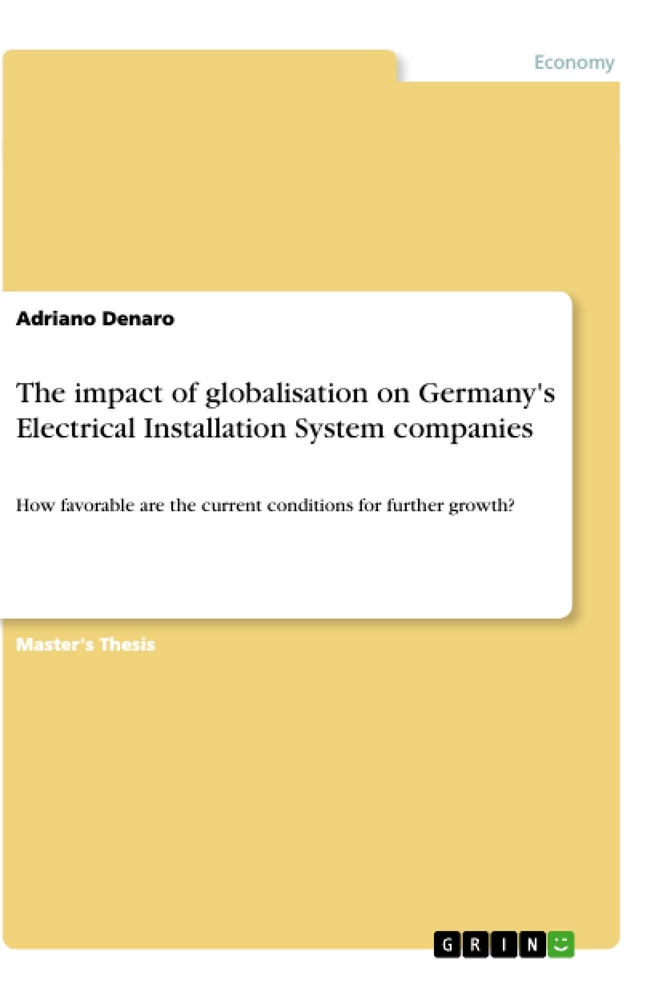
Table of Contents
1 Introduction
1.1 Management Issues
1.2 Thesis aims
1.3 Research design
1.4 Thesis Structure
2 Review of current thinking
2.1.1 Ethical reflection
3 Theoretical framework
3.1 PESTEL
3.2 Yip ́s Internationalisation Driver ́s
3.3 Porter ́s Five Forces
3.4 Market entry modes
3.4.1 The International Strategies
3.5 The Theories – a summary
4 Methodology
4.1 Research method
4.2 Ethical issues
4.3 Critical Review
5 Data collection
5.1 Industry focus
5.1.1 The German Electrical Installation System Market as target group
5.2 Assumptions
5.3 Design of Questionnaire
5.3.1 General Information
5.3.2 Strategic Position
5.3.3 Strategic Choices
5.3.4 Further Growth
5.4 Survey respondents
5.4.1 Structure of sample
5.4.2 Investigation Barriers
6 Data analysis
6.1 General Information
6.2 Strategic Position
6.2.1 Which are the external environmental factors on the strategy of Germen Electrical Installation System companies?
6.2.2 Which influences have competitors or suppliers in connection with globalisation on their strategy?
6.2.3 What are the globalised markets where GEISC are noticeable active?
6.3 Strategic Choices
6.3.1 Does GEISC have internationalisation strategies?
6.3.2 What are the globalisation strategies pursued by the German electric installation system companies?
6.3.3 How favourable are the conditions for further growth?
6.4 Secondary data analysis
6.4.1 Employees Trend
6.4.2 Turnover trend
7 Survey interpretation and findings
7.1 General
7.2 Strategic Position
7.3 Strategic Choices
7.4 Further Growth
8 Conclusion
9 List of references
10 APPENDICES
10.1 Appendix A: Market entry modes- Advantages & Disadvantages
10.2 Appendix B: Survey questionnaire
10.3 Appendix C: Summary of survey results
Research Objectives & Key Themes
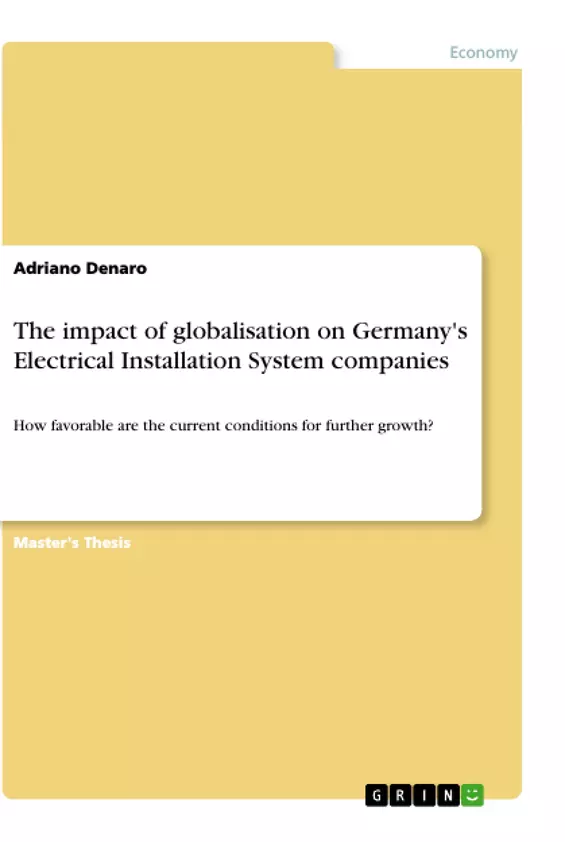
This thesis examines the impact of globalisation on the strategies of German companies within the Electrical Installation System sector. It specifically investigates whether these companies possess explicit internationalisation strategies, how they assess current global growth conditions, and what strategic adjustments are required to maintain competitiveness in a changing global landscape.
- Analysis of the strategic position of German Electrical Installation System companies.
- Evaluation of market entry modes and internationalisation strategies.
- Assessment of external environmental drivers using PESTEL and Porter's Five Forces.
- Identification of growth opportunities and risks within international markets.
- Analysis of turnover trends and the shift from domestic to global market focus.
Excerpt from the Book
1 Introduction
The German electrical industry is one of the most important industrial sectors in Germany (Statista, 2013). According to German (Zentralverband der Elektro Industrie - Central union of the electro industry) ZVEI, Germany is one of the largest electric producers in the world (ZVEI, 2011). The product range of German electrical companies includes innovative (cross-sectional) technologies and is widely spread. The portfolio is divided in capital goods, intermediate goods and consumer goods. According to DeStatis (2014) the German electrical industry consist of more than 15 market segments. In this case this thesis is limited to the market segment of the German Electrical Installation System. Chapter 5.1.1 describes the investigated area and gives an overview of the characteristics of the German Electrical Installation System market.
Germany is undergoing a change, in everyday life, in the economy and in society world. The usage of electronics continues to rise. In the shortest time they are able to generate completely new complex and highly efficient systems. In 2013 the export value amounted €158 billion (ZVEI, 2014). Thus, the electronic industry is one of the largest exporting sectors in Germany.
According to the ZVEI (2014) the most important electrical export countries are the USA, China and France with strong global activities. With this knowledge, the researcher raises the questions: Does globalisation impact the strategies of Germany´s Electrical Installation System companies? And how favourable are the current conditions for further growth?
Summary of Chapters
1 Introduction: This chapter defines the research purpose and questions regarding the impact of globalisation on the German Electrical Installation System industry.
2 Review of current thinking: This section examines existing literature on international strategies and ethical considerations relevant to the global business landscape.
3 Theoretical framework: This chapter introduces key analytical models such as PESTEL, Porter's Five Forces, and market entry theories to support the empirical research.
4 Methodology: This section describes the research design, detailing the use of a quantitative survey administered to industry managers.
5 Data collection: This chapter details the collection process, including industry focus and survey design, and provides descriptive data on the German electrical market.
6 Data analysis: This chapter presents the empirical results of the survey, categorized by strategic position, choices, and growth conditions.
7 Survey interpretation and findings: This section interprets the survey results and secondary data, providing strategic insights for the target industry.
8 Conclusion: This final chapter synthesizes the research findings and offers recommendations for the strategic alignment of German companies.
Keywords
Dissertation, German Electrical Industry, German Electrical Installation System, Globalisation, Internationalisation, International-Trade & Competition, International Strategy, Strategy, PESTEL, Porter's Five Forces, Market Entry, Export, Innovation, Industry 4.0, Growth Targets
Frequently Asked Questions
What is the core focus of this dissertation?
The dissertation investigates how globalisation affects the business strategies of German companies in the Electrical Installation System sector and assesses their growth prospects.
Which key themes are explored?
The research explores strategic positioning, international market entry modes, the impact of external environmental factors, and the role of innovation projects like Industry 4.0.
What is the primary research objective?
The objective is to determine if globalization influences company strategies and to identify favourable conditions for future international growth.
What scientific methods were employed?
The author uses a mixed methodology, combining a literature review of theoretical frameworks (e.g., PESTEL, Porter's Five Forces) with primary quantitative data gathered via an online survey of industry managers.
What does the main body of the work cover?
The main body covers the theoretical foundations, the methodology of the empirical survey, the analysis of survey responses, and an interpretation of these findings in the context of secondary market data.
What are the primary keywords associated with this work?
Key terms include Globalisation, Internationalisation, German Electrical Installation System, International Strategy, and competitive advantage.
How do German companies currently view internationalisation?
The survey findings reveal that many of these companies are active internationally but often lack a formal, long-term internationalisation strategy, frequently relying on simple export models.
What is the recommended strategic direction for these companies?
The author recommends that companies should formalize their internationalisation strategies and broaden their market focus to include emerging markets with high building investment potential, such as Turkey.
Ende der Leseprobe aus 118 Seiten
- nach oben
- Arbeit zitieren
- Adriano Denaro (Autor:in), 2015, The impact of globalisation on Germany's Electrical Installation System companies, München, Page::Imprint:: GRINVerlagOHG, https://www.diplomarbeiten24.de/document/935817

neugierig - aktuell - relevant
Entdecken Sie hilfreiche Tipps und Tricks rund ums Studium!

Entdecken Sie hilfreiche Tipps und Tricks rund ums Studium!
Ihre Hausarbeit / Abschlussarbeit:

- - Publikation als E-Book und Buch
- - Hohes Honorar auf die Verkäufe
- - Für Sie komplett kostenlos - mit ISBN
- - Es dauert nur 5 Minuten
- - Jede Arbeit findet Leser

- © GRIN Publishing GmbH.
- Alle Inhalte urheberrechtlich geschützt. Kopieren und verbreiten untersagt.
- info@grin.com
- AGB
- Open Publishing
Der GRIN Verlag hat sich seit 1998 auf die Veröffentlichung akademischer eBooks und Bücher spezialisiert. Der GRIN Verlag steht damit als erstes Unternehmen für User Generated Quality Content. Die Verlagsseiten GRIN.com, Hausarbeiten.de und Diplomarbeiten24 bieten für Hochschullehrer, Absolventen und Studenten die ideale Plattform, wissenschaftliche Texte wie Hausarbeiten, Referate, Bachelorarbeiten, Masterarbeiten, Diplomarbeiten, Dissertationen und wissenschaftliche Aufsätze einem breiten Publikum zu präsentieren.
Kostenfreie Veröffentlichung: Hausarbeit, Bachelorarbeit, Diplomarbeit, Dissertation, Masterarbeit, Interpretation oder Referat jetzt veröffentlichen!
Folgen Sie GRIN auf


- GRIN Verlag GmbH
-
- Nymphenburger Str. 86
- 80636
- Munich, Deutschland
- +49 89-550559-0
- +49 89-550559-10
- info@grin.com
-
