
präsentiert von

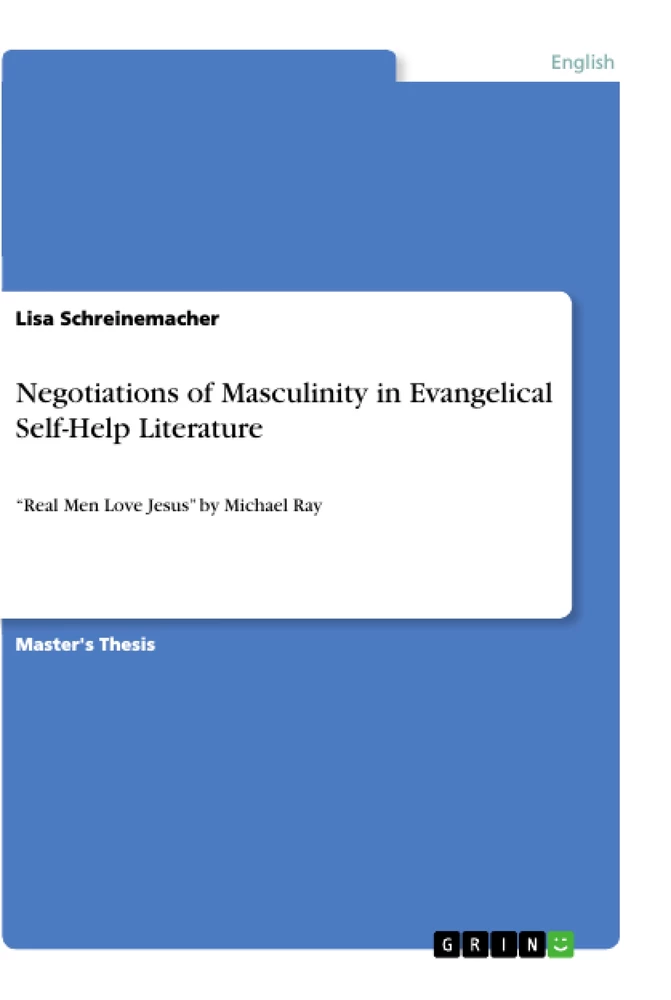
Table of Contents
1. Introduction: Why Evangelical Men Really Love Jesus
2. Men As Providers
2.1.What Wives Wish Their Husbands Knew About Women
2.1.1. Characteristics of a Man
2.1.2. What Is Wrong With Men?
2.1.3. How to Make Your Wife Happy
3. Men As Tender Warriors
3.1.Tender Warrior
3.1.1. The Pillar of the King
3.1.2. The Pillar of the Warrior
3.1.3. The Pillar of the Mentor
3.1.4. The Pillar of the Friend
4. Men As Dangerous Warriors
4.1.Wild at Heart
4.1.1. A Battle to Fight
4.1.2. An Adventure to Live
4.1.3. A Beauty to Rescue
5. Conclusion
Research Objectives and Themes
This master thesis investigates how evangelical self-help literature has negotiated and shaped ideals of masculinity from the 1970s to the early 2000s, analyzing how these texts promote aggressive or militant characteristics under the guise of biblical teachings to maintain patriarchal structures.
- Evolution of evangelical masculine ideals from the 1970s to the post-9/11 era.
- Connection between religious gender ideology and the maintenance of female subordination.
- Use of hegemonic masculinity theory to analyze the power dynamics within evangelical self-help manuals.
- Role of popular culture, sports, and war imagery in constructing modern evangelical manhood.
- Impact of these negotiations on social attitudes towards gender equality and sexual minorities.
Excerpt from the Book
3.1.2. The Pillar of the Warrior
The second pillar is the pillar of the warrior (Weber 41). A warrior is given strength and his purpose is to protect and offer stability (41). First and foremost, he is the protector of his family, but he is also responsible to protect his church, community and the nation (42). Weber remarks that men are at their best when they can protect and defend (41). The warrior man has high moral standards and “is willing to live by them, stand by them, spend himself in them, and if necessary die for them” (41). In regards to the Promise Keepers Movement, men should live according to the aforementioned seven promises. Weber claims that, keeping these promises will result in true manhood and provide some form of stability for the family and the nation (59). Since at the center of the warrior is his purpose to offer security, Weber likes to mention his own experiences as a soldier during Vietnam War. Overall in his book, Weber creates a tense and urgent atmosphere whilst talking about his war experiences. He opens his book with a combat scenery and his near-death experience, when he had to jump out of a plane and realized that this was his wake-up call (16). He admits to his readers that he “faced the real possibility that I would never come home”(16) and that he “could actually die. Within hours. Minutes. Seconds” (16). His choice of words throughout the book indicates that a man’s world is a world of warriors. He makes use of words like archer, arrows, target, shooting, shaft, hunting, and many more (155). Without any doubt, the challenges he had to face during the war must have been devastating. However, during this difficult time he realized the strength and endurance of manhood (56). Weber illustrates that while he and his fellow comrades were crawling along on our bellies under logs and through mucky, water-filled trenches … we began to find out something about the limits of a man’s mind and body. We could get along without food. We could function without sleep. We could go day after day after day. (56)
Summary of Chapters
1. Introduction: Why Evangelical Men Really Love Jesus: Introduces the research focus on evangelical self-help literature as an underrated genre that shapes gender definitions through a lens of militant masculinity.
2. Men As Providers: Analyzes James Dobson’s 1975 book to illustrate how 1970s evangelicalism established men as the authoritative heads and financial providers of the nuclear family.
3. Men As Tender Warriors: Explores the 1990s Promise Keepers Movement and Stu Weber’s work, which introduced a more complex, four-pillar model of manhood that balances authority with a new focus on emotional vulnerability.
4. Men As Dangerous Warriors: Examines John Eldredge’s work in the post-9/11 context, highlighting a shift toward a more aggressive, wild, and hyper-masculine definition of the evangelical man.
5. Conclusion: Synthesizes the findings, arguing that evangelical self-help manuals have become increasingly militaristic over time, consistently serving to justify patriarchal control and resist gender equality.
Keywords
Evangelicalism, Masculinity, Gender Roles, Self-Help Literature, Hegemonic Masculinity, Patriarchy, James Dobson, Promise Keepers, John Eldredge, Bible, Family Values, Christian Warrior, Gender Inequality, Fatherhood, Servant Leadership
Frequently Asked Questions
What is the core subject of this thesis?
The thesis explores the construction and negotiation of masculine ideals within evangelical self-help literature from the 1970s through the early 2000s.
What are the primary themes addressed?
Key themes include the defense of traditional family values, the concept of male headship, the role of fatherhood, and the shift from domestic providership to a more militant, "warrior-like" masculinity.
What is the research goal?
The primary goal is to analyze how these self-help manuals influence gender ideology and maintain patriarchal power structures, often by framing female subordination as divinely ordained.
Which theoretical framework is utilized?
The author primarily employs Raewyn Connell’s theory of "hegemonic masculinity" to analyze the supremacy of heterosexual, white, evangelical men and the marginalization of other gender roles.
What does the main part of the thesis cover?
It provides an in-depth analysis of three distinct evangelical books across different decades, tracing the evolution from Dobson’s 1970s provider role to Weber’s 1990s "Tender Warrior" and Eldredge’s post-9/11 "Dangerous Warrior" model.
Which keywords characterize the work?
Essential keywords include Evangelicalism, Masculinity, Hegemonic Masculinity, Patriarchy, Christian Warrior, and Biblicism.
How does the author interpret the shift to militant masculinity after 9/11?
The author argues that the terrorist attacks intensified the evangelical demand for strong, aggressive, and heroic men, leading to a rejection of "softer" or more sensitive masculine ideals in favor of a wilder, more dangerous warrior archetype.
Does this work analyze the role of sports in evangelical masculinity?
Yes, the author highlights how football metaphors and, more recently, Mixed Martial Arts (MMA) are used in evangelical ministries to cultivate a bold, physical, and aggressive Christian identity.
Ende der Leseprobe aus 74 Seiten
- nach oben
- Arbeit zitieren
- Lisa Schreinemacher (Autor:in), 2020, Negotiations of Masculinity in Evangelical Self-Help Literature, München, Page::Imprint:: GRINVerlagOHG, https://www.diplomarbeiten24.de/document/937318


neugierig - aktuell - relevant
Entdecken Sie hilfreiche Tipps und Tricks rund ums Studium!

Entdecken Sie hilfreiche Tipps und Tricks rund ums Studium!
Ihre Hausarbeit / Abschlussarbeit:

- - Publikation als E-Book und Buch
- - Hohes Honorar auf die Verkäufe
- - Für Sie komplett kostenlos - mit ISBN
- - Es dauert nur 5 Minuten
- - Jede Arbeit findet Leser

- © GRIN Publishing GmbH.
- Alle Inhalte urheberrechtlich geschützt. Kopieren und verbreiten untersagt.
- info@grin.com
- AGB
- Open Publishing
Der GRIN Verlag hat sich seit 1998 auf die Veröffentlichung akademischer eBooks und Bücher spezialisiert. Der GRIN Verlag steht damit als erstes Unternehmen für User Generated Quality Content. Die Verlagsseiten GRIN.com, Hausarbeiten.de und Diplomarbeiten24 bieten für Hochschullehrer, Absolventen und Studenten die ideale Plattform, wissenschaftliche Texte wie Hausarbeiten, Referate, Bachelorarbeiten, Masterarbeiten, Diplomarbeiten, Dissertationen und wissenschaftliche Aufsätze einem breiten Publikum zu präsentieren.
Kostenfreie Veröffentlichung: Hausarbeit, Bachelorarbeit, Diplomarbeit, Dissertation, Masterarbeit, Interpretation oder Referat jetzt veröffentlichen!
Folgen Sie GRIN auf


- GRIN Verlag GmbH
-
- Nymphenburger Str. 86
- 80636
- Munich, Deutschland
- +49 89-550559-0
- +49 89-550559-10
- info@grin.com
-
