
präsentiert von

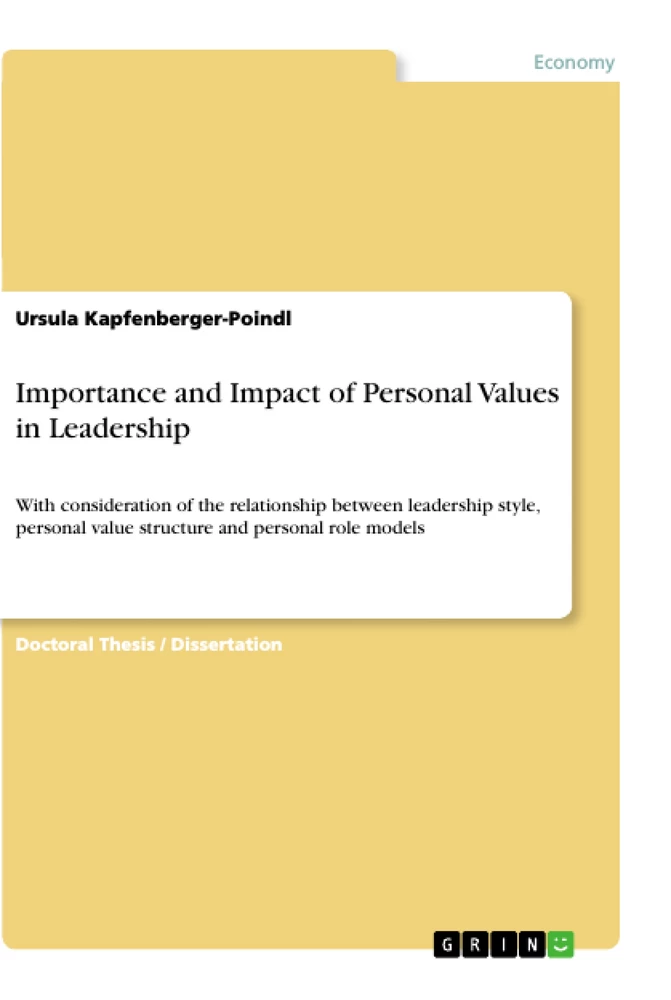
Table of Contents
1 INTRODUCTION
1.1 Problem and initial situation
1.2 Research questions, hypotheses and objectives
1.3 Methodology and structure of the work
2 ANALYSIS OF LITERATURE
2.1 Leadership
2.1.1 Definition
2.1.2 Leadership Theory
2.1.3 Leadership Styles
2.1.4 Tasks of Leadership
2.1.5 Crucial Key Factors in Leadership
2.1.6 Corporate Culture
2.1.7 Summary
2.2 Personal and Organizational Values
2.2.1 Definition
2.2.2 Value Theory
2.2.3 Personal Value Models
2.2.4 Value Studies
2.2.5 Summary
3 EMPIRICAL STUDY
3.1 Research Design
3.2 Survey and Analysis
3.2.1 Secondary Research
3.2.2 Primary Research
3.3 Answers to Key Questions and Hypotheses
4 CONCLUSION
4.1 Target Achievement
4.2 Findings and Scientific results
4.3 Limits of Research and Recommendations
Objectives and Research Themes
The dissertation aims to explore the significance of leadership values at both the individual and executive levels. By integrating scientific theories with an empirical survey of managers, the study seeks to uncover value-based conflicts, investigate the influence of early role models, and provide recommendations for a more effective and humane approach to leadership.
- Analysis of the evolution of leadership styles and the role of personal value orientations.
- Examination of the correspondence between personal values, corporate governance, and leadership behavior.
- Evaluation of how early childhood role models influence the value structures of contemporary executives.
- Identification of value-based gaps between theoretical leadership descriptions and practical survey findings.
Excerpt from the Book
1.1 Problem and initial situation
When people act, they often act on the basis of their personal value system. These values are characterized by personal experiences, by socialization in childhood and school, by the opinions and beliefs of family and friends, by religious leaders or later by superiors. Also the specific geographical and political region where a person live, makes a difference to the personal value world. Schools and universities communicate certain value schemes, as well as commercials in the TV or hero’s and protagonists in books or movies. All these experiences influence the personality and also the own value system. With this base of vast amount of impressions and values, every human being develops its own personal value profile. These values become part of the personality and change little or very slowly. However, a person can show different value patterns in different situations. Thus, not every single personal value that is relevant in private life will be important or expedient in the professional field. Only few universal values are valid for a whole society or an organization. Most values are individually noticed by people and their importance is varying. In extreme cases complementary values compete within a society or are contradictory (Volkmann, 2012, p. 154ff) like the value “freedom” and “safety”, although they actually have equal importance. However, a complete aversion from personal values in different contexts is also unlikely, as this would contradict the nature of the person and could be, long-term, counterproductive or even unhealthy.
Summary of Chapters
1 INTRODUCTION: Outlines the problem, research questions, and the methodology used to investigate the relationship between personal values and leadership.
2 ANALYSIS OF LITERATURE: Reviews existing theories on leadership, management styles, and the scientific basis for personal and organizational values.
3 EMPIRICAL STUDY: Details the research design, the survey process, and provides a descriptive analysis of the findings regarding executive values and leadership styles.
4 CONCLUSION: Summarizes the results, reviews the achievement of research objectives, and provides recommendations for future study.
Keywords
Leadership styles, personal values, corporate culture, value-based leadership, transformational leadership, servant leadership, employee motivation, organizational values, role models, value theory, management, leadership behavior, empirical study, corporate ethics, decision-making.
Frequently Asked Questions
What is the core focus of this dissertation?
The dissertation examines the importance and impact of personal values on leadership, exploring how these values influence leadership styles, behavior, and the overall corporate environment.
What are the central thematic areas?
The main themes include leadership theories, the definition and structure of personal and organizational values, the impact of role models on professional development, and the link between values and corporate performance.
What is the primary research goal?
The research goal is to understand how personal values drive leadership behavior and to develop options for a more conscious, effective, and humane leadership approach.
What scientific methods were employed?
The research uses a two-part approach: a secondary analysis of existing scientific literature and an empirical primary survey involving 118 managers in Austria and neighboring countries.
What does the main body address?
The main body covers a comprehensive review of historical and modern leadership theories, a detailed value theory section, and an extensive analysis of survey data collected from executives across various sectors.
Which keywords characterize this work?
Key terms include Leadership styles, value-based leadership, personal values, corporate culture, and employee motivation.
How do early childhood role models affect current leadership?
The study suggests that values admired in childhood role models (such as family members or literature heroes) often persist and influence the personal and professional value systems of adult leaders.
Is there a discrepancy between leadership theory and practice?
Yes, the empirical survey reveals that leadership in practice often diverges from theoretical models, particularly in how value categories like stimulation or security are prioritized by managers compared to academic descriptions.
Ende der Leseprobe aus 227 Seiten
- nach oben
- Arbeit zitieren
- Mag. (FH) MSc, MBA Ursula Kapfenberger-Poindl (Autor:in), 2020, Importance and Impact of Personal Values in Leadership, München, Page::Imprint:: GRINVerlagOHG, https://www.diplomarbeiten24.de/document/938319

neugierig - aktuell - relevant
Entdecken Sie hilfreiche Tipps und Tricks rund ums Studium!

Entdecken Sie hilfreiche Tipps und Tricks rund ums Studium!
Ihre Hausarbeit / Abschlussarbeit:

- - Publikation als E-Book und Buch
- - Hohes Honorar auf die Verkäufe
- - Für Sie komplett kostenlos - mit ISBN
- - Es dauert nur 5 Minuten
- - Jede Arbeit findet Leser

- © GRIN Publishing GmbH.
- Alle Inhalte urheberrechtlich geschützt. Kopieren und verbreiten untersagt.
- info@grin.com
- AGB
- Open Publishing
Der GRIN Verlag hat sich seit 1998 auf die Veröffentlichung akademischer eBooks und Bücher spezialisiert. Der GRIN Verlag steht damit als erstes Unternehmen für User Generated Quality Content. Die Verlagsseiten GRIN.com, Hausarbeiten.de und Diplomarbeiten24 bieten für Hochschullehrer, Absolventen und Studenten die ideale Plattform, wissenschaftliche Texte wie Hausarbeiten, Referate, Bachelorarbeiten, Masterarbeiten, Diplomarbeiten, Dissertationen und wissenschaftliche Aufsätze einem breiten Publikum zu präsentieren.
Kostenfreie Veröffentlichung: Hausarbeit, Bachelorarbeit, Diplomarbeit, Dissertation, Masterarbeit, Interpretation oder Referat jetzt veröffentlichen!
Folgen Sie GRIN auf


- GRIN Verlag GmbH
-
- Nymphenburger Str. 86
- 80636
- Munich, Deutschland
- +49 89-550559-0
- +49 89-550559-10
- info@grin.com
-
