
präsentiert von

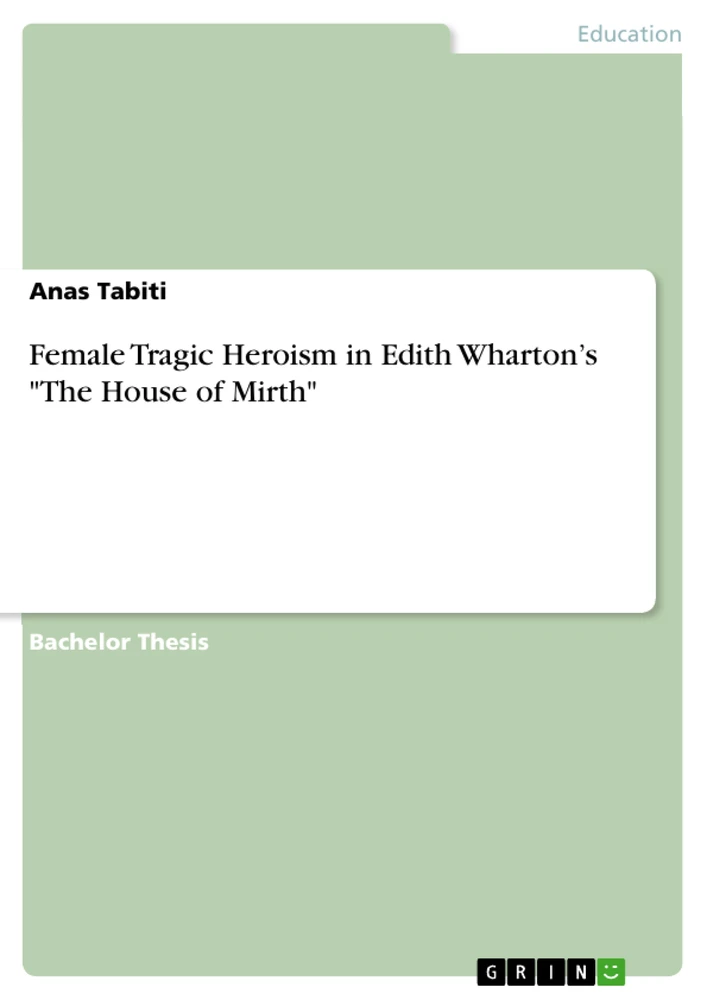
Table of Contents
Introduction
Chapter one: Lily Bart’s main characteristics that makes her a female tragic hero.
1 Miss Lily’s hamartias
1-1 Miss Lily Bart and lying
1-2 Debts and gambling
1-3 Loving money and wealth:
2 Recognition:
3 Reversal of the situation:
Chapter two: Tragic fate and coincidence
Chapter three: Unfulfilled dreams
Objectives and Research Focus
This monograph examines the protagonist Lily Bart from Edith Wharton's "The House of Mirth" through the lens of Aristotelian tragic heroism. It explores how social constraints, inherited fate, and psychological internal conflicts lead to her inevitable downfall and ultimate failure to realize her aspirations.
- Application of Aristotelian tragic characteristics to a female protagonist.
- Impact of 19th-century patriarchal and materialist societal structures on women.
- Influence of Darwinian evolutionary theory and naturalism on Lily Bart's life.
- Psychological analysis of character fragmentation and dissociative tendencies.
- The role of coincidence and inherited fate in determining personal outcomes.
Excerpt from the Book
1 Miss Lily’s hamartias
Before discussing the main characteristics of this female tragic hero, it is necessary to look what tragedy means. In his book Poetics Aristotle explained tragedy:
…Tragedy is the imitation of an action; and an action implies personal agents, who necessarily possess certain distinctive qualities both of character and thought; for it is by these that we qualify actions themselves, and these- thought and character- are the two natural causes from which actions spring, and on actions again all success or failure depends. (Poetics ch.VI)
From this definition, it clearly appears that tragedy is about imitation of an action done by characters. These characters or tragic heroes must have some distinctive qualities either positive or negative. In my case Miss Lily has many bad qualities and some good qualities.
Miss Lily Bart has a lot of bad qualities or “hamartias”. The word hamartia’s meaning “…has been much debated. It has been variously translated as tragic ‘fault’, ‘flaw’, ‘mistake’, ‘fallibility’, ‘frailty’ and ‘error’ ” (The Philosophy of Tragedy From Plato to Žižek 35). Miss Lily is dominated by her flaws or errors which makes her failure and downfall at the end of this novel.
Summary of Chapters
Chapter one: Lily Bart’s main characteristics that makes her a female tragic hero.: Analyzes the protagonist's personal flaws, her recognition of failure, and the various reversals of fortune she experiences.
Chapter two: Tragic fate and coincidence: Explores the influence of Darwinian theory and the concept of naturalism on the character’s predetermined life and tragic trajectory.
Chapter three: Unfulfilled dreams: Examines Lily's failed attempts to secure her social and financial future through marriage compared to the success of male characters.
Keywords
Edith Wharton, The House of Mirth, Lily Bart, Tragic Heroism, Aristotle, Poetics, Naturalism, Charles Darwin, Evolution, Dissociative Identity Disorder, Patriarchy, Materialism, Marriage, Hamartia, Tragic Fate
Frequently Asked Questions
What is the core focus of this research paper?
The paper focuses on analyzing Lily Bart as a female tragic hero in Edith Wharton’s novel "The House of Mirth," utilizing the framework of Aristotelian tragedy.
What are the primary thematic fields explored in the work?
The work covers themes such as socioeconomic pressure, gender roles in late 19th-century New York, psychological trauma, and the conflict between individual desire and social expectation.
What is the main research question or objective?
The primary objective is to demonstrate that Lily Bart embodies the characteristics of a traditional tragic hero and to explain how her environment and inherited traits inevitably lead to her destruction.
Which scientific or theoretical methods are applied?
The author employs literary analysis based on Aristotle’s "Poetics," integrates Charles Darwin’s theory of evolution and naturalism, and references psychological perspectives on dissociative identity.
What content is covered in the main body of the monograph?
The main body examines Lily's specific personal flaws (hamartias), the impact of her father's bankruptcy, her struggle for financial security through marriage, and the influence of coincidental events on her fate.
Which keywords best characterize this study?
Key terms include tragic heroism, naturalism, patriarchy, materialist society, inherited fate, and psychological fragmentation.
How does the author relate the concept of "hamartia" to Lily Bart?
The author identifies Lily's specific flaws—such as lying, addiction to gambling, and an obsessive need for wealth—as the "hamartias" that trigger her tragic downfall.
What role does the myth of Andromeda and Perseus play in the interpretation?
The myth serves as an intertextual reference to highlight Lily's inability to be "rescued" from her fate, as her personal choices and social circumstances prevent a successful intervention by any male savior.
Ende der Leseprobe aus 31 Seiten
- nach oben
- Arbeit zitieren
- Anas Tabiti (Autor:in), 2019, Female Tragic Heroism in Edith Wharton’s "The House of Mirth", München, Page::Imprint:: GRINVerlagOHG, https://www.diplomarbeiten24.de/document/942279

neugierig - aktuell - relevant
Entdecken Sie hilfreiche Tipps und Tricks rund ums Studium!

Entdecken Sie hilfreiche Tipps und Tricks rund ums Studium!
Ihre Hausarbeit / Abschlussarbeit:

- - Publikation als E-Book und Buch
- - Hohes Honorar auf die Verkäufe
- - Für Sie komplett kostenlos - mit ISBN
- - Es dauert nur 5 Minuten
- - Jede Arbeit findet Leser

- © GRIN Publishing GmbH.
- Alle Inhalte urheberrechtlich geschützt. Kopieren und verbreiten untersagt.
- info@grin.com
- AGB
- Open Publishing
Der GRIN Verlag hat sich seit 1998 auf die Veröffentlichung akademischer eBooks und Bücher spezialisiert. Der GRIN Verlag steht damit als erstes Unternehmen für User Generated Quality Content. Die Verlagsseiten GRIN.com, Hausarbeiten.de und Diplomarbeiten24 bieten für Hochschullehrer, Absolventen und Studenten die ideale Plattform, wissenschaftliche Texte wie Hausarbeiten, Referate, Bachelorarbeiten, Masterarbeiten, Diplomarbeiten, Dissertationen und wissenschaftliche Aufsätze einem breiten Publikum zu präsentieren.
Kostenfreie Veröffentlichung: Hausarbeit, Bachelorarbeit, Diplomarbeit, Dissertation, Masterarbeit, Interpretation oder Referat jetzt veröffentlichen!
Folgen Sie GRIN auf


- GRIN Verlag GmbH
-
- Nymphenburger Str. 86
- 80636
- Munich, Deutschland
- +49 89-550559-0
- +49 89-550559-10
- info@grin.com
-
