
präsentiert von

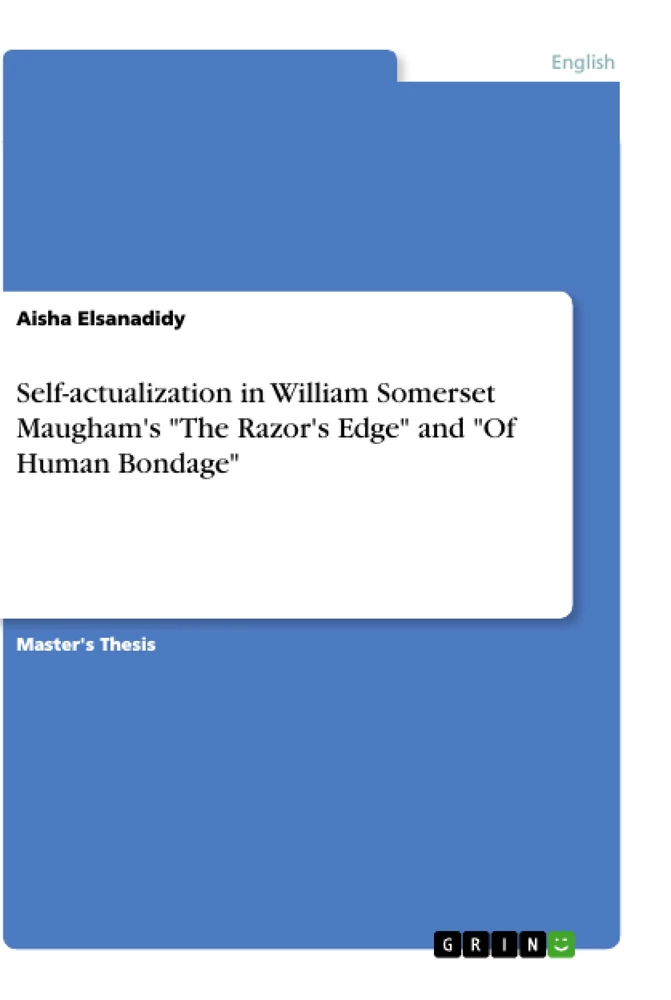
Table of Contents
Abstract
Introduction
Chapter One: The Intersection of the Theory of the Third Force Psychology and Literature
Chapter Two: Maslow’s Hierarchy of Needs and its Application to Maugham’s The Razor’s Edge and Of Human Bondage
Chapter Three: The Characteristics of Self-actualized People in Maugham’s Two Novels: The Razor’s Edge and Of Human Bondage
Conclusion
Works Cited
Research Objectives and Key Topics
This thesis explores the intersection of humanistic psychology and literature by examining two novels by William Somerset Maugham, The Razor’s Edge and Of Human Bondage, through the lens of Abraham Maslow’s motivational theory. The central research aim is to analyze how the protagonists of these novels transition through Maslow’s hierarchy of needs to achieve self-actualization, demonstrating the strong, interdependent relationship between literary character development and psychological principles.
- The application of Maslow’s Hierarchy of Needs to fictional characters.
- The conceptualization of Third Force Psychology and its focus on human potential.
- An analysis of self-actualization as the ultimate goal of human motivation.
- The thematic connection between Maugham’s literary works and psychological concerns.
- The identification of specific characteristics that distinguish self-actualized individuals.
Excerpt from the Book
The Intersection of the Theory of the Third Force Psychology and Literature
This chapter shows the dimensions of the Third Force Psychology and their relation to literature. It first sheds light on the theorist’s life and how his life has a great effect on exploring the positive sides of human beings. Second, it concentrates on discovering the optimistic sides of the theory through depicting the defects and demerits of the two forces of Psychoanalysis and Behaviorism. Third, it focuses on illustrating the theory of Humanistic Psychology only from Maslow’s perspective. As a result, it deals with Maslow’s Hierarchy of Needs and how it can be achieved to reach self-actualization. It also reveals the aspects of self-actualization and its characteristics. Finally, it shows how psychology can be applicable to literary works such as those of William Somerset Maugham’s.
Abraham Harold Maslow is considered the founder of Humanistic Psychology (Saeednia 94). He was born in Brooklyn, New York in 1908; he was the oldest child of seven children but he suffered a lot and lived an unhappy childhood. First, he was a Jewish immigrant child who came from Russia to New York so that his neighbors and friends began to despise and laugh at him. Second, he suffered from his parents’ maltreatment since he became resentful at the age of seventeen, when his father forced him to attend law classes at the city college of New York; the major that he did not love but he attended just to satisfy his parents (Boeree 3).
All these difficulties have led Maslow to find a refuge in the library where he finds his own interest. Reading different kinds of books had a great effect on broadening his mind. Hoffman describes it as follows: “he had plenty of leisure time in his teenage years, which he spent reading. Eventually, young Maslow developed idealistic notions to improving the world through science” (133).
Summary of Chapters
Chapter One: The Intersection of the Theory of the Third Force Psychology and Literature: This chapter introduces Maslow's humanistic theory and the foundational connection between psychological motivations and literary analysis.
Chapter Two: Maslow’s Hierarchy of Needs and its Application to Maugham’s The Razor’s Edge and Of Human Bondage: This chapter applies Maslow’s hierarchy to the protagonists of the two novels, tracing their progress from basic physiological needs toward self-actualization.
Chapter Three: The Characteristics of Self-actualized People in Maugham’s Two Novels: The Razor’s Edge and Of Human Bondage: This chapter identifies and analyzes the traits of self-actualized individuals, such as spontaneity and problem-centering, as they manifest in the characters.
Keywords
Maslow, Third Force Psychology, Humanistic Psychology, self-actualization, William Somerset Maugham, The Razor’s Edge, Of Human Bondage, hierarchy of needs, motivation, personality, literature, psychology, peak-experiences, self-esteem, character analysis.
Frequently Asked Questions
What is the primary focus of this thesis?
The thesis examines William Somerset Maugham’s novels The Razor’s Edge and Of Human Bondage using Abraham Maslow’s theory of human motivation, specifically focusing on the concept of self-actualization.
What are the central themes discussed in the work?
Key themes include the relationship between literature and psychology, the influence of childhood and life experiences on character development, and the human drive toward growth and fulfillment.
What is the ultimate goal of the protagonists in the studied novels?
The primary goal is to reach self-actualization, which involves using one's full potentialities to become the best version of oneself, transcending basic deficiency needs.
Which scientific method is utilized in this study?
The study employs a literary-psychological approach, analyzing the characters' motivations and behaviors through the framework of Maslow’s Hierarchy of Needs.
What does the main body of the work cover?
The main body is divided into three chapters: the theoretical intersection of Third Force Psychology and literature, the application of Maslow’s hierarchy to the two selected novels, and an analysis of the characteristics of self-actualized individuals within those texts.
Which keywords best characterize this research?
The work is characterized by terms such as Maslow, self-actualization, humanistic psychology, motivation, character analysis, and the psychological interplay between literature and the human psyche.
How does the author explain the relationship between physiological needs and higher aspirations?
The author argues, following Maslow, that humans must satisfy basic physiological and safety needs before they can effectively focus on higher-level needs like self-actualization.
How is the concept of "detachment" portrayed in the novels?
Detachment is portrayed as a positive quality of self-actualized individuals, where they seek privacy and solitude to foster introspection, reflection, and spiritual growth rather than experiencing it as loneliness.
Ende der Leseprobe aus 131 Seiten
- nach oben
- Arbeit zitieren
- Aisha Elsanadidy (Autor:in), 2020, Self-actualization in William Somerset Maugham's "The Razor's Edge" and "Of Human Bondage", München, Page::Imprint:: GRINVerlagOHG, https://www.diplomarbeiten24.de/document/947928

neugierig - aktuell - relevant
Entdecken Sie hilfreiche Tipps und Tricks rund ums Studium!

Entdecken Sie hilfreiche Tipps und Tricks rund ums Studium!
Ihre Hausarbeit / Abschlussarbeit:

- - Publikation als E-Book und Buch
- - Hohes Honorar auf die Verkäufe
- - Für Sie komplett kostenlos - mit ISBN
- - Es dauert nur 5 Minuten
- - Jede Arbeit findet Leser

- © GRIN Publishing GmbH.
- Alle Inhalte urheberrechtlich geschützt. Kopieren und verbreiten untersagt.
- info@grin.com
- AGB
- Open Publishing
Der GRIN Verlag hat sich seit 1998 auf die Veröffentlichung akademischer eBooks und Bücher spezialisiert. Der GRIN Verlag steht damit als erstes Unternehmen für User Generated Quality Content. Die Verlagsseiten GRIN.com, Hausarbeiten.de und Diplomarbeiten24 bieten für Hochschullehrer, Absolventen und Studenten die ideale Plattform, wissenschaftliche Texte wie Hausarbeiten, Referate, Bachelorarbeiten, Masterarbeiten, Diplomarbeiten, Dissertationen und wissenschaftliche Aufsätze einem breiten Publikum zu präsentieren.
Kostenfreie Veröffentlichung: Hausarbeit, Bachelorarbeit, Diplomarbeit, Dissertation, Masterarbeit, Interpretation oder Referat jetzt veröffentlichen!
Folgen Sie GRIN auf


- GRIN Verlag GmbH
-
- Nymphenburger Str. 86
- 80636
- Munich, Deutschland
- +49 89-550559-0
- +49 89-550559-10
- info@grin.com
-
