
präsentiert von

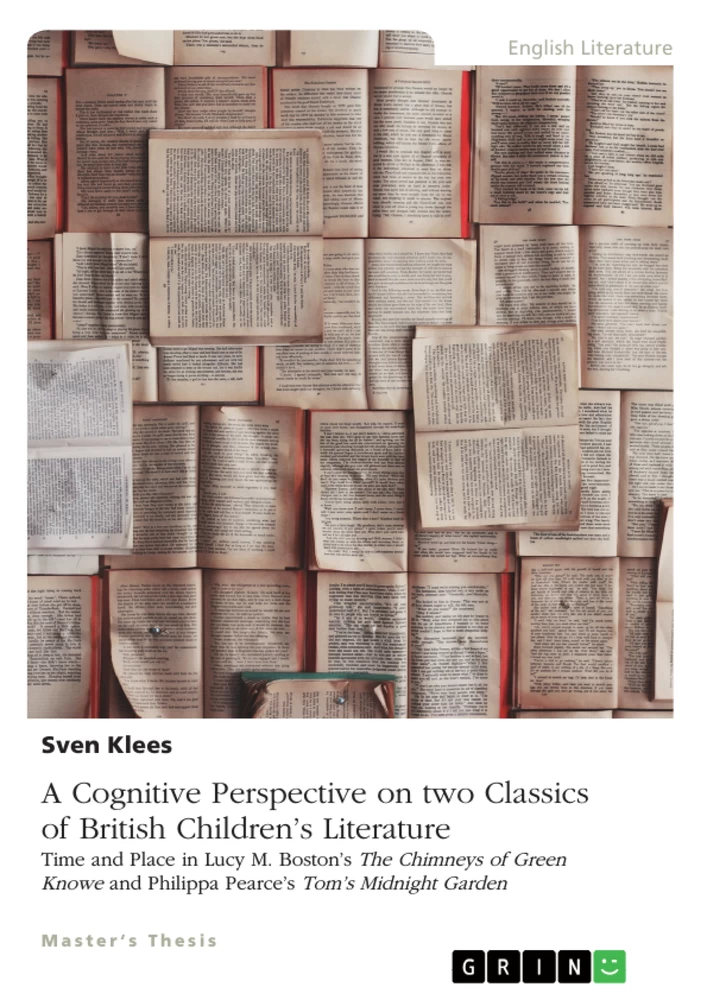
Table of Contents
1. Introduction
2. Time
2.1. Time in The Chimneys of Green Knowe
2.2. Time in Tom’s Midnight Garden
3. Place
3.1. Place in The Chimneys of Green Knowe
3.2 Place in Tom’s Midnight Garden
4. Frameworks and Concepts of Cognitive Criticism
5. The ‘Story in the Story’
6. Outlook: Children’s Perspectives
Research Objective and Core Themes
This work explores how a child readership can extract meaning and learn from two classic British time-slip novels, Lucy Boston's The Chimneys of Green Knowe and Philippa Pearce's Tom’s Midnight Garden, focusing on how narrative structures facilitate this learning process through cognitive engagement.
- Representation of 'time' as a means for identity formation and historical connection.
- The symbolic function of 'place' (houses and gardens) as archives of memory.
- Application of cognitive criticism to analyze reader-text interaction.
- The significance of the 'story within the story' as a didactic meta-technique.
- Intergenerational transmission of memory and the role of the child protagonist.
Auszug aus dem Buch
2.1. Time in The Chimneys of Green Knowe
The first step of my analysis of time is to look at what levels of time are present in the novel. If we apply a chronological order, the first ‘time’ which is represented is the last years of the eighteenth century. The reader knows this as Mrs. Oldknow tells Tolly that Maria’s, Susan’s mother’s, jewels were stolen in 1798 (Boston 15). Although, if pieced together, Mrs. Oldknow’s story is told in a chronological order, we, as readers, do not exactly know what time span the story encompasses. As Susan’s father, Captain Oldknow, is away on his ship voyages for several months on several occasions, we can leap to the conclusion that the narrated time spans a few years.
At the ending of her story to Tolly, Mrs. Oldknow even tells her what has become of Susan and Jacob (185), extending the time frame by several decades. The next time level is the time when Mrs. Oldknow has been told the stories, which she now passes on to Tolly, by her nanny when she herself was a small child (56). The time when the stories are told again, now to Tolly, is what we could label the frame narrative. Tolly is both a consumer of his great-grandmother’s stories, but also an active agent. His searches the manor house for old objects, which he presents to his great-grandmother. These objects always seem to lead to the next bit of the story, which gives the novel also a hint of a detective story.
Summary of Chapters
1. Introduction: Presents the comparative focus on time-slip novels and outlines the central questions regarding reader learning and structural facilitation.
2. Time: Discusses the genre of time-slip literature and defines the difference between linear (adult) time and mythic (reversible) time as experienced by the child protagonists.
3. Place: Explores how historic houses and gardens function as physical archives that store collective memories and facilitate the protagonists' discovery of their roots.
4. Frameworks and Concepts of Cognitive Criticism: Introduces theoretical approaches to literary communication, examining how authors employ specific techniques to guide child readers through texts.
5. The ‘Story in the Story’: Examines the didactic role of embedded narratives and how they encourage identification and empathy in the reader to make moral and structural implications.
6. Outlook: Children’s Perspectives: Reviews empirical evidence from reading journals to analyze real children’s engagement with these novels and proposes further research directions.
Keywords
Time-slip novels, Children’s literature, Cognitive criticism, Memory, Archive, Green Knowe, Tom’s Midnight Garden, Theory of Mind, Metafiction, Identification, Didacticism, Narrative structure, Mythic time, Childhood, Storytelling.
Frequently Asked Questions
What is the primary focus of this study?
The study examines how child readers learn from two specific British children's classics, The Chimneys of Green Knowe and Tom’s Midnight Garden, specifically through their engagement with concepts of time and place.
Which theoretical framework is applied?
The author applies cognitive criticism to understand the interaction between reader and text, focusing on how literary structures influence the reader's engagement and meaning-making process.
What is the role of the 'story within the story'?
It acts as a didactic meta-technique that helps the child protagonist and the implied reader process moral lessons and complex temporal structures while building empathy.
How does the author define mythic time?
Mythic time, or 'kairos,' is presented as a reversible, non-linear experience that exists within the human mind and allows characters to transcend traditional temporal boundaries.
What function do the houses serve in these novels?
The houses function as 'archives,' where objects and oral storytelling keep family history and collective memories alive, preventing them from being forgotten in a rapidly changing world.
Why is the concept of 'nostalgia' addressed?
The author re-evaluates nostalgia not as a negative, regressive longing, but as a positive creative incentive for the author to connect the reader to a past that they cannot access through direct experience.
How do Tolly and Tom differ as 'detectives'?
Tolly acts as a mediator within a family archive, searching for jewels and heritage, whereas Tom acts as a 'detective' of time, trying to understand the mystery of the grandfather clock and his experiences in the garden.
What is the significance of the 'seeing/not seeing' binary?
It symbolizes the transition between childhood and adulthood; the ability to 'see' the fantastic or the magical often correlates with an openness to childhood wonder, which may be lost as characters grow up.
Ende der Leseprobe aus 66 Seiten
- nach oben
- Arbeit zitieren
- Sven Klees (Autor:in), 2020, A Cognitive Perspective on two Classics of British Children’s Literature, München, Page::Imprint:: GRINVerlagOHG, https://www.diplomarbeiten24.de/document/951085

neugierig - aktuell - relevant
Entdecken Sie hilfreiche Tipps und Tricks rund ums Studium!

Entdecken Sie hilfreiche Tipps und Tricks rund ums Studium!
Ihre Hausarbeit / Abschlussarbeit:

- - Publikation als E-Book und Buch
- - Hohes Honorar auf die Verkäufe
- - Für Sie komplett kostenlos - mit ISBN
- - Es dauert nur 5 Minuten
- - Jede Arbeit findet Leser

- © GRIN Publishing GmbH.
- Alle Inhalte urheberrechtlich geschützt. Kopieren und verbreiten untersagt.
- info@grin.com
- AGB
- Open Publishing
Der GRIN Verlag hat sich seit 1998 auf die Veröffentlichung akademischer eBooks und Bücher spezialisiert. Der GRIN Verlag steht damit als erstes Unternehmen für User Generated Quality Content. Die Verlagsseiten GRIN.com, Hausarbeiten.de und Diplomarbeiten24 bieten für Hochschullehrer, Absolventen und Studenten die ideale Plattform, wissenschaftliche Texte wie Hausarbeiten, Referate, Bachelorarbeiten, Masterarbeiten, Diplomarbeiten, Dissertationen und wissenschaftliche Aufsätze einem breiten Publikum zu präsentieren.
Kostenfreie Veröffentlichung: Hausarbeit, Bachelorarbeit, Diplomarbeit, Dissertation, Masterarbeit, Interpretation oder Referat jetzt veröffentlichen!
Folgen Sie GRIN auf


- GRIN Verlag GmbH
-
- Nymphenburger Str. 86
- 80636
- Munich, Deutschland
- +49 89-550559-0
- +49 89-550559-10
- info@grin.com
-
