
präsentiert von

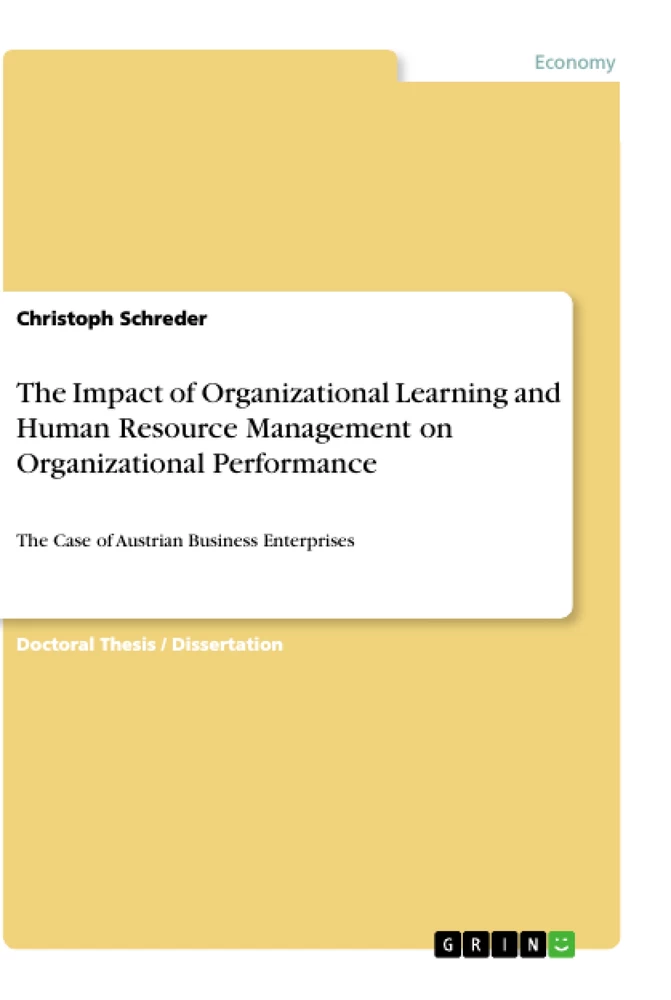
Table of Contents
Introduction
1 Conceptual framework of interdependecies between organizational learning, human resource management and organizational performance
1.1 Main approaches to the relationship between organizational learning, human resource management and organizational performance
1.2 Definition of main theoretical concepts
1.3 Open questions in existing literature as starting points for further research
2 Research methodology for testing the interdependencies between human resource management, organizational learning, and organizational performance
2.1 Research hypotheses about the connection between organizational learning, human resource management and organizational performance
2.2 Dimensions of the research model and measurement of organizational learning, human resource management, and organizational performance
2.3 Target population and sampling approach to research on the linkage between organizational learning, human resource management, and organizational performance
2.4 Approach to reliability and validity in the conducted research
2.5 Theoretical scheme of the presupposed connex between organizational learning, human resource management, and organizational performance
2.6 Measurement model of the connex between organizational learning, human resource management, and organizational performance
2.7 Research roadmap: the development of the research scheme and evidence based adaptation
2.8 Approach to research evaluation
3 Quantitative and qualitative analysis of the relationship between organizational learning and human resource management on organizational performance
3.1 Impact of organizational learning and human resource management on organizational performance: partial factor analysis
3.2 Modified evidence-based research model
3.3 Factor scores’ Pearson correlation and linear regression
3.4 Testing interdependencies as basis for confirmation or disconfirmation of the hypotheses: regression analysis
3.5 Testing interdependencies via Structural Equation Modeling
3.6 The findings of the research
4 Best-practice-example of practical implementation of research in Austrian companies
Conclusions and suggestions
List of sources
Appendices
Appendix 1: Organization of Questionnaire
Appendix 2: Detailes Information on Findings from Literature Review
Appendix 3: Detailed Results of Analysis
Appendix 4: Practical Implementation and approbation
Research Objectives and Focus
This thesis aims to develop and test a comprehensive model examining the interdependencies between organizational learning, human resource management (HRM), and organizational performance within the context of Austrian business enterprises. The study seeks to investigate how these constructs correlate and whether they positively influence performance, with the ultimate goal of providing evidence-based insights for practical implementation in management.
- The theoretical and practical interdependencies between organizational learning, HRM, and organizational performance.
- Development of a unique theoretical framework and evidence-based research model tailored to Austrian businesses.
- Methodological rigorousness through triangulation, involving both quantitative electronic surveys and qualitative expert post-studies.
- Exploration of how specific dimensions of organizational learning and HRM impact different spheres of organizational performance (economic performance vs. competitive capacity).
- Derivation of practical recommendations and a "six-legged approach" to integrated organizational development.
Excerpt from the Book
The measurement approach to organizational learning
As a complex construct organizational learning is not simply about whether individuals have learned something new (Huber 1991 et al.). Rather new knowledge has to be applied to a strategic context (Crossan et al. 1999 et al.). Different authors have done research on the subject of organizational learning in order to identify its dimensions. Table 8 below in an effort to make the picture more comprehensive clusters the dimensions in the rows according to (presumed) equivalence.
In order to test the theoretical construct, organizational learning is divided in the dimensions identified above. Each of the dimensions is tested in a questionnaire via different test items summarized as factors aimed at a comprehensive picture of the dimension’s relevant properties. Table 9 below gives the items of organizational learning in the dimensions: knowledge acquisition, knowledge distribution, knowledge interpretation, and improvement attitude.
Summary of Chapters
1 Conceptual framework of interdependecies between organizational learning, human resource management and organizational performance: This chapter reviews existing literature, defines central theoretical concepts, and identifies research gaps to establish a theoretical foundation for the study.
2 Research methodology for testing the interdependencies between human resource management, organizational learning, and organizational performance: This chapter outlines the development of research hypotheses, the conceptualization of the research model, and the methodology, including sampling and measurement design, to ensure valid data collection.
3 Quantitative and qualitative analysis of the relationship between organizational learning and human resource management on organizational performance: This chapter presents the empirical results, including factor analysis and structural equation modeling, which led to an evidence-based modification of the research model.
4 Best-practice-example of practical implementation of research in Austrian companies: This chapter discusses the practical application of research findings within an Austrian industrial enterprise, introducing a new integrated development approach.
Keywords
Human Resource Development, Human Resource Management, Learning Organization, Organization Development, Organizational Learning, Organizational Performance, Strategic Human Resource Management, Austrian Business Enterprises, Competitiveness, Economic Performance, Knowledge Management, Structural Equation Modeling, Factor Analysis, Management Science, Competitive Capacity.
Frequently Asked Questions
What is the core focus of this doctoral thesis?
The thesis examines the complex interdependencies between organizational learning, human resource management (HRM), and organizational performance, specifically within Austrian business enterprises.
What are the primary research themes?
Key themes include the impact of learning capabilities on organizational success, the strategic role of HRM, and the measurement of organizational performance beyond mere financial indicators.
What is the primary objective of this research?
The research aims to test whether organizational learning and HRM positively influence organizational performance and to create an evidence-based research model for practical application.
Which scientific methods are applied?
The researcher uses method triangulation, including a meta-analysis, a pre-study with expert interviews, a quantitative electronic survey across Austrian business sectors, and a post-study for plausibility validation using Structural Equation Modeling (SEM).
What is covered in the main body of the work?
The work covers theoretical framework development, the detailed definition of constructs, hypothesis derivation, extensive statistical data analysis including factor and regression analysis, and the presentation of a best-practice implementation example.
Which keywords characterize this work?
Essential keywords include Organizational Learning, Human Resource Management, Organizational Performance, Competitive Capacity, and Strategic Management, reflecting the study's focus on organizational effectiveness.
How does the thesis categorize organizational performance?
Based on factor analysis, the thesis differentiates organizational performance into two distinct spheres: economic performance (financial outcomes) and competitive capacity (non-financial factors like reputation and employee satisfaction).
What does the "six-legged approach" represent?
It is a practical, integrated development model developed by the author that aligns talent management, workforce planning, human resource development, employee participation, improvement attitude, and knowledge distribution to foster organizational performance.
Ende der Leseprobe aus 221 Seiten
- nach oben
- Arbeit zitieren
- Dr. Christoph Schreder (Autor:in), 2019, The Impact of Organizational Learning and Human Resource Management on Organizational Performance, München, Page::Imprint:: GRINVerlagOHG, https://www.diplomarbeiten24.de/document/961354

neugierig - aktuell - relevant
Entdecken Sie hilfreiche Tipps und Tricks rund ums Studium!

Entdecken Sie hilfreiche Tipps und Tricks rund ums Studium!
Ihre Hausarbeit / Abschlussarbeit:

- - Publikation als E-Book und Buch
- - Hohes Honorar auf die Verkäufe
- - Für Sie komplett kostenlos - mit ISBN
- - Es dauert nur 5 Minuten
- - Jede Arbeit findet Leser

- © GRIN Publishing GmbH.
- Alle Inhalte urheberrechtlich geschützt. Kopieren und verbreiten untersagt.
- info@grin.com
- AGB
- Open Publishing
Der GRIN Verlag hat sich seit 1998 auf die Veröffentlichung akademischer eBooks und Bücher spezialisiert. Der GRIN Verlag steht damit als erstes Unternehmen für User Generated Quality Content. Die Verlagsseiten GRIN.com, Hausarbeiten.de und Diplomarbeiten24 bieten für Hochschullehrer, Absolventen und Studenten die ideale Plattform, wissenschaftliche Texte wie Hausarbeiten, Referate, Bachelorarbeiten, Masterarbeiten, Diplomarbeiten, Dissertationen und wissenschaftliche Aufsätze einem breiten Publikum zu präsentieren.
Kostenfreie Veröffentlichung: Hausarbeit, Bachelorarbeit, Diplomarbeit, Dissertation, Masterarbeit, Interpretation oder Referat jetzt veröffentlichen!
Folgen Sie GRIN auf


- GRIN Verlag GmbH
-
- Nymphenburger Str. 86
- 80636
- Munich, Deutschland
- +49 89-550559-0
- +49 89-550559-10
- info@grin.com
-
