
präsentiert von

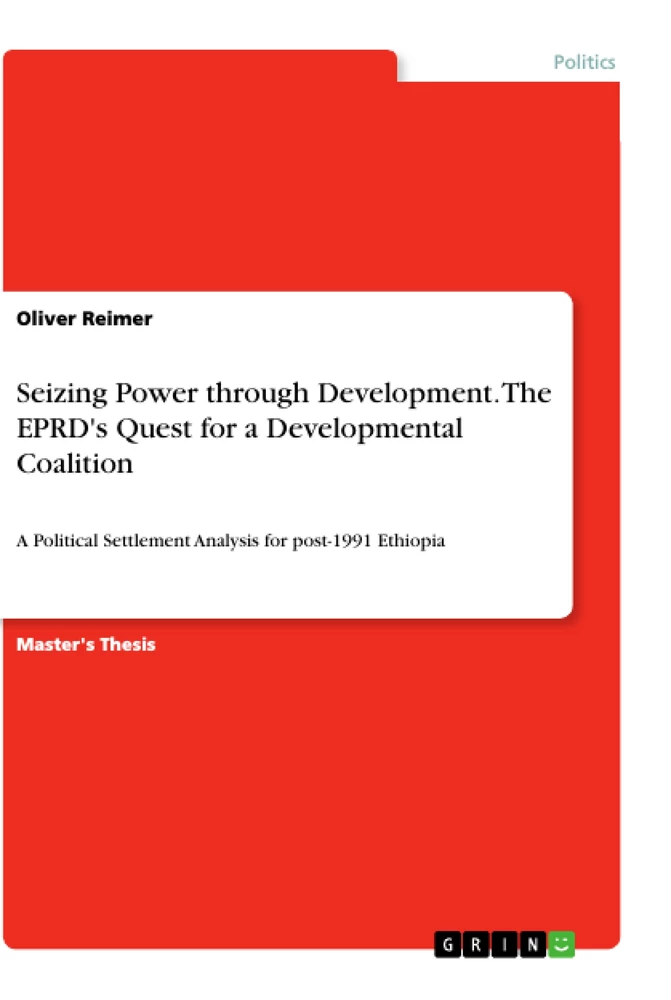
Table of Contents
1 Introduction
1.1 Opening the Discussion: Conceptualising the Link Between Capitalism and It’s Institutions
1.2 The Structure of this Thesis: Political Settlements of Mustaq Khan and the Case of Ethiopia
2 State of the Art
2.1.1 Between Market and State: Early Theories of Development Economics
2.1.2 State-dependent Development: the Cases of the Fast-growing East Countries
2.2 A Political Turn in Development Theory: Early Contributions of Adrian Leftwich
2.3.1 From Institutions to Development: a Framework by North, Wallis and Weingast
2.3.2 Institutions as Development Traps: a Framework by Acemoğlu and Robinson
2.4 From Development to Institutions: the Political Settlement Theory by Mustaq Khan
3 Methodology: Process Tracing by Beach and Pedersen
4 Political Settlements and Institutional Change: the Case of Ethiopia
4.1.1 Ground in the Mill of Modernisation: Authoritarian Reform and the Politicisation of Ethiopian Ethnicities
4.1.2 Growing Beyond Ones Limits: Forging the EPRDF Coalition
4.2.1 Perceptual Organisation: Building the Democratic Authoritarian State
4.2.2 Joggling Political Demands: Liberalisation and State-led Peasant Economy
4.3 Reshuffling the Deck: the Ethio-Eritrean War and the Rise of the Developmental State Paradigm
4.4.1 My Neighbour, the Developmental State: Intimate State-Society Relations and Technological Diffusion
4.4.2 A Thin Ice for Authoritarian Expansion: The Sudden Rise of Horizontal Factions
4.4.3 Enlightened Authoritarianism: Developing Rural Economies
4.4.4 Industrialising Ethiopia: Between Forgotten Leaders and Spoiled Newcomers
4.5 Development Without the People: Collapse of the Developmental State?
5 Discussion and Concluding Remarks: Political Settlements, Economic Policy and Agency of the Global South
5.1 Theories of Economic Development: Evidence from Ethiopia
5.2 Political Settlement Theory of Mustaq Khan: Possible Implications for Ethiopian Policy Makers
5.3 Implications for Theory? – Some Preliminary Suggestions
Research Objective and Core Themes
This thesis examines the evolution of institutional performance and economic growth in Ethiopia following the 1991 regime change, specifically testing Mustaq Khan’s Political Settlement theory. It seeks to answer how the power dynamics between the ruling coalition and various social forces influence institutional effectiveness and whether these dynamics explain distinct episodes of economic development in the country.
- The relationship between political power distribution and institutional enforcement.
- The role of the EPRDF ruling coalition in shaping the "developmental state" paradigm.
- Empirical analysis of agricultural and industrial policies, including land management and state-owned enterprises.
- The impact of informal institutions and patronage on development outcomes.
- The utility of Mustaq Khan’s political economy framework compared to New Institutional Economics.
Excerpt from the Book
4.4.2 A Thin Ice for Authoritarian Expansion: the Sudden Rise of Horizontal Factions
In approaching the 2005 national elections, the EPRDF seemed sure about having the consent of a majority of the electorate and the base of its developmental coalition to be fully consolidated. Against this backdrop, it liberalised the political space and the media. Oppositional parties were allowed to organise and rally for voter approval. They quickly consolidated in a pan-Ethiopian party coalition – the CUD – and one ethnicity-based oppositional block – the UEDF. The former was able to appeal to the neglected urban constituency, as well as Muslim trader communities and Gurage people (the ‘private sector’), the old Amhara elite and their followers. Its campaign could build on substantial financial contributions from the diaspora and private sector, and capitalise on the sense of ‘Ethiopianism’, which had gained momentum during the war with Eritrea. The UEDF also received diaspora support but concentrated its efforts on bases of strong ethnic dissidence in SNNPRS and centres of OLF activity in Oromia RS.
The EPRDF completely underestimated the situation. After the TPLF split, its most eloquent speakers had departed while the senior party personnel was busy in the daily workings of government. Until a month before the election it scarcely campaigned, allowing the opposition to dominate the public debate. The CUD denounced the dominance of Tigrayans in the Ethiopian state and their alleged enrichment through endowment funds. It demanded a liberal economy, private ownership of land, the end of urban poverty and that Ethiopia should take possession of the Eritrean port of Assab. The EPRDF accused the CUD of initiating a Rwandan Interahamwe. In some rural constituencies the EPRDF’s misapprehension of the situation was mirrored in unexpected ways on side of the farmers, who feared to be punished if they voted for the loser. Yet, due to its apparent weakness, this perceived loser was the EPRDF, not the opposition. Thus, in rural pockets of strong contestation, a sense of obedience tilted perceptions of power, giving the opposition an edge over the EPRDF.
Summary of Chapters
1 Introduction: Introduces the critique of liberal development theory and presents the research focus on Mustaq Khan’s political settlement theory within the Ethiopian context.
2 State of the Art: Provides a comprehensive literature review of development theories, moving from early state-centred models to New Institutional Economics and Mustaq Khan’s political settlement framework.
3 Methodology: Process Tracing by Beach and Pedersen: Details the theory-testing process tracing method chosen to analyse the causal mechanisms of institutional change in Ethiopia.
4 Political Settlements and Institutional Change: the Case of Ethiopia: Conducts an in-depth empirical study of the political and economic evolution of Ethiopia from the 1991 regime change through various developmental phases until the 2018 collapse.
5 Discussion and Concluding Remarks: Political Settlements, Economic Policy and Agency of the Global South: Discusses the findings, tests the theoretical predictions against the empirical evidence, and offers policy suggestions and theoretical implications.
Keywords
Political Settlements, Ethiopia, EPRDF, Mustaq Khan, Developmental State, Institutional Change, Economic Development, Process Tracing, Rent-seeking, Authoritarianism, Middle-income Trap, Decentralisation, Civil Service, Agricultural Policy, Industrialisation.
Frequently Asked Questions
What is the core subject of this thesis?
The thesis explores the connection between power distribution, institutional performance, and economic growth in post-1991 Ethiopia using the Political Settlement framework.
What theoretical lens does the author use?
The author primarily applies Mustaq Khan’s Political Settlement theory, contrasting it with traditional New Institutional Economics and developmental state models.
What is the primary research question?
The work investigates how the power of the ruling coalition in Ethiopia relative to other social forces affects institutional performance, and whether this link explains various episodes of economic growth.
Which methodology is applied?
The author employs "theory-testing process tracing" as outlined by Beach and Pedersen to investigate causal mechanisms within the single case of Ethiopia.
What are the main thematic areas covered?
The thesis covers Ethiopia’s political evolution, land reform, the role of state-owned enterprises, industrial policy (specifically leather and floriculture), and the impact of the EPRDF’s "developmental state" strategies.
Which key concepts characterize the research?
Key concepts include "Political Settlement," "holding power," "rent-seeking," "democratic centralism," and "developmental coalition."
How does the "developmental state" in Ethiopia differ from East Asian models?
The author argues that while Ethiopia attempted to emulate East Asian developmental success, it lacked similar institutional coherence and was more heavily influenced by internal factional power struggles and precarious rent-sharing arrangements.
What role did the "model farmer" policy play?
This policy was a tool used by the EPRDF to expand its clientelist base, improve agricultural input distribution, and secure rural political loyalty, although its actual economic effectiveness was mixed and led to increased inequality.
Ende der Leseprobe aus 159 Seiten
- nach oben
- Arbeit zitieren
- Oliver Reimer (Autor:in), 2020, Seizing Power through Development. The EPRD's Quest for a Developmental Coalition, München, Page::Imprint:: GRINVerlagOHG, https://www.diplomarbeiten24.de/document/962543

neugierig - aktuell - relevant
Entdecken Sie hilfreiche Tipps und Tricks rund ums Studium!

Entdecken Sie hilfreiche Tipps und Tricks rund ums Studium!
Ihre Hausarbeit / Abschlussarbeit:

- - Publikation als E-Book und Buch
- - Hohes Honorar auf die Verkäufe
- - Für Sie komplett kostenlos - mit ISBN
- - Es dauert nur 5 Minuten
- - Jede Arbeit findet Leser

- © GRIN Publishing GmbH.
- Alle Inhalte urheberrechtlich geschützt. Kopieren und verbreiten untersagt.
- info@grin.com
- AGB
- Open Publishing
Der GRIN Verlag hat sich seit 1998 auf die Veröffentlichung akademischer eBooks und Bücher spezialisiert. Der GRIN Verlag steht damit als erstes Unternehmen für User Generated Quality Content. Die Verlagsseiten GRIN.com, Hausarbeiten.de und Diplomarbeiten24 bieten für Hochschullehrer, Absolventen und Studenten die ideale Plattform, wissenschaftliche Texte wie Hausarbeiten, Referate, Bachelorarbeiten, Masterarbeiten, Diplomarbeiten, Dissertationen und wissenschaftliche Aufsätze einem breiten Publikum zu präsentieren.
Kostenfreie Veröffentlichung: Hausarbeit, Bachelorarbeit, Diplomarbeit, Dissertation, Masterarbeit, Interpretation oder Referat jetzt veröffentlichen!
Folgen Sie GRIN auf


- GRIN Verlag GmbH
-
- Nymphenburger Str. 86
- 80636
- Munich, Deutschland
- +49 89-550559-0
- +49 89-550559-10
- info@grin.com
-
