
präsentiert von

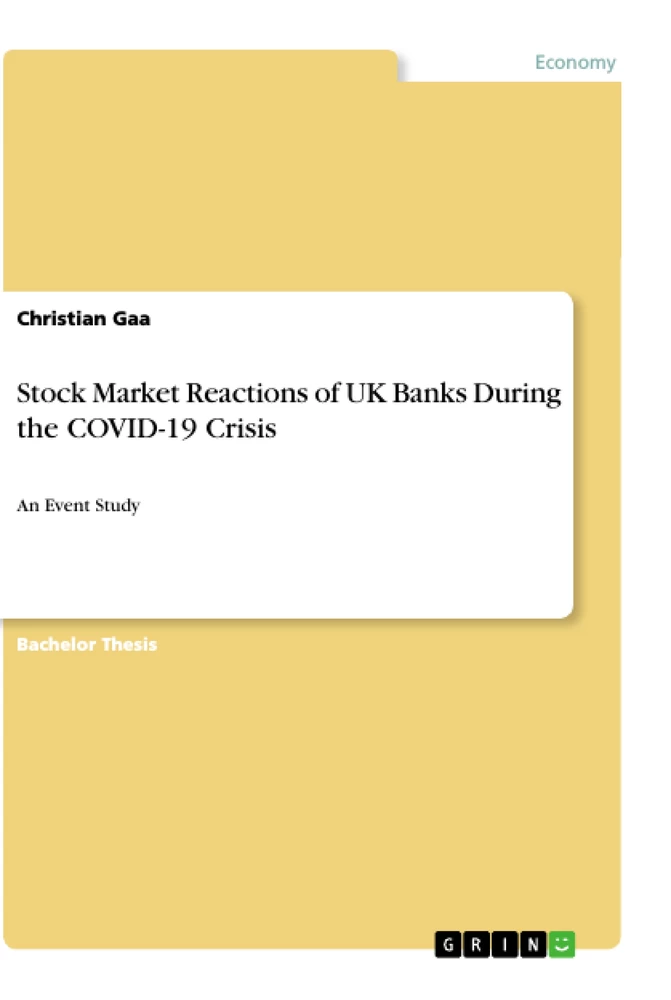
Table of Contents
1 Introduction
2 Hypothesis development
2.1 Literature review
2.1.1 Theoretical framework
2.1.1.1 Market reactions to news
2.1.1.2 Influence of major events on the stock market
2.1.2 Function of banks
2.1.3 The banking system in the UK
2.1.4 Previous studies on the effect of COVID-19 on financial markets
2.2 Global financial of crisis 2007 to 2009
2.2.1 Timeline and causes
2.2.2 Event study description
2.2.3 Event study results
2.3 Hypothesis formulation
3 Event study methodology
3.1 Definition
3.2 Timeline
3.3 Calculating returns
3.4 Measuring normal returns
3.4.1 Constant mean return model
3.4.2 Market model
3.4.3 Economic models
3.5 Abnormal returns
3.5.1 Calculation of abnormal returns with the market model
3.5.2 Calculation of cumulative and average returns
3.6 Significance test
3.7 Robustness checks
4 Event study data
4.1 Historical data
4.2 Event dates
5 Empirical results
5.1 Bad-news events
5.2 Good-news events
5.3 Hypothesis analysis
6 Conclusion
Research Objectives and Themes
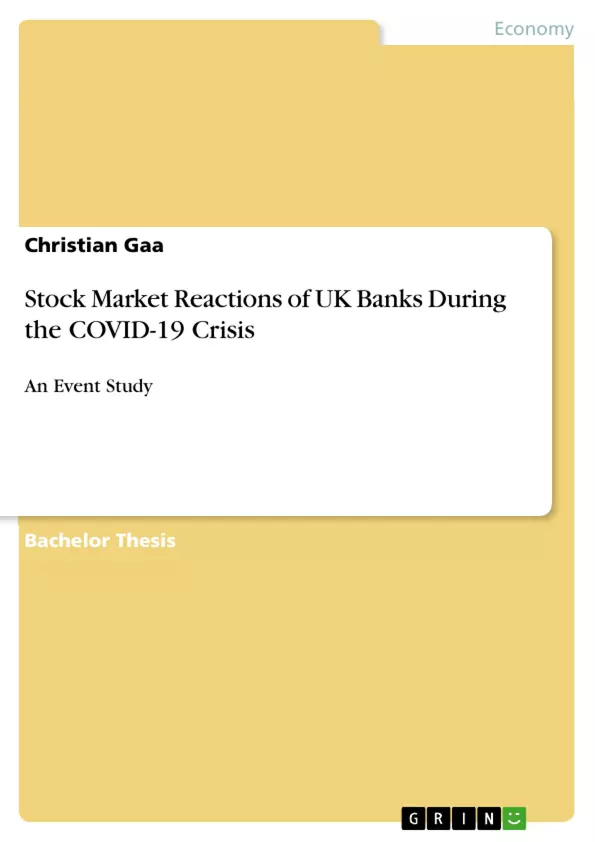
This thesis examines the impact of COVID-19-related news on the stock market performance of banks in the United Kingdom. It aims to determine whether UK bank stock prices react more sensitively to both positive and negative news compared to the broader market, as represented by the FTSE 350 index, by applying an event study methodology.
- Analysis of stock market efficiency in the context of the COVID-19 pandemic.
- Investigation of the role of banks as financial intermediaries during economic crises.
- Evaluation of stock market reactions to specific bad-news events (e.g., pandemic declaration, national lockdown).
- Assessment of market responses to good-news events (e.g., reopening of non-essential retail).
- Comparative analysis of abnormal returns (AR) between individual banks and the market index.
Excerpt from the Book
1 Introduction
Police-enforced curfews; closed schools, parks and restaurants; never leaving your home without a mask; not being able to visit friends and family – after starting like any other year, 2020 took an unexpected turn due to the outbreak of corona-virus disease 2019 (COVID-19). The respiratory disease COVID-19, caused by a novel strain of the coronavirus family, originated in Wuhan, China and has since reached a dramatic scale, socially and economically, that could not have been predicted.
The economic impact of the virus can be seen in the world’s major stock markets. Between 1 January 2020 and 17 March 2020, the Nikkei, Dow Jones and Financial Times Stock Exchange (FTSE) dropped by 27%, 29% and 33%, respectively1 (BBC, 2020b). Furthermore, the unemployment rate in the United States of America (USA) reached its highest level since the start of recording by U. S. Bureau of Labour Statistics (2020) at 14.7% in April 2020, rising from 3.6% in January 2020. On the other hand, unemployment rates in the United Kingdom remained stable at 3.9% in the first two quarters of 2020 (Office for National Statistics, 2020). One reason for these stable numbers is the fact that furloughed workers are still counted as employed, despite their wages being paid by the government.
Summary of Chapters
1 Introduction: Introduces the economic context of the COVID-19 pandemic and outlines the research question regarding the abnormal stock price reactions of UK banks.
2 Hypothesis development: Establishes the theoretical framework, reviews relevant literature on market efficiency and bank functions, and formulates specific hypotheses based on past financial crises.
3 Event study methodology: Details the quantitative approach used to calculate abnormal returns, including the market model and significance testing procedures.
4 Event study data: Describes the selection of the 11 UK banks and the FTSE 350 index, as well as the identification of specific event dates during the pandemic.
5 Empirical results: Presents the calculated abnormal returns for both bad-news and good-news events and analyzes whether the collected data supports the formulated hypotheses.
6 Conclusion: Summarizes the study's findings, acknowledges limitations regarding the short-term focus, and suggests avenues for future research on pandemic impacts in a globalized economy.
Key Words
Event study, COVID-19, UK banks, stock market, abnormal return, market efficiency, financial crisis, FTSE 350, bank stocks, quantitative easing, lockdown, banking sector, market model, statistical significance, hypothesis testing.
Frequently Asked Questions
What is the core focus of this thesis?
The thesis investigates how stock prices of UK banks react to significant news events during the COVID-19 pandemic compared to the overall market performance.
What are the primary themes addressed?
Key themes include stock market efficiency, the role of banks as financial intermediaries, the impact of pandemic-related events on financial markets, and quantitative event study analysis.
What is the central research question?
The research asks whether bank stock prices react more abnormally to good and bad news than the broader market (represented by the FTSE 350) and how this reaction manifests.
Which scientific methodology is applied?
The study utilizes an event study methodology, specifically the market model, using ordinary least squares (OLS) regression to estimate coefficients and t-tests to verify statistical significance.
What is covered in the main body of the work?
The main body covers the development of hypotheses, the methodology of event studies, the data selection process, and the empirical analysis of four specific events during the COVID-19 crisis.
What are the key terms that define this work?
This work is characterized by terms such as event study, abnormal return, stock market reaction, financial crisis, and COVID-19, reflecting its focus on financial economics.
How were the event dates selected for the study?
Event dates were categorized into good-news and bad-news events based on significant pandemic developments, ensuring they were public and allowed for the analysis of abnormal returns.
Does the study find that banks react differently than the market?
Yes, the study concludes that UK banks show a more sensitive reaction to news, particularly confirming that bad-news events lead to significant negative abnormal returns.
Ende der Leseprobe aus 48 Seiten
- nach oben
- Arbeit zitieren
- Christian Gaa (Autor:in), 2020, Stock Market Reactions of UK Banks During the COVID-19 Crisis, München, Page::Imprint:: GRINVerlagOHG, https://www.diplomarbeiten24.de/document/974203

neugierig - aktuell - relevant
Entdecken Sie hilfreiche Tipps und Tricks rund ums Studium!

Entdecken Sie hilfreiche Tipps und Tricks rund ums Studium!
Ihre Hausarbeit / Abschlussarbeit:

- - Publikation als E-Book und Buch
- - Hohes Honorar auf die Verkäufe
- - Für Sie komplett kostenlos - mit ISBN
- - Es dauert nur 5 Minuten
- - Jede Arbeit findet Leser

- © GRIN Publishing GmbH.
- Alle Inhalte urheberrechtlich geschützt. Kopieren und verbreiten untersagt.
- info@grin.com
- AGB
- Open Publishing
Der GRIN Verlag hat sich seit 1998 auf die Veröffentlichung akademischer eBooks und Bücher spezialisiert. Der GRIN Verlag steht damit als erstes Unternehmen für User Generated Quality Content. Die Verlagsseiten GRIN.com, Hausarbeiten.de und Diplomarbeiten24 bieten für Hochschullehrer, Absolventen und Studenten die ideale Plattform, wissenschaftliche Texte wie Hausarbeiten, Referate, Bachelorarbeiten, Masterarbeiten, Diplomarbeiten, Dissertationen und wissenschaftliche Aufsätze einem breiten Publikum zu präsentieren.
Kostenfreie Veröffentlichung: Hausarbeit, Bachelorarbeit, Diplomarbeit, Dissertation, Masterarbeit, Interpretation oder Referat jetzt veröffentlichen!
Folgen Sie GRIN auf


- GRIN Verlag GmbH
-
- Nymphenburger Str. 86
- 80636
- Munich, Deutschland
- +49 89-550559-0
- +49 89-550559-10
- info@grin.com
-
