
präsentiert von

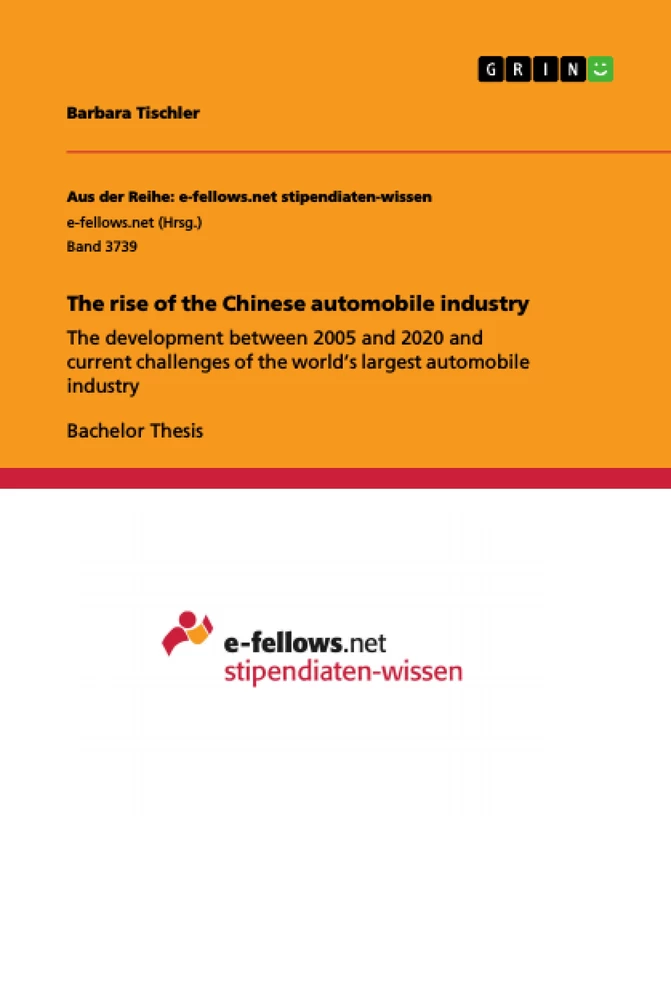
Table of Contents
1 Introduction
1.1 Aim of the work
1.2 Methodological approach
1.3 Structure of the work
2 The Chinese system – Politics and Economics in China
2.1 The Chinese economy before 1949
2.2 The socialist era 1949–1978
2.2.1 First 5-Year plan 1953–1957
2.2.2 Major events during socialist era
2.2.2.1 Great leap forward 1958–1962
2.2.2.2 Great proletarian cultural revolution 1966–1976
2.2.3 Overall economic performance during socialist era
2.3 Open door policy – 1978
2.3.1 The Chinese approach to transition
2.3.2 Dual-track system
2.3.3 Special economic zones 1980–1984
2.3.4 Tiananmen
2.3.5 The second phase of reform 1993–present
2.4 Major political events and economic reforms in the 21st century
2.4.1 Accession to the WTO in 2001
2.4.2 Belt and Road Initiative
2.4.3 Made in China 2025
2.5 China today
3 History of the Chinese Automobile Industry – Development until 2005
3.1 Central planning and the emergence of the automobile industry
3.2 Chinese automobile industry after 1978
3.3 WTO accession and effects on Chinese automobile industry
3.4 How did the Chinese automobile industry look like in 2005?
4 The Development of the Chinese Automobile Industry over the past 15 years (2005 – 2020)
4.1 Economic policy and government regulations for China’s automobile industry
4.1.1 Entering China requirements
4.1.1.1 Initial joint venture requirements
4.1.1.2 Introduction of wholly foreign owned subsidiaries
4.1.1.3 Draft rules and drop of JV-requirements for foreign companies
4.1.2 General requirements
4.1.2.1 CCC
4.1.2.2 MIIT vehicle public announcement–bulletin register
4.1.3 China’s recent auto sector policies and measures
4.1.3.1 Automotive readjustment and revitalization plan 2009 – 2011
4.1.3.2 Indigenous brands and industry consolidation
4.1.3.3 Chinese government fleet procurement
4.1.3.4 Energy-saving and new-energy auto industry plan (2012-2020)
4.1.4 Subsidies policies and protectionism
4.1.4.1 NEV subsidies
4.2 The competitive landscape
4.2.1 A booming industry – Sales and production numbers
4.2.2 Best-selling brands
4.2.3 Domestic and foreign manufacturers and their “China stories”
4.2.3.1 International joint ventures in Chinese automobile sector
4.2.3.2 State-owned manufacturers
4.2.3.3 Independent Chinese manufacturers
4.3 Available products
4.3.1 ICVs and EVs sales – a comparison
4.3.2 Focus on EVs
4.3.3 Hydrogen fuel-cell vehicles
4.3.4 Connectivity service – the desire for smart cars
4.4 The consumer side
4.4.1 China’s growing middle class
4.4.2 Car ownership in China
4.4.3 Consumer behavior
4.4.4 License plate restrictions
4.5 China’s automobile industry today
5 Empirical findings and discussion
5.1 Empirical design
5.2 Interview format
5.3 Interviewees – Introduction
5.4 Empirical findings and discussion
5.4.1 Thoughts on the past 15 years
5.4.2 Challenges for domestic and international manufacturers
5.4.3 Chinese automobile products
5.4.4 Focus on NEV
5.4.5 Consumer behavior
5.4.6 Future outlook
6 Conclusion and future work
6.1 Conclusion – research questions
6.2 Remarks – expert interviews
6.3 Limitations of the work and future research
Objectives and Research Scope
This thesis examines the evolution of the Chinese passenger car industry from 2005 to 2020, aiming to identify key drivers of its development, assess its current status, and analyze prevailing industry challenges through both literature review and expert insights.
- The influence of Chinese government policies and market regulations on industry growth.
- The competitive dynamics between domestic manufacturers and international joint ventures.
- The shift in consumer preferences and the role of the rising middle class.
- The strategic prioritization of New Energy Vehicles (NEVs) and connected car technologies.
- Expert perspectives on the industry's past milestones and future global competitiveness.
Excerpt from the Thesis
4.1.1 Entering China requirements
The Chinese leaders decided to open China’s auto market to international companies in the late 1970s. At that time domestic manufacturers had no chance to compete with more experienced foreign manufacturers. To tackle this problem, foreign automobile manufacturers were forced to set up joint ventures with a local partner when entering the Chinese market. Often times these local partners were state-owned enterprises and were 50-50 controlled by the two firms (Tang, 2012). García-Castro (García-Castro, 2009) states in her paper:
“Within a short period of time, from 1979 to the late 1990s, a fever of joint ventures hit the Chinese landscape with a large number of western Chinese alliances.”
Summary of Chapters
1 Introduction: Provides an overview of the development of the Chinese automobile market since 1990 and defines the research questions regarding industry transformation and future challenges.
2 The Chinese system – Politics and Economics in China: Discusses the historical context of China’s economy, moving from the socialist era under Mao Zedong to the reform-driven policies initiated by Deng Xiaoping.
3 History of the Chinese Automobile Industry – Development until 2005: Investigates the origins of the Chinese car industry through central planning and the subsequent transition post-1978 and WTO accession.
4 The Development of the Chinese Automobile Industry over the past 15 years (2005 – 2020): Analyzes policy, market competition, product trends, and the consumer landscape that shaped the industry during the last fifteen years.
5 Empirical findings and discussion: Synthesizes qualitative data from expert interviews to provide practical insights into the industry’s past evolution and potential future trajectories.
6 Conclusion and future work: Summarizes the key findings in response to the initial research questions and acknowledges the limitations of the current study.
Keywords
China, automobile industry, passenger cars, government regulations, joint ventures, NEV, electric vehicles, consumer behavior, middle class, connectivity, ICV, market competition, automotive policy, Made in China 2025, brand loyalty.
Frequently Asked Questions
What is the core focus of this bachelor thesis?
This thesis examines the development of the Chinese automobile industry (specifically passenger cars) between 2005 and 2020, analyzing how government policy, competition, and changing consumer habits have transformed China into the world's largest automotive market.
What are the primary research themes covered?
The work covers government regulations and subsidies, the evolving competitive landscape between domestic and foreign brands, the rise of electric vehicles (NEVs), and the behavioral patterns of the emerging Chinese middle-class consumer.
What is the central research question?
The research explores how the Chinese automobile industry has changed over the past fifteen years, assesses its current state, and identifies the major challenges the industry currently faces, such as pandemic impacts and international trade conflicts.
Which methodology is applied in this work?
The thesis utilizes a mixed approach, combining a comprehensive theoretical framework and literature review of contemporary history and industrial policies with qualitative data obtained from eight expert interviews with industry professionals.
What aspects of the industry are analyzed in the main part?
The main part analyzes economic policies (like the JV-requirements and NEV subsidies), market dynamics (sales and production trends), product evolution (ICE vs. EVs), and the influence of the growing middle class on purchasing decisions.
Which keywords best characterize the research?
Key terms include China, automobile industry, New Energy Vehicles (NEV), joint ventures, government policy, and consumer behavior.
How did China change its policy regarding foreign car manufacturers?
China initially required foreign manufacturers to enter the market via 50-50 joint ventures with local partners to facilitate technology transfer. However, recent regulatory changes, such as those related to Tesla’s entry and the 2018 policy updates, have allowed for wholly foreign-owned operations.
What role do NEV subsidies play?
Government subsidies were a critical instrument to catalyze the domestic electric vehicle industry. While they significantly increased sales and helped establish leading brands, their efficiency is now a subject of debate as the government shifts toward a more market-oriented development approach.
How does the "connected car" trend impact the industry?
Connected cars, or Internet of Vehicles (IoVs), are seen as the future of the industry. China leverages its advantages in 5G infrastructure and ICT to lead in this sector, encouraging local automakers to integrate smart, connected technologies to meet the high demand from younger Chinese consumers.
Ende der Leseprobe aus 76 Seiten
- nach oben
- Arbeit zitieren
- Barbara Tischler (Autor:in), 2020, The rise of the Chinese automobile industry, München, Page::Imprint:: GRINVerlagOHG, https://www.diplomarbeiten24.de/document/974659

neugierig - aktuell - relevant
Entdecken Sie hilfreiche Tipps und Tricks rund ums Studium!

Entdecken Sie hilfreiche Tipps und Tricks rund ums Studium!
Ihre Hausarbeit / Abschlussarbeit:

- - Publikation als E-Book und Buch
- - Hohes Honorar auf die Verkäufe
- - Für Sie komplett kostenlos - mit ISBN
- - Es dauert nur 5 Minuten
- - Jede Arbeit findet Leser

- © GRIN Publishing GmbH.
- Alle Inhalte urheberrechtlich geschützt. Kopieren und verbreiten untersagt.
- info@grin.com
- AGB
- Open Publishing
Der GRIN Verlag hat sich seit 1998 auf die Veröffentlichung akademischer eBooks und Bücher spezialisiert. Der GRIN Verlag steht damit als erstes Unternehmen für User Generated Quality Content. Die Verlagsseiten GRIN.com, Hausarbeiten.de und Diplomarbeiten24 bieten für Hochschullehrer, Absolventen und Studenten die ideale Plattform, wissenschaftliche Texte wie Hausarbeiten, Referate, Bachelorarbeiten, Masterarbeiten, Diplomarbeiten, Dissertationen und wissenschaftliche Aufsätze einem breiten Publikum zu präsentieren.
Kostenfreie Veröffentlichung: Hausarbeit, Bachelorarbeit, Diplomarbeit, Dissertation, Masterarbeit, Interpretation oder Referat jetzt veröffentlichen!
Folgen Sie GRIN auf


- GRIN Verlag GmbH
-
- Nymphenburger Str. 86
- 80636
- Munich, Deutschland
- +49 89-550559-0
- +49 89-550559-10
- info@grin.com
-
