
präsentiert von

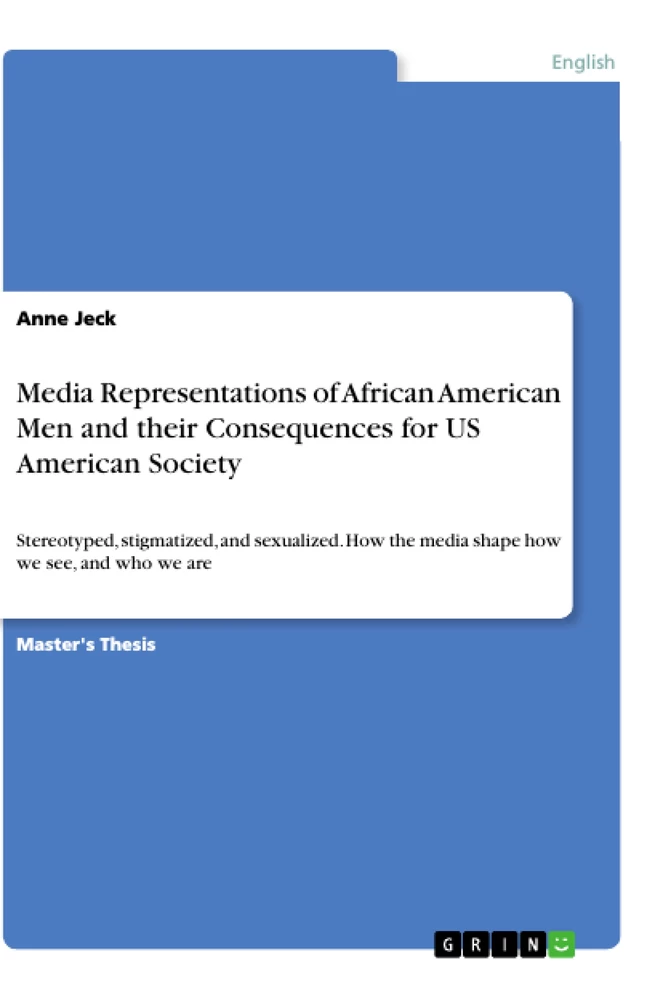
Table of Contents
1 INTRODUCTION
1.1 PROCEDURE
1.2 MAIN RESEARCH QUESTIONS AND HYPOTHESIS
2 THEORETICAL FRAMEWORK
2.1 TRIANGULAR APPROACH: INTOXICATED INTERSECTIONALITY FOR BLACK MEN
2.2 PRIME TIME: WHEN MEDIA PRIMING TURNS INTO MEDIA FRAMING
3 BLACKOUT: THE POLITICS OF VISIBILITY
4 BLACKLIST: LACK OF QUALITATIVE REPRESENTATION
4.1 BLACKFACE: COLORING CRIME
4.2 BLACKBOX: HYPER-SEXUALIZATION OF BLACK MEN
5 B(L)ACKLASH: RESHAPING MEDIA REPRESENTATIONS OF BLACK MEN
5.1 FROM CATEGORIZATION TO INDIVIDUATION
5.2 DE-CORPORALITY PROCESS
6 CONCLUSION AND DISCUSSION
Research Objectives and Core Themes
This thesis examines the representation of African American men in contemporary US media and analyzes the societal consequences of these portrayals. By bridging cultural and media studies, the research explores how stereotypical depictions of black males contribute to systemic discrimination and shape public perceptions of reality.
- Intersectionality as a framework for understanding race, gender, and class.
- Media priming and cultivation theory as mechanisms of social influence.
- The quantitative and qualitative misrepresentation of black men in cinema and news.
- Historical roots of criminalization and hyper-sexualization in media discourse.
- Strategies for reshaping representation and challenging institutionalized bias.
Excerpt from the Book
Blackface: Coloring Crime
While in the previous chapter it was argued that there is a quantitative misrepresentation of African American men in the media, this chapter will be concerned with a qualitative inquiry and examine how at the same time there is a blatant overrepresentation of black males in regard to their depiction as criminals. This overrepresentation becomes particularly relevant when the representation of blacks in connection to crime is not limited to fictional forms of representation anymore, but can also be found in non-fictional media. Malika Cyril, Executive Director of the Center for Media Justice, argues:
Black people, black men in particular, […] are overrepresented in news as criminals. When I say overrepresented, that means they are shown as criminals more times than is accurate, that they are actually criminals […] based on FBI statistics. (Cyril qtd. in 13th 2016: 00:27:50)
According to this statement the number of African Americans shown as criminals in the news is not compatible with factual arrest rates. This does not mean that people shown in the news are not criminals; it primarily means that the media representation of criminals in regard to race is not evenly distributed, as it either ignores the coverage of crimes committed by people of other races or overrepresents whites as victims of crimes committed by blacks (Oliver 2003: 7). Above-average representation of African Americans as criminals, e.g. handcuffed, while being arrested, or in jail (Oliver 2003: 6), conveys the impression that African Americans are by some means prone to criminal offences. Not only are black men overrepresented as criminals relative to actual arrest rates, but also relative to their numbers in US American population (Eberhardt 2010: 441). By over-proportionately representing black men in relation to crime, it needs to be subsumed that the audience is purposefully manipulated with the intention to trigger negative emotions and opinions towards that ethnic group.
Summary of Chapters
1 INTRODUCTION: Outlines the problem of racial discrimination in the US and the pervasive influence of media representations on societal perceptions.
2 THEORETICAL FRAMEWORK: Establishes an interdisciplinary foundation using intersectionality, cultivation theory, and media priming to analyze social identity and media impact.
3 BLACKOUT: THE POLITICS OF VISIBILITY: Analyzes the quantitative representation of African Americans in popular film and the exclusionary nature of the media industry.
4 BLACKLIST: LACK OF QUALITATIVE REPRESENTATION: Investigates the harmful overrepresentation of black men as criminals and the hyper-sexualization of the black male body.
5 B(L)ACKLASH: RESHAPING MEDIA REPRESENTATIONS OF BLACK MEN: Explores revolutionary art projects and social movements aiming to challenge traditional stereotypes and foster more authentic representations.
6 CONCLUSION AND DISCUSSION: Synthesizes the findings, confirming the link between biased media framing and real-world prejudices, and suggests future directions for media accountability.
Keywords
Media Representation, African American Men, Intersectionality, Media Priming, Cultivation Theory, Criminalization, Hyper-sexualization, Mass Incarceration, Black Masculinity, Racial Stereotypes, Systemic Racism, Media Accountability, Social Construction, Hollywood Diversity, Counter-stereotypes.
Frequently Asked Questions
What is the core focus of this thesis?
This thesis explores the specific ways in which African American men are depicted in US media and the negative consequences these depictions have on their social and economic lives.
What are the central thematic areas?
The work covers quantitative media visibility, the criminalization of black men in news and fiction, the hyper-sexualization of black bodies, and movements working toward more accurate representation.
What is the primary research goal?
The aim is to determine if reinforced stereotypical media representations negatively impact the lives of African American men and if these portrayals lead to pervasive social prejudice.
Which scientific methods are employed?
The author uses an interdisciplinary approach, combining intersectionality (for identity and power analysis) with media studies theories like cultivation theory and media priming.
What does the main body of the work address?
The main part examines numerical data on media representation, the qualitative framing of black men as "criminal" or "hyper-sexualized," and case studies of art projects fighting these stereotypes.
Which keywords best characterize this work?
Key terms include media representation, intersectionality, criminalization, hyper-sexualization, systemic racism, and social justice communication.
How does the author define the "New Racism" in media?
It is defined as a mixture of traditional, persistent racist patterns combined with new, subtle forms of discrimination that keep African Americans at the bottom of the social hierarchy.
What role does the 13th Amendment play in the author's argument?
The author discusses the "criminality clause" in the 13th Amendment as a legal loophole that facilitates the mass incarceration of African Americans, turning the prison system into a modern tool of racial control.
How is the "Blackbox" metaphor used in this context?
The metaphor describes the black male body as something acted upon and inscribed with external, stereotypical meanings by mainstream culture, leaving little room for black men to define their own identities.
Ende der Leseprobe aus 82 Seiten
- nach oben
- Arbeit zitieren
- Anne Jeck (Autor:in), 2017, Media Representations of African American Men and their Consequences for US American Society, München, Page::Imprint:: GRINVerlagOHG, https://www.diplomarbeiten24.de/document/975873

neugierig - aktuell - relevant
Entdecken Sie hilfreiche Tipps und Tricks rund ums Studium!

Entdecken Sie hilfreiche Tipps und Tricks rund ums Studium!
Ihre Hausarbeit / Abschlussarbeit:

- - Publikation als E-Book und Buch
- - Hohes Honorar auf die Verkäufe
- - Für Sie komplett kostenlos - mit ISBN
- - Es dauert nur 5 Minuten
- - Jede Arbeit findet Leser

- © GRIN Publishing GmbH.
- Alle Inhalte urheberrechtlich geschützt. Kopieren und verbreiten untersagt.
- info@grin.com
- AGB
- Open Publishing
Der GRIN Verlag hat sich seit 1998 auf die Veröffentlichung akademischer eBooks und Bücher spezialisiert. Der GRIN Verlag steht damit als erstes Unternehmen für User Generated Quality Content. Die Verlagsseiten GRIN.com, Hausarbeiten.de und Diplomarbeiten24 bieten für Hochschullehrer, Absolventen und Studenten die ideale Plattform, wissenschaftliche Texte wie Hausarbeiten, Referate, Bachelorarbeiten, Masterarbeiten, Diplomarbeiten, Dissertationen und wissenschaftliche Aufsätze einem breiten Publikum zu präsentieren.
Kostenfreie Veröffentlichung: Hausarbeit, Bachelorarbeit, Diplomarbeit, Dissertation, Masterarbeit, Interpretation oder Referat jetzt veröffentlichen!
Folgen Sie GRIN auf


- GRIN Verlag GmbH
-
- Nymphenburger Str. 86
- 80636
- Munich, Deutschland
- +49 89-550559-0
- +49 89-550559-10
- info@grin.com
-
