
präsentiert von

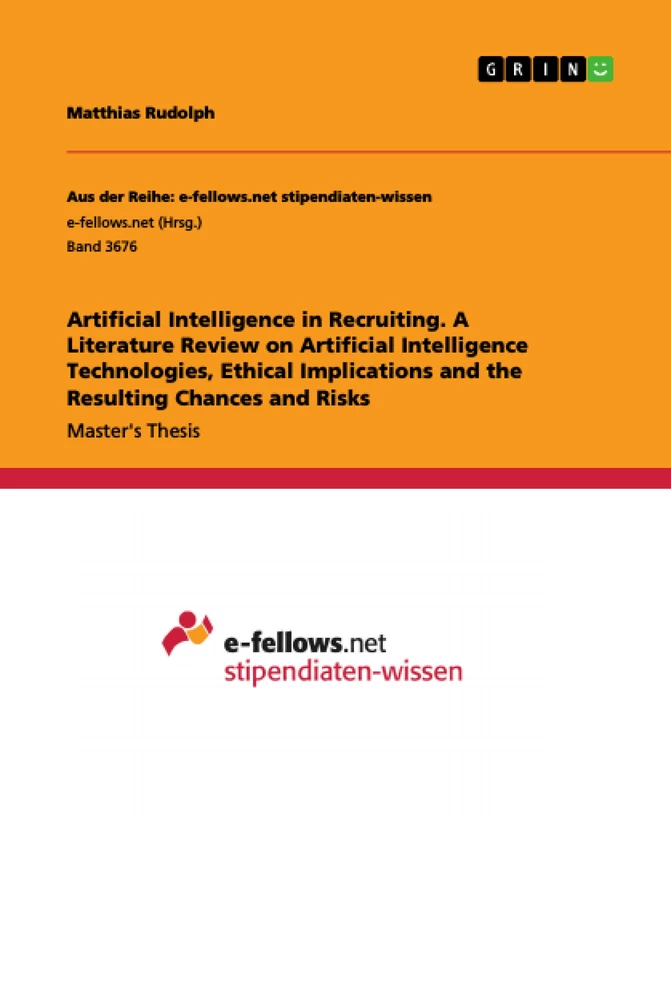
Table of Contents
1 Introduction
1.1 Problem statement
1.2 Objective and structure of the thesis
2 Theoretical Background
2.1 Recruiting as a part of Human Resources
2.1.1 Recruiting and its subprocesses
2.1.1.1 Reaching out subprocess
2.1.1.2 Preselecting subprocess
2.1.1.3 Assessing subprocess
2.1.2 Evolution of digitalization in recruiting
2.2 Machine learning as a part of artificial intelligence (AI)
2.2.1 Central framework used to create machine learning models
2.2.2 Supervised learning algorithms used in AI-based recruiting tools
2.2.2.1 Machine learning using statistical models
2.2.2.2 Machine learning using instance-based models
2.2.2.3 Machine learning using decision tree models
2.2.2.4 Machine learning using neural network models
2.3 Relevant ethical principles affected by AI-based recruiting tools
2.3.1 Ethical principle fairness
2.3.2 Ethical principle transparency
3 Method
3.1 Phase 1 - Definition of review scope
3.2 Phase 2 - Conceptualization of the topic
3.3 Phase 3 - Literature search
3.3.1 Phase 3.1 - Identification of relevant journals and conferences
3.3.2 Phase 3.2 - Identification of search databases
3.3.3 Phase 3.3 - Keyword search
3.3.4 Phase 3.4 - Forward and backward search
4 Results
4.1 Analysis of AI-based recruiting tools
4.1.1 Enhancing the reaching out subprocess
4.1.1.1 Challenges in the reaching out subprocess
4.1.1.2 Need and approaches for identifying high potential passive candidates
4.1.1.3 Analysis of AI-based recruiting tools in the reaching out subprocess
4.1.2 Enhancing the preselecting subprocess
4.1.2.1 Challenges in the preselecting subprocess
4.1.2.2 Need and approaches for preselecting candidates
4.1.2.3 Need and approach for creating personalized questions for questionnaires
4.1.2.4 Analysis of AI-based recruiting tools in the preselecting subprocess
4.1.3 Enhancing the assessing subprocess
4.1.3.1 Challenges in the assessing subprocess
4.1.3.2 Need and approaches for objectivizing audio-visual input
4.1.3.3 Need and approaches for objectivizing the derivation of personal characteristics
4.1.3.4 Need and approaches for predicting job performance and working habits
4.1.3.5 Need and approaches for predicting the salary of candidates
4.1.3.6 Analysis of AI-based recruiting tools in the assessing subprocess
4.1.4 Concluding assessment of AI-based recruiting tools
4.2 Analysis of the addressing of ethical challenges arising from AI-based recruiting tools
4.2.1 Addressing of fairness
4.2.1.1 Challenge of using data of poor quality in AI-based recruiting tools
4.2.1.2 Need for addressing fairness in AI-based recruiting
4.2.1.3 Analysis of the addressing of fairness in AI-based recruiting tools
4.2.2 Addressing of transparency
4.2.2.1 Challenge of using black box models in AI-based recruiting tools
4.2.2.2 Need for addressing transparency in AI-based recruiting
4.2.2.3 Analysis of the addressing of transparency in in AI-based recruiting tools
4.2.3 Concluding assessment of the addressing of ethical challenges
5 Discussion
5.1 Implications for research
5.2 Implications for practice
6 Conclusion
6.1 Summary
6.2 Limitations and further research needs
Research Objective and Key Themes
The master thesis analyzes the tension between the benefits of implementing Artificial Intelligence (AI) in recruiting and the associated risks, specifically focusing on how academic research addresses ethical challenges. The central research question explores which AI technologies are applied to influence the recruiting process and how major ethical concerns, particularly fairness and transparency, are mitigated by these AI-based tools.
- Application and influence of AI technologies within the different recruiting subprocesses (reaching out, preselecting, and assessing).
- Technical analysis of machine learning algorithms used to automate and enhance recruiting tasks.
- Evaluation of ethical challenges arising from AI implementation, with a focus on algorithmic bias and the "black box" nature of models.
- Systematic review and assessment of how existing literature addresses fairness and transparency in AI-recruiting models.
- Derivation of implications for future research and practical management of AI-based recruiting tools.
Extract from the Book
1.1 Problem statement
In 2020, approximately 54% of companies experience shortages of high-quality employees according to the survey of the ManpowerGroup (2020, p. 2) covering half a million organizations worldwide. Next to the difficulty of recruiting well-fitting candidates, the hiring process for one employee takes approximately 42 to 52 days and costs an organization around USD 4,000. At the same time, the recruiting process is considered to be highly subjective (Black and van Esch 2020, pp. 216-217; Zhu et al. 2018, p. 2). To increase the efficiency and objectivity of the recruiting process, organizations started using AI-based tools. While early adopters stated that through the implementation of such tools, they were able to reduce cost and time-to-hire and to enhance the quality of the recruiting process, the technology also bared new risks. For example, in 2015, one year after the launch of their AI-based recruiting tools, Amazon became aware that its tool strongly preferred male candidates for job openings and, in turn, discriminated against women. Next to the awareness of the tool’s discriminatory tendencies, the in-transparency of the decision-making process led Amazon to the conclusion that they cannot guarantee “that the machines would not devise other ways of sorting candidates” than intended. Thus, the project was stopped in 2017 (Dastin 2018, p. 2). In accordance, LinkedIn Talent Solution’s vice president John Jersin, who is responsible for offering AI-based tools to recruiters, stated that he “would not trust any AI system today to make a hiring decision on its own” (Dastin 2018, p. 5). Consequently, it appears that AI-based recruiting tools can be used to raise potentials in the field of recruiting. Nevertheless, and underscored by the examples from practice, it becomes clear that the success of AI-based recruiting tools does not only depend on the potential chances an implementation would create, but also on the addressing of ethical questionings such as fairness and transparency.
Summary of Chapters
1 Introduction: Provides the problem statement regarding the inefficiency and subjectivity of traditional recruiting and outlines the research objective of analyzing ethical risks in AI-based recruiting.
2 Theoretical Background: Defines recruiting subprocesses, explains machine learning as a core component of AI, and introduces ethical principles like fairness and transparency.
3 Method: Describes the framework for the systematic literature review (SLR), including search strategies and relevance criteria to identify and analyze relevant academic publications.
4 Results: Analyzes the literature set regarding technological applications in the three recruiting subprocesses and evaluates how these studies address fairness and transparency.
5 Discussion: Discusses the findings from the literature analysis, comparing them to conceptual studies and evaluating implications for both research and management practice.
6 Conclusion: Summarizes the thesis's contribution to identifying research gaps and outlines limitations while suggesting directions for future research in AI-based recruiting.
Keywords
Artificial Intelligence, AI-based recruiting, machine learning, supervised learning, recruitment subprocesses, fairness, transparency, algorithmic bias, black box models, explainable AI, human resources, talent acquisition, recruitment ethics, systematic literature review.
Frequently Asked Questions
What is the primary focus of this master thesis?
The thesis focuses on the integration of Artificial Intelligence (AI) into the recruiting process, examining how it changes traditional hiring methods and evaluating the associated ethical risks such as bias and lack of transparency.
What are the three main subprocesses of recruiting discussed?
The author identifies three distinct phases: the "reaching out" subprocess (attracting candidates), the "preselecting" subprocess (screening candidates), and the "assessing" subprocess (evaluating candidates and final selection).
What is the core research objective?
The goal is to close the existing research gap by systematically analyzing how AI technologies influence recruiting and, critically, how these AI-based tools address—or fail to address—essential ethical challenges like fairness and transparency.
What scientific methodology does the author use?
The thesis employs a Systematic Literature Review (SLR) based on established frameworks (like vom Brocke et al.), involving a rigorous search process to identify and analyze academic publications relevant to AI, recruiting, and ethical considerations.
How does the author categorize AI-based tools?
Tools are categorized based on the machine learning algorithms they utilize, such as statistical models, instance-based models, decision trees, and neural networks, and whether these models are considered "transparent" or "black box" (in-transparent).
Which ethical principles are specifically analyzed?
The analysis concentrates on "fairness" and "transparency" as the most prominent ethical guidelines within the AI ecosystem, as identified by the work of Jobin et al. (2019).
Why did Amazon stop its AI-based recruiting project?
The project was discontinued because the tool exhibited strong gender-based discrimination and its decision-making process was so opaque ("black box") that the company could not guarantee that the machine would stop sorting candidates in unfair ways.
How does the thesis evaluate the "fairness" of the analyzed models?
It uses an evaluation metric based on "fairness through unawareness," where models are rated on whether they exclude discriminatory features from training data or employ specific mitigation methods to prevent biased outcomes.
Ende der Leseprobe aus 130 Seiten
- nach oben
- Arbeit zitieren
- Matthias Rudolph (Autor:in), 2020, Artificial Intelligence in Recruiting. A Literature Review on Artificial Intelligence Technologies, Ethical Implications and the Resulting Chances and Risks, München, Page::Imprint:: GRINVerlagOHG, https://www.diplomarbeiten24.de/document/978174

neugierig - aktuell - relevant
Entdecken Sie hilfreiche Tipps und Tricks rund ums Studium!

Entdecken Sie hilfreiche Tipps und Tricks rund ums Studium!
Ihre Hausarbeit / Abschlussarbeit:

- - Publikation als E-Book und Buch
- - Hohes Honorar auf die Verkäufe
- - Für Sie komplett kostenlos - mit ISBN
- - Es dauert nur 5 Minuten
- - Jede Arbeit findet Leser

- © GRIN Publishing GmbH.
- Alle Inhalte urheberrechtlich geschützt. Kopieren und verbreiten untersagt.
- info@grin.com
- AGB
- Open Publishing
Der GRIN Verlag hat sich seit 1998 auf die Veröffentlichung akademischer eBooks und Bücher spezialisiert. Der GRIN Verlag steht damit als erstes Unternehmen für User Generated Quality Content. Die Verlagsseiten GRIN.com, Hausarbeiten.de und Diplomarbeiten24 bieten für Hochschullehrer, Absolventen und Studenten die ideale Plattform, wissenschaftliche Texte wie Hausarbeiten, Referate, Bachelorarbeiten, Masterarbeiten, Diplomarbeiten, Dissertationen und wissenschaftliche Aufsätze einem breiten Publikum zu präsentieren.
Kostenfreie Veröffentlichung: Hausarbeit, Bachelorarbeit, Diplomarbeit, Dissertation, Masterarbeit, Interpretation oder Referat jetzt veröffentlichen!
Folgen Sie GRIN auf


- GRIN Verlag GmbH
-
- Nymphenburger Str. 86
- 80636
- Munich, Deutschland
- +49 89-550559-0
- +49 89-550559-10
- info@grin.com
-
