
präsentiert von

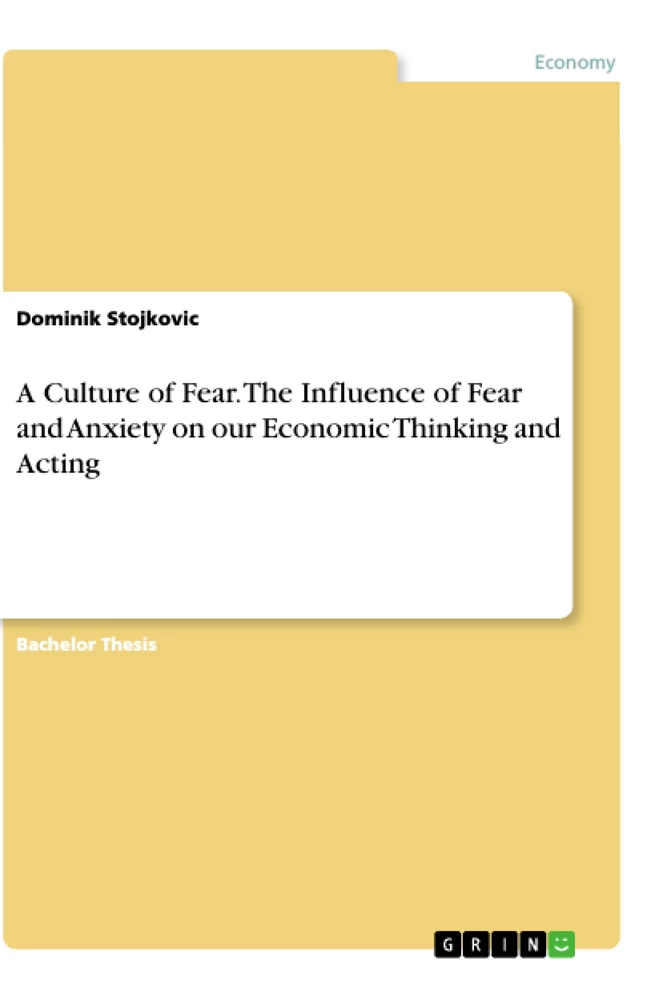
Table of Contents
1 Defining Fear and Anxiety
Emotions
From Fear to Anxiety
The Attraction of Fear
Fear: Omnipresent and Strong
2 The Culture of Fear
Fear and Risk
3 Economics of Fear
Homo Anxietas
Fear and Action
Fear and Performance
4 Beyond Fear
Objectives and Topics
This thesis analyzes the impact of fear and anxiety on Western culture, specifically investigating how these emotions influence economic thinking, decision-making, and the perceived prevalence of risk.
- Neurobiological and philosophical foundations of fear and anxiety.
- The emergence of a "culture of fear" and its impact on social discourse.
- The intersection of fear, uncertainty, and economic decision-making.
- The development of the "Homo Anxietas" model to describe behavior driven by anxiety.
Excerpt from the Book
Homo Anxietas
Certain emotions are generally believed to tell us something about reality. Fear is one of them. It is, then, seen as an instrument of perception. However, those instruments may work properly or improperly. As stated earlier, a person’s interpretation of a situation is essential for the person’s emotions regarding that situation. Nevertheless, these interpretations may as well be insufficient, which may, therefore, result in our emotional assessment of a situation to be insufficient. We make mistakes, as Aristotle points out, when we fear the wrong things, in the wrong way or at the wrong time (Aristotle, 2000, pp. 31–32). This, for instance, would be the case if someone is afraid of flying but not of driving a car because he or she (wrongly) assumes that flying is more dangerous than driving a car. That fear would be incorrect; one’s interpretation would be misguided.
In economics, economic behavior is often explained by the anthropology of the homo economicus. It is like a robot calculating cost and profit: homo economicus lacks emotion, does not give in to temptations, and is not greedy nor altruistic. It describes a utility-maximizer that operates rationally concerning its target function. Homo economicus’ main traits are 1) self-interest, 2) rational behavior, 3) maximizing personal utility, 4) reaction to constraints, 5) fixed preferences, and 6) complete information (Franz, 2004).
Summary of Chapters
1 Defining Fear and Anxiety: This chapter establishes an interdisciplinary foundation by defining emotions, distinguishing between fear and anxiety, and exploring their evolutionary and neurobiological roles.
2 The Culture of Fear: This chapter analyzes how fear has transitioned into a persistent cultural characteristic in Western societies, impacting norms, behaviors, and the perception of risk.
3 Economics of Fear: This chapter introduces the "Homo Anxietas" model, contrasting it with the neoclassical "Homo Economicus" to explain how fear and anxiety drive economic decision-making.
4 Beyond Fear: This chapter explores potential ways to move past the culture of fear, advocating for a shift in mindset from anxiety toward hope and realistic, critical thinking.
Keywords
Fear, Anxiety, Culture of Fear, Homo Anxietas, Economic Decision-Making, Risk, Uncertainty, Behavioral Economics, Rationality, Evolutionary Biology, Amygdala, Cognitive Performance, Yerkes-Dodson Law, Hope.
Frequently Asked Questions
What is the core subject of this thesis?
The thesis explores the influence of fear and anxiety on economic thinking and acting within Western societies, investigating how these emotions shape modern life.
What are the primary thematic fields covered?
The work integrates insights from psychology, neurobiology, sociology, philosophy, and behavioral economics to provide a comprehensive view of the "culture of fear."
What is the main objective or research question?
The aim is to analyze the impact of fear on people in Western cultures and specifically determine how growing anxiety affects economic decision-making and leads to financial or social losses.
Which scientific method is utilized?
The author conducts in-depth conceptual and theoretical research, synthesizing existing findings from various academic disciplines to build a new analytical model.
What is addressed in the main body of the work?
The work moves from defining fear at a neurobiological level to analyzing it as a cultural phenomenon, eventually applying these insights to economic behavior and proposing a transition toward hope.
Which keywords best characterize this work?
Key concepts include the "culture of fear," "Homo Anxietas," risk perception, uncertainty, and the psychological underpinnings of economic behavior.
How does the "Homo Anxietas" model differ from "Homo Economicus"?
Unlike "Homo Economicus," which assumes perfect rationality and complete information, "Homo Anxietas" describes an anxious individual driven by self-protection, irrational impulses, and reaction to uncertainty.
What is the author's conclusion regarding the role of fear in the economy?
The author concludes that fear, while biologically protective, often distorts economic decision-making in modern society, and suggests that a broader, interdisciplinary approach to risk management is necessary.
Ende der Leseprobe aus 83 Seiten
- nach oben
- Arbeit zitieren
- Dominik Stojkovic (Autor:in), 2020, A Culture of Fear. The Influence of Fear and Anxiety on our Economic Thinking and Acting, München, Page::Imprint:: GRINVerlagOHG, https://www.diplomarbeiten24.de/document/978863

neugierig - aktuell - relevant
Entdecken Sie hilfreiche Tipps und Tricks rund ums Studium!

Entdecken Sie hilfreiche Tipps und Tricks rund ums Studium!
Ihre Hausarbeit / Abschlussarbeit:

- - Publikation als E-Book und Buch
- - Hohes Honorar auf die Verkäufe
- - Für Sie komplett kostenlos - mit ISBN
- - Es dauert nur 5 Minuten
- - Jede Arbeit findet Leser

- © GRIN Publishing GmbH.
- Alle Inhalte urheberrechtlich geschützt. Kopieren und verbreiten untersagt.
- info@grin.com
- AGB
- Open Publishing
Der GRIN Verlag hat sich seit 1998 auf die Veröffentlichung akademischer eBooks und Bücher spezialisiert. Der GRIN Verlag steht damit als erstes Unternehmen für User Generated Quality Content. Die Verlagsseiten GRIN.com, Hausarbeiten.de und Diplomarbeiten24 bieten für Hochschullehrer, Absolventen und Studenten die ideale Plattform, wissenschaftliche Texte wie Hausarbeiten, Referate, Bachelorarbeiten, Masterarbeiten, Diplomarbeiten, Dissertationen und wissenschaftliche Aufsätze einem breiten Publikum zu präsentieren.
Kostenfreie Veröffentlichung: Hausarbeit, Bachelorarbeit, Diplomarbeit, Dissertation, Masterarbeit, Interpretation oder Referat jetzt veröffentlichen!
Folgen Sie GRIN auf


- GRIN Verlag GmbH
-
- Nymphenburger Str. 86
- 80636
- Munich, Deutschland
- +49 89-550559-0
- +49 89-550559-10
- info@grin.com
-
