
präsentiert von

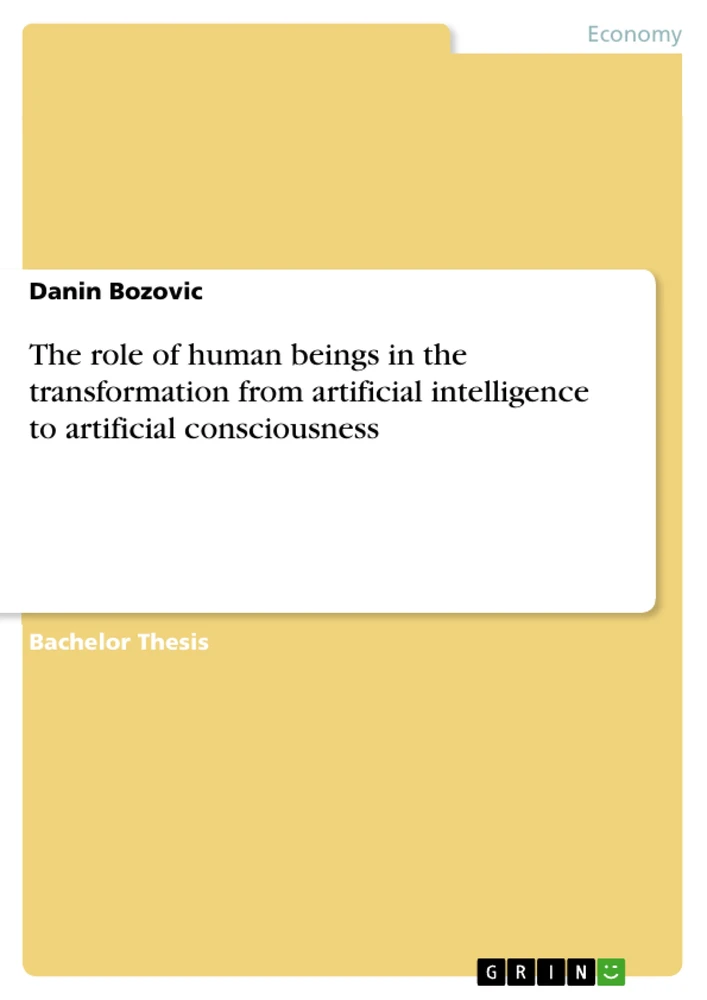
Table of Contents
1 Introduction
2 Artificial Intelligence
2.1 What is intelligence?
2.1.1 What is memory?
2.1.2 How do we learn?
2.2 Can machines think? Turing Test
2.3 The Winograd Challenge exuberates the thinking of machines
2.4 Comparison of artificial intelligence and biological intelligence
2.5 Current State of Artificial Intelligence
2.5.1 Artificial General Intelligence
2.5.2 Society’s perception of artificial intelligence
2.6 Ethical problems of artificial intelligence
3 Consciousness
3.1 What is consciousness? An exposition of the philosophic debate through the course of time
3.2 What is consciousness? A scientific approach to the revelation of the mystery
3.3 The importance of the intersection of philosophy and science in today’s time
3.4 Does artificial consciousness exist?
3.5 What importance does artificial consciousness have?
4 Future work
4.1 Definition of the term
4.2 The role of human beings in the prospective work sphere
4.3 Productivity augmentation due to the introduction of machines and computers
4.3.1 Why can we augment productivity?
4.3.2 Company example of how humans and machines work together
4.4 Future work under the consideration of business ethics
5 Conclusion
Research Objectives and Themes
This thesis examines the evolving role of human beings as creators and workers in the context of the transition from artificial intelligence to potential artificial consciousness. It explores the technological, philosophical, and ethical implications of this shift, focusing on how humans can remain relevant and productive in a landscape increasingly shaped by autonomous systems.
- Comparison between human biological intelligence and artificial intelligence capabilities.
- Philosophical and scientific explorations into the nature of consciousness.
- Impact of automation and digital transformation on the future of the global workforce.
- Ethical considerations and the necessity of frameworks for human-machine synergy.
Excerpt from the Book
2.1 What is intelligence?
Defining intelligence is controversial, because there is no explicit, unequivocal definition of the term. As R.J Sternberg states it: “Viewed narrowly, there seem to be almost as many definitions of intelligence as there were experts asked to define it.”
Therefore, a comprehensive definition will be given, that incorporates the largest possible aspects.
Intelligence is the capacity to achieve complex objectives. This definition is comprehensive enough in order to incorporate different concepts, that are understood as aspects of intelligence. For instance, understanding, consciousness, problem solving and learning can all be examples for complex objectives.
Since various forms of objectives exist, we observe a diversity of manners of intelligence. It is difficult to compare intelligence to one another. Taking the example of computer programs. Is a program that only knows how to play Go more intelligent than one that only knows to how to play chess? There is no reasonable answer for that context. We can only say that a third program would be more intelligent, than the mentioned ones, if it performs at least comparably as well as the other two in achieving their objectives. This brings us to the classification of intelligence, since the differentiation between limited and encompassing intelligence exists.
Summary of Chapters
1 Introduction: Introduces the research purpose of exploring the changing position of humans in an era defined by digital transformation and artificial intelligence.
2 Artificial Intelligence: Analyzes the definition of intelligence, memory, and learning in both biological and artificial systems, while addressing key concepts like the Turing Test and current ethical dilemmas.
3 Consciousness: Investigates the philosophical and scientific dimensions of consciousness, exploring whether artificial systems could ever achieve subjective experience or emotional intelligence.
4 Future work: Examines how frontier technologies and automation are shifting the role of humans in the workforce from creators to delegators, necessitating new ethical guidelines.
5 Conclusion: Summarizes the findings, emphasizing the importance of human intellect, cooperation, and proactive ethical management in navigating the future of artificial intelligence.
Keywords
Artificial Intelligence, Artificial Consciousness, Digital Transformation, Human-Machine Interaction, Neural Networks, Future of Work, Automation, Ethics, Business Management, Singularity, Consciousness, Machine Learning, Productivity, Philosophy, Technology.
Frequently Asked Questions
What is the core focus of this thesis?
The work focuses on the transformation of the role of human beings as technology evolves from basic artificial intelligence toward the potential for artificial consciousness.
What are the central thematic fields covered?
The thesis covers computer science (AI and automation), philosophy (the nature of consciousness and existence), and management (the future of work and business ethics).
What is the primary research goal?
The primary goal is to discover how humans will navigate and redefine their position in a future where machines increasingly possess advanced cognitive capabilities.
Which scientific methods are utilized?
The research relies on literature reviews, interdisciplinary analysis of technological trends, and expert interviews with professionals in fields like automated driving and management consulting.
What topics are discussed in the main body?
The main body covers the definition and comparison of intelligence types, the hard problem of consciousness, the integration of automation in industry, and the necessity of ethical governance.
Which keywords best characterize this work?
Key terms include Artificial Consciousness, Digital Transformation, Human-Machine Interaction, Future of Work, and Business Ethics.
How does the author distinguish between AGI and artificial consciousness?
The author differentiates them by noting that AGI focuses on performing human-level tasks, whereas artificial consciousness implies the addition of subjective, emotional awareness and self-reference.
What is the significance of the "delegator" concept in the work sphere?
The author suggests that as machines become more capable, the human role shifts from direct creator to a delegator and overseer, requiring new skills in management and ethical judgment.
Ende der Leseprobe aus 35 Seiten
- nach oben
- Arbeit zitieren
- Danin Bozovic (Autor:in), 2020, The role of human beings in the transformation from artificial intelligence to artificial consciousness, München, Page::Imprint:: GRINVerlagOHG, https://www.diplomarbeiten24.de/document/989945

neugierig - aktuell - relevant
Entdecken Sie hilfreiche Tipps und Tricks rund ums Studium!

Entdecken Sie hilfreiche Tipps und Tricks rund ums Studium!
Ihre Hausarbeit / Abschlussarbeit:

- - Publikation als E-Book und Buch
- - Hohes Honorar auf die Verkäufe
- - Für Sie komplett kostenlos - mit ISBN
- - Es dauert nur 5 Minuten
- - Jede Arbeit findet Leser

- © GRIN Publishing GmbH.
- Alle Inhalte urheberrechtlich geschützt. Kopieren und verbreiten untersagt.
- info@grin.com
- AGB
- Open Publishing
Der GRIN Verlag hat sich seit 1998 auf die Veröffentlichung akademischer eBooks und Bücher spezialisiert. Der GRIN Verlag steht damit als erstes Unternehmen für User Generated Quality Content. Die Verlagsseiten GRIN.com, Hausarbeiten.de und Diplomarbeiten24 bieten für Hochschullehrer, Absolventen und Studenten die ideale Plattform, wissenschaftliche Texte wie Hausarbeiten, Referate, Bachelorarbeiten, Masterarbeiten, Diplomarbeiten, Dissertationen und wissenschaftliche Aufsätze einem breiten Publikum zu präsentieren.
Kostenfreie Veröffentlichung: Hausarbeit, Bachelorarbeit, Diplomarbeit, Dissertation, Masterarbeit, Interpretation oder Referat jetzt veröffentlichen!
Folgen Sie GRIN auf


- GRIN Verlag GmbH
-
- Nymphenburger Str. 86
- 80636
- Munich, Deutschland
- +49 89-550559-0
- +49 89-550559-10
- info@grin.com
-
