
präsentiert von

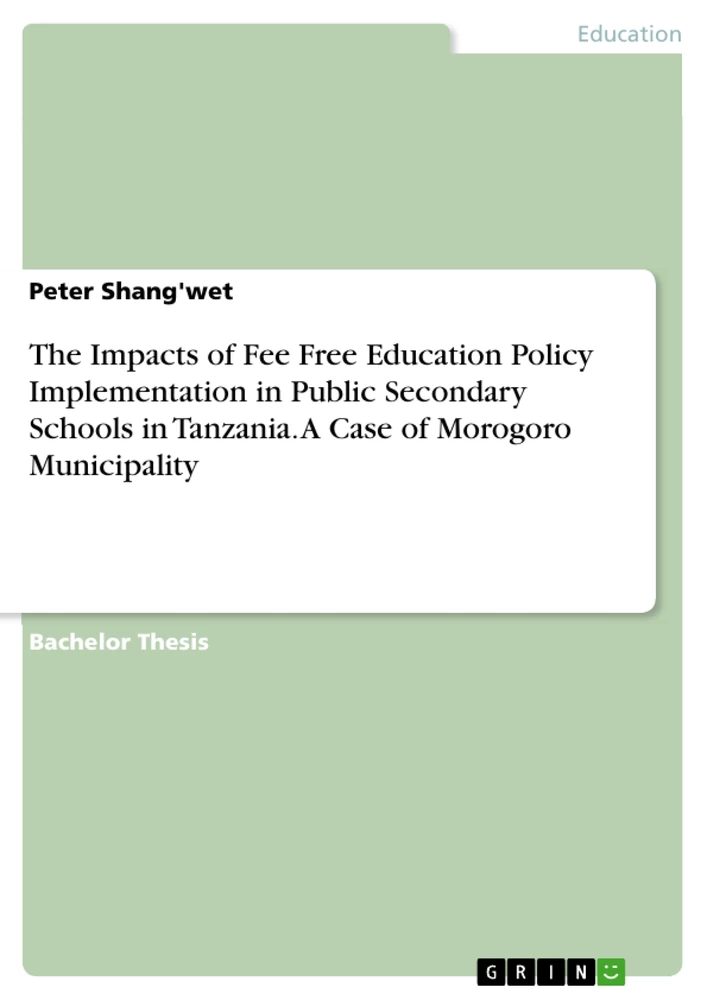
Table of Contents
1. Introduction
1.1 Background of the study
1.2 Problem Statement.
1.3 Objectives of the study.
1.3.1 General objective.
1.3.2 Specific objectives.
1.4 Research questions.
1.5 Significance of the study.
1.6 Scope of the Study
1.7 Limitations of the study
2. Literature Review
2.1 The concept of Fee Free Education (FFE).
2.2 Challenges in Abolishing School Fees
2.3 The impacts of FFE policy.
2.4 Research Gap.
3. Research Methodology
3.1 Description of the study Area.
3.2 Sampling procedure and Sample size
3.2.1 Research design
3.2.2 Research approach.
3.2.3 Sampling Procedure.
3.2.4 Sample size.
3.3 Data collection methods.
3.3.1 Primary data.
3.3.2 Secondary data.
3.4 Data Analysis and Presentation.
4. Results and Discussions
4.1 Understanding on the Concept of Fee Free Education.
4.1.1 Teachers’ understanding on FFE policy
4.1.2 Students’ understanding on FFE policy
4.1.3 Parents’ understanding on FFE policy
4.2 Involvement in the implementation of FFE
4.2.1 Teachers’ involvement in implementation of FFE
4.2.2 Students’ involvement in implementation of FFE
4.3 Challenges in the Implementation of FFE.
4.3.1 Challenges in the Implementation of FFE according to teachers
4.3.2 Challenges in the Implementation of FFE according to students
4.3.3 Challenges in the Implementation of FFE according to Parents.
4.4 Impacts of the Implementation of FFE policy.
4.4.1 Impacts of the Implementation of FFE policy according to teachers.
4.4.2 Impacts of the Implementation of FFE policy according to students.
4.4.3 Impacts of the Implementation of FFE policy according to parents.
4.5 Suggestions for Improving Provision of FFE
4.5.1 Teachers’ suggestions for Improving Provision of FFE
4.5.2 Students’ suggestions for Improving Provision of FFE
4.5.3 Parents’ suggestions for Improving Provision of FFE
5. Conclusion and Recommendations
5.1 Conclusion
5.2 Recommendations
Research Objectives and Themes
The primary aim of this research is to evaluate the socio-economic and political impacts of the Fee Free Education (FFE) policy in public secondary schools in Tanzania, specifically focusing on the Morogoro Municipality. The study investigates stakeholders' awareness of the policy and identifies the practical challenges faced during its implementation.
- Stakeholder understanding and awareness of the Fee Free Education policy.
- Challenges encountered by teachers, students, and parents during policy implementation.
- Positive and negative socio-economic impacts of the policy on school operations.
- Proposed strategies and suggestions for improving the provision of FFE in public schools.
Excerpt from the Book
1.1 Background of the study
Education is one of the most important sector in any nation. It is the responsibility of a government to set and launch national education policy and participate in setting up international policies on education. Countries have been investing much in education especially primary and secondary education, regarded as a basic education (Abagi, 1998).
Since independence 1961, Tanzania has made various efforts in broadening the education service to her people. This is to ensure that education service is accessible to nearly every Tanzanian. In Tanzania, the first effort of Fee Free Education was instigated in 1963 to ensure that majority of Tanzanians get education and to remove the enrolment gap between poor and rich households. Therefore, government financed and provided free education from primary to university level (HakiElimu, 2017). International efforts on ensuring free education for all also guided Tanzania towards implementation of free education. World Conference on Education for All (EFA) held on 1990 at Jomtien in Thailand rearticulated the desire of achieving Universal Primary Education by 2000 (UNESCO, 2000).
In 2000, it was then realized that most countries failed to achieve or implement the goal of UPE, hence two international efforts were declared to ensure access to free education, these were Dakar Framework for Action and Millennium Development Goals (MDG’s). These declarations had similar goals, they needed every government to ensure all children especially girls should have access to and complete primary education by 2015 (UNESCO, 2000).
Summary of Chapters
Chapter One: Provides an overview of the educational landscape in Tanzania, defines the problem statement regarding FFE implementation, and outlines the specific research objectives and questions.
Chapter Two: Reviews literature on the concept of Fee Free Education, existing challenges in abolishing school fees globally, and the documented impacts of similar policies.
Chapter Three: Details the research methodology, including the case study design, mixed-methods approach, sampling procedures, and the data collection tools used in the Morogoro Municipality.
Chapter Four: Presents the primary results and discussions, covering stakeholder understanding, involvement, identified challenges, and the perceived impacts of the FFE policy.
Chapter Five: Concludes the study by summarizing findings and offering strategic recommendations to the government and education stakeholders to improve FFE provision.
Keywords
Fee Free Education, Secondary Schools, Implementation, Challenges, Impacts, Morogoro, Education Policy, Stakeholder Awareness, Teacher Workload, School Infrastructure, Education Access, Socio-economic, Teaching Materials, Student Enrolment, Education Quality.
Frequently Asked Questions
What is the core subject of this research?
The research examines the implementation of the Fee Free Education (FFE) policy in public secondary schools in Tanzania, focusing on its real-world impacts and challenges within the Morogoro Municipality.
What are the primary themes explored in the study?
The central themes include stakeholder knowledge of the FFE policy, the challenges faced by school communities during implementation, the impact of the policy on student enrolment and school resources, and potential improvements.
What is the primary objective of this study?
The primary objective is to assess the socio-economic and political impacts of the Fee Free Education policy on public schools, while evaluating how stakeholders understand and participate in this initiative.
Which scientific methodology was employed?
The study utilized a case study research design and a mixed research approach, incorporating both qualitative insights and quantitative data gathered via questionnaires and interviews.
What does the main body of the work cover?
The main body (Chapters 2-4) explores theoretical perspectives on FFE, explains the research methodology in the Morogoro context, and presents detailed findings regarding teacher, student, and parent experiences with the policy.
Which keywords define this work?
Key terms include Fee Free Education, Secondary Schools, Implementation, Challenges, Impacts, and stakeholder engagement.
How does the policy affect teaching and learning resources?
The study reveals that while enrolment has increased, schools face significant shortages in teaching and learning materials, overcrowded classrooms, and increased teacher workloads.
What do parents perceive as the main challenges?
Parents identified inadequate teaching and learning facilities, lack of sufficient science teachers, and the insufficient knowledge of the FFE concept among the community as primary obstacles.
What specific suggestions are made for improvement?
Suggestions include improving school infrastructure, employing more teachers, timely distribution of government capitation grants, and conducting educational programs to better inform parents about the policy.
Ende der Leseprobe aus 55 Seiten
- nach oben
- Arbeit zitieren
- Peter Shang'wet (Autor:in), 2020, The Impacts of Fee Free Education Policy Implementation in Public Secondary Schools in Tanzania. A Case of Morogoro Municipality, München, Page::Imprint:: GRINVerlagOHG, https://www.diplomarbeiten24.de/document/993594

neugierig - aktuell - relevant
Entdecken Sie hilfreiche Tipps und Tricks rund ums Studium!

Entdecken Sie hilfreiche Tipps und Tricks rund ums Studium!
Ihre Hausarbeit / Abschlussarbeit:

- - Publikation als E-Book und Buch
- - Hohes Honorar auf die Verkäufe
- - Für Sie komplett kostenlos - mit ISBN
- - Es dauert nur 5 Minuten
- - Jede Arbeit findet Leser

- © GRIN Publishing GmbH.
- Alle Inhalte urheberrechtlich geschützt. Kopieren und verbreiten untersagt.
- info@grin.com
- AGB
- Open Publishing
Der GRIN Verlag hat sich seit 1998 auf die Veröffentlichung akademischer eBooks und Bücher spezialisiert. Der GRIN Verlag steht damit als erstes Unternehmen für User Generated Quality Content. Die Verlagsseiten GRIN.com, Hausarbeiten.de und Diplomarbeiten24 bieten für Hochschullehrer, Absolventen und Studenten die ideale Plattform, wissenschaftliche Texte wie Hausarbeiten, Referate, Bachelorarbeiten, Masterarbeiten, Diplomarbeiten, Dissertationen und wissenschaftliche Aufsätze einem breiten Publikum zu präsentieren.
Kostenfreie Veröffentlichung: Hausarbeit, Bachelorarbeit, Diplomarbeit, Dissertation, Masterarbeit, Interpretation oder Referat jetzt veröffentlichen!
Folgen Sie GRIN auf


- GRIN Verlag GmbH
-
- Nymphenburger Str. 86
- 80636
- Munich, Deutschland
- +49 89-550559-0
- +49 89-550559-10
- info@grin.com
-
